Table of Contents
- Database Optimization Techniques for Faster Business Applications
- Why Database Performance Matters
- 1. Optimize Database Queries
- 2. Use Database Indexes
- 3. Analyze Query Execution Plans
- 4. Avoid Unnecessary Data Retrieval
- 5. Optimize Database Schema
- 6. Choose Appropriate Data Types
- 7. Reduce the Number of Database Calls
- 8. Implement Database Caching
- 9. Use Connection Pooling
- 10. Optimize Database Joins
- 11. Use Pagination for Large Datasets
- 12. Archive Old Data
- 13. Monitor Database Performance
- 14. Identify Slow Queries
- 15. Manage Database Locks and Transactions
- 16. Optimize Database Storage
- 17. Use Read Replicas When Appropriate
- 18. Scale Database Infrastructure
- Vertical Scaling
- Horizontal Scaling
- 19. Secure the Database
- 20. Regularly Review Database Performance
- Common Database Optimization Mistakes
- Adding Too Many Indexes
- Ignoring Slow Queries
- Retrieving Too Much Data
- Skipping Monitoring
- Relying Only on Hardware
- Ignoring Database Growth
- Neglecting Backups
- Database Optimization Checklist
- How Database Optimization Supports Business Growth
- Conclusion
Database Optimization Techniques for Faster Business Applications
Modern business applications depend heavily on databases. Whether a company operates an eCommerce website, CRM platform, ERP system, booking application, or custom business software, the database plays a central role in storing and retrieving information.
As applications grow, databases can become slower because of increasing data volumes, inefficient queries, poor indexing, excessive connections, or inadequate infrastructure. Slow database performance can affect page loading times, user experience, productivity, and even business operations.
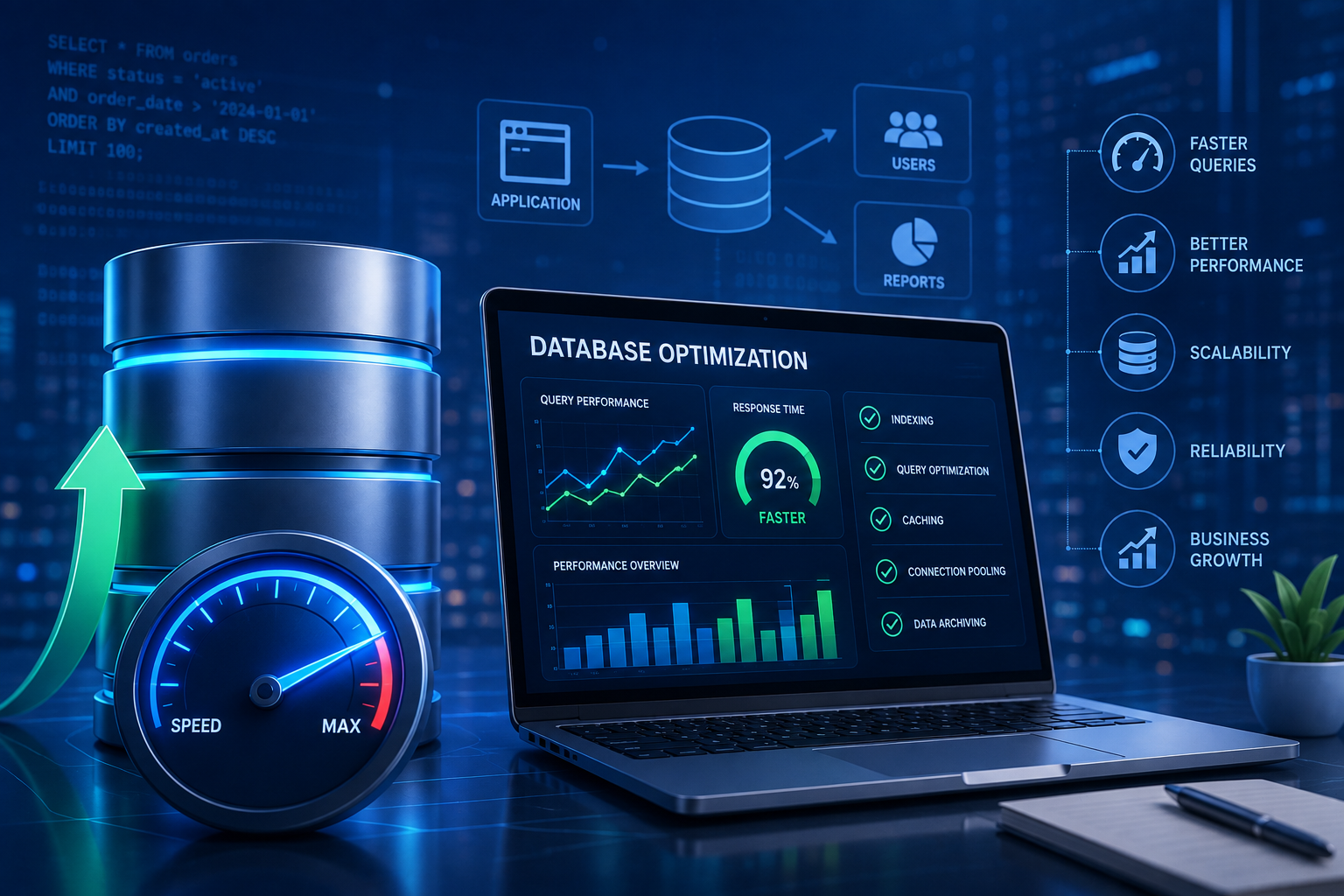
Database optimization is the process of improving database performance, efficiency, reliability, and resource usage so applications can access information more quickly and consistently.
This article explores practical database optimization techniques that can help businesses build faster and more efficient applications.
Why Database Performance Matters
A business application may perform many database operations every second.
For example, an eCommerce application may need to:
- Retrieve product information
- Check inventory
- Load customer accounts
- Process orders
- Calculate prices
- Store payment-related information
- Generate reports
If database queries are slow, the application can become slow even when the frontend design is well optimized.
Poor database performance can lead to:
- Slow page loading
- Poor user experience
- Increased server resource usage
- Application timeouts
- Reduced employee productivity
- Higher infrastructure costs
- Problems during traffic spikes
Database optimization therefore needs to be considered as part of overall application performance.
1. Optimize Database Queries
One of the most effective ways to improve database performance is to review the queries used by the application.
An inefficient query may process thousands or millions of records when only a small number are actually required.
For example, instead of retrieving every customer record and filtering the results in application code, a query should generally request only the records required.
Good query practices include:
- Select only required columns
- Filter data appropriately
- Avoid unnecessary joins
- Avoid repeated queries
- Use appropriate conditions
- Limit returned records when possible
- Review complex queries regularly
A query that returns only the required information can reduce database workload and network traffic.
2. Use Database Indexes
Indexes are one of the most important tools for improving database query performance.
An index creates an additional data structure that helps the database locate records more efficiently.
For example, if an application frequently searches customers by email address, an index on the email column may make those searches significantly faster.
Indexes can be useful for:
- Search fields
- Foreign keys
- Frequently filtered columns
- Sorting columns
- Frequently queried identifiers
However, adding indexes to every column is not a good strategy.
Indexes also require storage and can increase the work required when records are inserted, updated, or deleted.
The goal is to create appropriate indexes based on actual query patterns.
3. Analyze Query Execution Plans
Database systems can provide execution plans that show how a query is being processed.
An execution plan can help developers identify:
- Full table scans
- Inefficient joins
- Missing indexes
- Expensive operations
- Sorting overhead
- Unexpected query behavior
Instead of guessing why a query is slow, developers can use execution-plan analysis to understand where the database is spending resources.
This makes performance optimization more systematic.
4. Avoid Unnecessary Data Retrieval
Applications should retrieve only the information they need.
For example, if a dashboard needs:
- Customer name
- Order number
- Order status
there may be no reason to retrieve an entire customer record containing dozens of additional fields.
Reducing unnecessary data retrieval can improve:
- Query performance
- Network efficiency
- Application response time
- Memory usage
This principle is particularly important for applications that process large datasets.
5. Optimize Database Schema
Database structure can have a significant impact on performance.
A well-designed schema should consider:
- Relationships between tables
- Data types
- Primary keys
- Foreign keys
- Indexes
- Constraints
- Normalization requirements
Poor database design can result in duplicated information, complicated queries, inconsistent data, and unnecessary storage requirements.
Businesses should design database structures according to the application's actual requirements rather than simply adding tables and fields as the application grows.
6. Choose Appropriate Data Types
Using appropriate data types can help reduce storage requirements and improve database efficiency.
For example, a field that stores a small numeric value does not necessarily require a large numeric data type.
Similarly, dates should generally be stored using suitable date/time types instead of unnecessarily storing them as text.
Choosing appropriate data types can help with:
- Storage efficiency
- Query performance
- Data validation
- Index size
- Application consistency
Developers should select data types according to the actual range and format of the information being stored.
7. Reduce the Number of Database Calls
An application can become slow if it sends too many individual requests to the database.
For example:
Application
   ↓
Query Customer
   ↓
Query Orders
   ↓
Query Products
   ↓
Query Payments
   ↓
Query Addresses
If these requests are executed unnecessarily or repeatedly, the application can generate significant database overhead.
Developers can reduce unnecessary database calls by:
- Combining appropriate queries
- Fetching related information efficiently
- Using batch operations
- Caching frequently requested data
- Avoiding repeated queries
The exact approach depends on the application's architecture and database system.
8. Implement Database Caching
Caching can reduce repeated database operations.
If certain information does not change frequently, an application may temporarily store it in a cache.
Examples include:
- Product categories
- Website configuration
- Frequently accessed articles
- Public business information
- Frequently requested reports
Instead of requesting the same information from the database every time, the application can retrieve it from the cache when appropriate.
Caching can reduce database workload and improve response times.
However, cached data needs an appropriate expiration or invalidation strategy to prevent users from receiving outdated information.
9. Use Connection Pooling
Applications frequently communicate with databases through database connections.
Creating a new connection for every request can create unnecessary overhead.
Connection pooling allows applications to reuse existing database connections rather than repeatedly creating and closing them.
This can improve application efficiency, particularly for applications handling many simultaneous requests.
Connection pool settings should be configured according to:
- Application traffic
- Database capacity
- Number of concurrent users
- Query behavior
- Infrastructure resources
Too many database connections can also create performance problems, so connection limits need to be managed carefully.
10. Optimize Database Joins
Joins allow applications to combine information from multiple tables.
For example:
Customers
   +
Orders
   +
Products
However, poorly designed joins can become expensive when tables contain large amounts of data.
Developers should:
- Join tables using appropriate keys
- Index frequently joined columns
- Retrieve only required fields
- Avoid unnecessary joins
- Analyze complex queries
Execution plans can help determine whether a particular join is causing performance problems.
11. Use Pagination for Large Datasets
Displaying thousands of records on a single page can create unnecessary database and application workload.
Instead, applications can use pagination.
For example:
Page 1 → Records 1–25
Page 2 → Records 26–50
Page 3 → Records 51–75
Pagination is useful for:
- Customer lists
- Product catalogs
- Order histories
- Employee records
- Reports
- Search results
It reduces the amount of data that needs to be processed and displayed at one time.
12. Archive Old Data
Business databases can grow continuously.
Older records may not need to remain in the primary database indefinitely.
Businesses can establish appropriate data-retention and archival policies.
Potential candidates for archival may include:
- Old transactions
- Historical logs
- Completed records
- Legacy reports
- Outdated application data
Moving appropriate historical information to an archive can help keep frequently used operational datasets manageable.
Archiving should always follow the organization's legal, regulatory, contractual, and business requirements.
13. Monitor Database Performance
Database optimization should not be a one-time activity.
Businesses should continuously monitor important performance indicators.
These may include:
- Query execution time
- CPU usage
- Memory usage
- Disk usage
- Database connections
- Locking
- Transaction performance
- Error rates
- Storage growth
Monitoring helps development and IT teams identify performance problems before they significantly affect users.
14. Identify Slow Queries
Most database systems provide ways to identify queries that consume significant resources.
A slow-query log or database monitoring system can help identify:
- Queries taking too long
- Frequently executed queries
- Queries using excessive resources
- Queries that may benefit from indexes
- Unexpected application behavior
Developers can then investigate and optimize the most important performance bottlenecks.
Instead of optimizing every query, businesses should prioritize queries that have the greatest impact on application performance.
15. Manage Database Locks and Transactions
Transactions help maintain data consistency, particularly when multiple database operations need to succeed or fail together.
However, poorly designed transactions can remain open for too long and cause locking problems.
Long-running transactions may prevent other operations from accessing required resources.
Developers should:
- Keep transactions appropriately short
- Commit changes when appropriate
- Avoid unnecessary operations inside transactions
- Monitor blocking and locking
- Design concurrent operations carefully
Proper transaction management can improve both reliability and performance.
16. Optimize Database Storage
Storage performance can affect database performance significantly.
Businesses should monitor:
- Available storage
- Database file growth
- Temporary storage
- Index size
- Log growth
- Storage performance
As databases become larger, storage management becomes increasingly important.
Regular maintenance and capacity planning can help prevent unexpected performance problems caused by insufficient resources.
17. Use Read Replicas When Appropriate
Applications with heavy read traffic may benefit from separating certain read operations from primary database operations.
A read replica can maintain a copy of database information and handle selected read requests.
A simplified architecture could look like:
                 ┌───────────────┐
                 │   Application │
                 └───────┬───────┘
                         │
              ┌──────────┴──────────┐
              ↓                     ↓
       ┌─────────────┐       ┌─────────────┐
       │ Primary DB  │       │  Read Replica│
       │ Write Data  │       │ Read Data    │
       └─────────────┘       └─────────────┘
This approach can be useful for applications with significant read workloads, although it introduces additional architectural complexity and potential replication-lag considerations.
18. Scale Database Infrastructure
Sometimes software optimization alone is not enough.
If an application has grown significantly, the database may need additional infrastructure resources.
Businesses can consider:
Vertical Scaling
Increasing resources such as:
- CPU
- RAM
- Storage performance
Horizontal Scaling
Adding additional database resources or nodes to distribute workloads.
The appropriate strategy depends on the database technology, application architecture, workload, and business requirements.
Infrastructure scaling should generally complement query and application optimization rather than replace it.
19. Secure the Database
Performance should never come at the expense of security.
Businesses should implement appropriate controls such as:
- Strong authentication
- Role-based permissions
- Least-privilege access
- Encryption
- Secure backups
- Network restrictions
- Monitoring
- Regular updates
Database credentials should also be protected and should not be unnecessarily exposed in application source code.
A secure database helps protect customer information and business-critical data while supporting reliable operations.
20. Regularly Review Database Performance
Application requirements change over time.
A database that performs well when an application has 1,000 users may require optimization when the application grows to 100,000 users.
Businesses should periodically review:
- Query performance
- Database size
- Index effectiveness
- Traffic patterns
- Storage requirements
- Application architecture
- Infrastructure capacity
Regular reviews allow businesses to identify potential bottlenecks before they become major problems.
Common Database Optimization Mistakes
Adding Too Many Indexes
Indexes can improve searches but can also increase storage and write overhead.
Ignoring Slow Queries
A single inefficient query executed thousands of times can have a major impact.
Retrieving Too Much Data
Applications should avoid loading unnecessary records and columns.
Skipping Monitoring
Without monitoring, performance problems can remain hidden until users experience them.
Relying Only on Hardware
Adding more CPU or RAM may not solve an inefficient query or poorly designed database.
Ignoring Database Growth
Database performance should be evaluated as data volume increases.
Neglecting Backups
Performance improvements should never compromise data protection.
Database Optimization Checklist
Businesses can use this checklist when reviewing their applications:
- ✅ Analyze slow queries
- ✅ Review execution plans
- ✅ Create appropriate indexes
- ✅ Avoid unnecessary data retrieval
- ✅ Optimize database joins
- ✅ Use pagination
- ✅ Consider caching
- ✅ Use connection pooling
- ✅ Review database schema
- ✅ Choose appropriate data types
- ✅ Monitor database resources
- ✅ Manage transactions carefully
- ✅ Archive appropriate historical data
- ✅ Plan for database growth
- ✅ Maintain secure backups
- ✅ Review database permissions
- ✅ Keep database software updated
- ✅ Test performance after major application changes
How Database Optimization Supports Business Growth
A well-optimized database can support a business as its applications and customer base grow.
Consider an online business:
More Customers
       ↓
More Transactions
       ↓
More Database Records
       ↓
Higher Query Volume
       ↓
Potential Performance Bottlenecks
       ↓
Database Optimization
       ↓
Improved Application Performance
Optimization helps businesses prepare for growth rather than waiting until performance problems become severe.
For companies developing custom business applications, database optimization should be considered alongside application architecture, backend development, cloud infrastructure, cybersecurity, and user experience.
Conclusion
Database performance has a direct impact on modern business applications. Slow queries, inefficient database structures, excessive connections, poor indexing, and uncontrolled data growth can affect application speed and user experience.
Businesses can improve database performance by optimizing queries, using appropriate indexes, reducing unnecessary database calls, implementing caching, managing connections, improving database design, monitoring performance, and planning for growth.
The most effective approach is not simply adding more hardware. Instead, businesses should identify actual bottlenecks, measure performance, optimize the areas that matter most, and continuously monitor results.
With a well-planned database optimization strategy, organizations can build applications that are faster, more reliable, scalable, and better prepared to support long-term business growth.
This article is intended for general informational purposes. Specific database optimization techniques should be selected according to the database technology, application architecture, workload, and business requirements.