Table of Contents
- How Digital Attendance Systems Simplify Employee Management
- What Is a Digital Attendance System?
- 1. Reduces Manual Attendance Work
- 2. Improves Attendance Accuracy
- 3. Provides Real-Time Attendance Information
- 4. Simplifies Leave Management
- 5. Makes Payroll Processing Easier
- 6. Helps Manage Late Arrivals and Early Departures
- 7. Supports Different Work Shifts
- 8. Supports Remote and Hybrid Employees
- 9. Provides Useful Attendance Reports
- 10. Makes Employee Self-Service Possible
- 11. Simplifies Attendance Corrections
- 12. Improves Employee Accountability
- 13. Reduces Paperwork
- 14. Helps Identify Attendance Trends
- 15. Improves Workforce Planning
- 16. Helps Manage Overtime
- 17. Improves HR Efficiency
- 18. Supports Better Management Decisions
- 19. Enhances Data Security and Access Control
- 20. Supports Business Growth
- Best Practices for Implementing a Digital Attendance System
- Define Clear Attendance Rules
- Choose the Right Attendance Method
- Integrate With Payroll
- Set Appropriate User Permissions
- Train Employees
- Review Attendance Reports Regularly
- Conclusion
How Digital Attendance Systems Simplify Employee Management
Managing employee attendance is an important responsibility for every organization. Businesses need accurate information about when employees arrive, leave, take breaks, work remotely, or remain absent. Attendance records can also affect payroll, leave management, overtime calculations, and overall workforce planning.
Traditional attendance methods, such as paper registers, manual spreadsheets, and physical punch cards, can become difficult to manage as the number of employees increases. They often require repetitive data entry and can make it harder to identify errors or prepare reports.
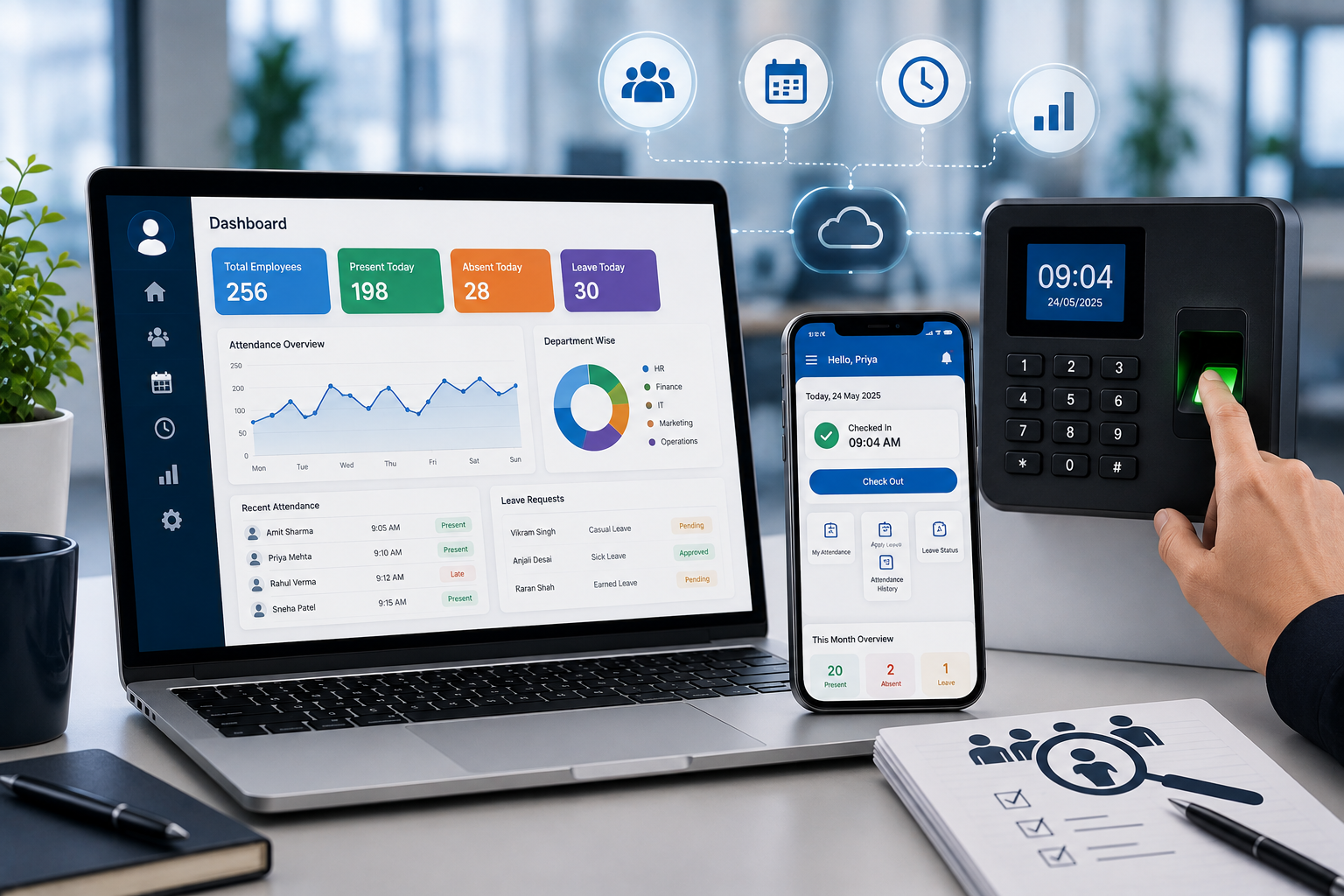
Digital attendance systems provide a more organized approach. By recording attendance electronically and connecting it with other employee management processes, these systems can save administrative time, improve accuracy, and give managers better visibility into workforce attendance.
What Is a Digital Attendance System?
A digital attendance system is software that records and manages employee attendance electronically.
Depending on the organization and system, attendance may be recorded using:
- Web-based attendance
- Mobile applications
- Biometric devices
- RFID or access cards
- QR codes
- Employee self-service portals
- GPS-enabled attendance
- Integrated workplace systems
The collected information can then be used for attendance reports, leave management, payroll processing, and employee performance tracking.
1. Reduces Manual Attendance Work
Maintaining attendance manually can require employees or HR staff to spend considerable time entering and checking records.
A digital system automatically records attendance information and stores it in a centralized database.
This reduces repetitive administrative work and allows HR teams to spend more time on other employee-related activities.
2. Improves Attendance Accuracy
Manual attendance records can contain mistakes caused by incorrect data entry, missing entries, or calculation errors.
Digital systems can automatically record attendance based on predefined rules.
For example, the system can calculate:
- Present days
- Absent days
- Late arrivals
- Early departures
- Working hours
- Overtime
- Leave days
Automated calculations can reduce common errors and provide more consistent attendance records.
3. Provides Real-Time Attendance Information
Managers often need to know who is currently present, absent, or working remotely.
A digital attendance system can provide updated attendance information through a dashboard.
Authorized managers may be able to view attendance by:
- Employee
- Department
- Date
- Location
- Shift
- Attendance status
This makes it easier to understand workforce availability without waiting for manual reports.
4. Simplifies Leave Management
Attendance and leave management are closely connected.
Employees may need to apply for different types of leave, while managers and HR teams need to review and approve those requests.
A digital system can allow employees to submit leave applications online and managers to approve or reject them through the system.
The approved leave can then be reflected automatically in attendance records.
This reduces paperwork and helps maintain consistent employee records.
5. Makes Payroll Processing Easier
Attendance information is often used to calculate employee salaries.
Factors such as unpaid leave, overtime, late attendance, and working days may affect payroll.
When attendance and payroll systems are integrated, relevant attendance information can be transferred automatically to the payroll process.
This can reduce manual calculations and help payroll teams prepare salary information more efficiently.
6. Helps Manage Late Arrivals and Early Departures
Frequent late arrivals or early departures can affect workforce productivity.
Digital attendance systems can automatically identify attendance patterns and generate reports.
Managers can review information such as:
- Number of late arrivals
- Early departures
- Total working hours
- Missed attendance
- Shift deviations
This provides managers with objective information when discussing attendance-related issues with employees.
7. Supports Different Work Shifts
Organizations such as hospitals, factories, security companies, retail businesses, and service organizations may operate multiple shifts.
Managing different shift timings manually can be complicated.
Digital attendance systems can be configured with different shift schedules and rules.
For example, the system may recognize:
- Morning shifts
- Evening shifts
- Night shifts
- Rotational shifts
- Flexible working hours
This makes attendance management easier for organizations with complex schedules.
8. Supports Remote and Hybrid Employees
Many businesses now have employees who work from different locations.
Digital attendance platforms can provide suitable attendance options for remote and hybrid work environments.
Depending on the organization's requirements, employees may be able to record attendance through a web portal or mobile application.
Some systems may also support location-based verification, subject to organizational policies and applicable privacy requirements.
9. Provides Useful Attendance Reports
HR teams and managers frequently need attendance reports for administrative and operational purposes.
Digital systems can generate reports such as:
- Daily attendance
- Monthly attendance
- Department-wise attendance
- Employee attendance history
- Absence reports
- Late attendance reports
- Overtime reports
- Leave reports
- Working-hours reports
Automated reports reduce the need to prepare spreadsheets manually.
10. Makes Employee Self-Service Possible
Digital attendance systems can give employees access to their own attendance information.
Through an employee portal or mobile application, employees may be able to view:
- Attendance history
- Working hours
- Leave balance
- Leave applications
- Attendance corrections
- Holiday calendars
This reduces the number of routine questions HR teams need to handle.
11. Simplifies Attendance Corrections
Attendance records may occasionally contain missing or incorrect entries.
For example, an employee may forget to record attendance or experience a technical issue while checking in.
A digital system can provide an attendance correction or regularization process.
The employee can submit a request, and an authorized manager or HR employee can review it before the record is updated.
This creates a more structured correction process.
12. Improves Employee Accountability
Digital attendance systems create clearer records of employee attendance.
Employees know that attendance information is being recorded systematically, while managers can review attendance history when necessary.
This can encourage employees to follow established attendance and working-hour policies.
However, businesses should communicate attendance policies clearly and use attendance information fairly and consistently.
13. Reduces Paperwork
Paper-based attendance management requires physical registers, forms, signatures, and manual filing.
Digital systems replace much of this paperwork with electronic records.
This can reduce document storage requirements and make historical information easier to search.
HR teams can quickly retrieve records instead of searching through physical files.
14. Helps Identify Attendance Trends
Attendance data can reveal patterns that may not be obvious from individual records.
For example, reports may show that:
- Absenteeism increases during specific periods.
- A particular shift has frequent late arrivals.
- Certain departments regularly require overtime.
- Employees are frequently absent on specific days.
Managers can use these insights to investigate underlying causes and make better workforce decisions.
15. Improves Workforce Planning
Accurate attendance information helps businesses understand workforce availability.
Managers can use attendance data to plan staffing requirements and identify periods when additional employees may be needed.
For example, if a department regularly experiences high absenteeism during a particular period, management can plan backup staffing in advance.
16. Helps Manage Overtime
Overtime needs to be tracked carefully to ensure employees are compensated appropriately and businesses can control labor costs.
Digital attendance systems can calculate working hours beyond predefined schedules.
Depending on the organization's rules, overtime records can be reviewed and approved before being used for payroll.
This creates a clearer process for tracking additional working hours.
17. Improves HR Efficiency
HR teams often manage large amounts of employee information.
When attendance, leave, employee records, and payroll processes are handled through separate manual systems, administrative work increases.
A centralized digital attendance platform can bring many of these processes together.
This helps HR employees spend less time maintaining records and more time focusing on recruitment, employee development, engagement, and organizational planning.
18. Supports Better Management Decisions
Accurate attendance information can support management decisions.
For example, managers can use attendance reports to understand staffing requirements, overtime costs, absenteeism patterns, and departmental workforce availability.
Instead of relying on assumptions or incomplete records, management can use actual attendance data to make informed decisions.
19. Enhances Data Security and Access Control
Employee attendance information is part of an organization's internal records.
Digital systems can provide user permissions that determine who can view, modify, approve, or export attendance information.
For example, employees may only be able to view their own records, while HR administrators may have broader access.
Role-based permissions can help protect employee information from unnecessary access.
20. Supports Business Growth
Attendance management becomes more complicated as organizations add employees, departments, locations, and shifts.
A digital system can scale more easily than a manual attendance register.
Businesses can add employees, configure new departments, introduce additional shifts, and generate reports without creating separate manual processes for every change.
Best Practices for Implementing a Digital Attendance System
Choosing the right software is only one part of successful attendance management. Businesses should also establish clear policies and processes.
Define Clear Attendance Rules
Organizations should clearly communicate working hours, grace periods, leave rules, overtime policies, and attendance correction procedures.
Choose the Right Attendance Method
The appropriate method depends on the workplace. An office may prefer web or mobile attendance, while a factory may require biometric or access-card systems.
Integrate With Payroll
Connecting attendance information with payroll can reduce duplicate data entry and simplify salary calculations.
Set Appropriate User Permissions
Only authorized employees should be able to modify or approve attendance records.
Train Employees
Employees should understand how to record attendance, apply for leave, and request corrections.
Review Attendance Reports Regularly
Managers and HR teams should review attendance information regularly to identify errors, unusual patterns, and staffing issues.
Conclusion
Digital attendance systems can significantly simplify employee management by replacing manual attendance processes with organized and automated workflows. They help businesses record attendance accurately, manage leave, track working hours, prepare reports, support payroll, and monitor workforce availability.
For HR teams, these systems can reduce administrative work and paperwork. For managers, they provide better visibility into attendance and staffing patterns. For employees, self-service features can make it easier to access attendance and leave information.
As businesses become more digitally connected, a well-designed attendance system can become an important part of an organization's overall employee management and HR technology infrastructure.