Table of Contents
- How GST Billing Software Simplifies Business Invoicing
- What Is GST Billing Software?
- How GST Billing Software Simplifies Invoicing
- 1. Faster Invoice Creation
- 2. Easier Tax and Discount Management
- 3. Better Invoice Accuracy
- 4. Organized Customer Information
- 5. Easy Product and Inventory Management
- 6. Simplified Payment Tracking
- 7. Quick Access to Previous Invoices
- 8. Useful Sales and Tax Reports
- 9. Better Data Organization and Security
- GST Billing Software vs Manual Invoicing
- Who Can Benefit From GST Billing Software?
- What Should You Look for in GST Billing Software?
- Conclusion
How GST Billing Software Simplifies Business Invoicing
Managing invoices is an essential part of running any business. For businesses dealing with GST, preparing accurate invoices while managing products, customers, taxes, payments, and records can become even more challenging when everything is handled manually.
A GST billing software can simplify this process by bringing billing and tax-related information into a structured digital system. Instead of repeatedly preparing invoices, calculating amounts, maintaining separate records, and checking previous transactions manually, businesses can manage their billing activities more efficiently.
For small businesses, retailers, wholesalers, distributors, manufacturers, service providers, and other organizations, digital billing can make everyday invoicing more organized and convenient.
What Is GST Billing Software?
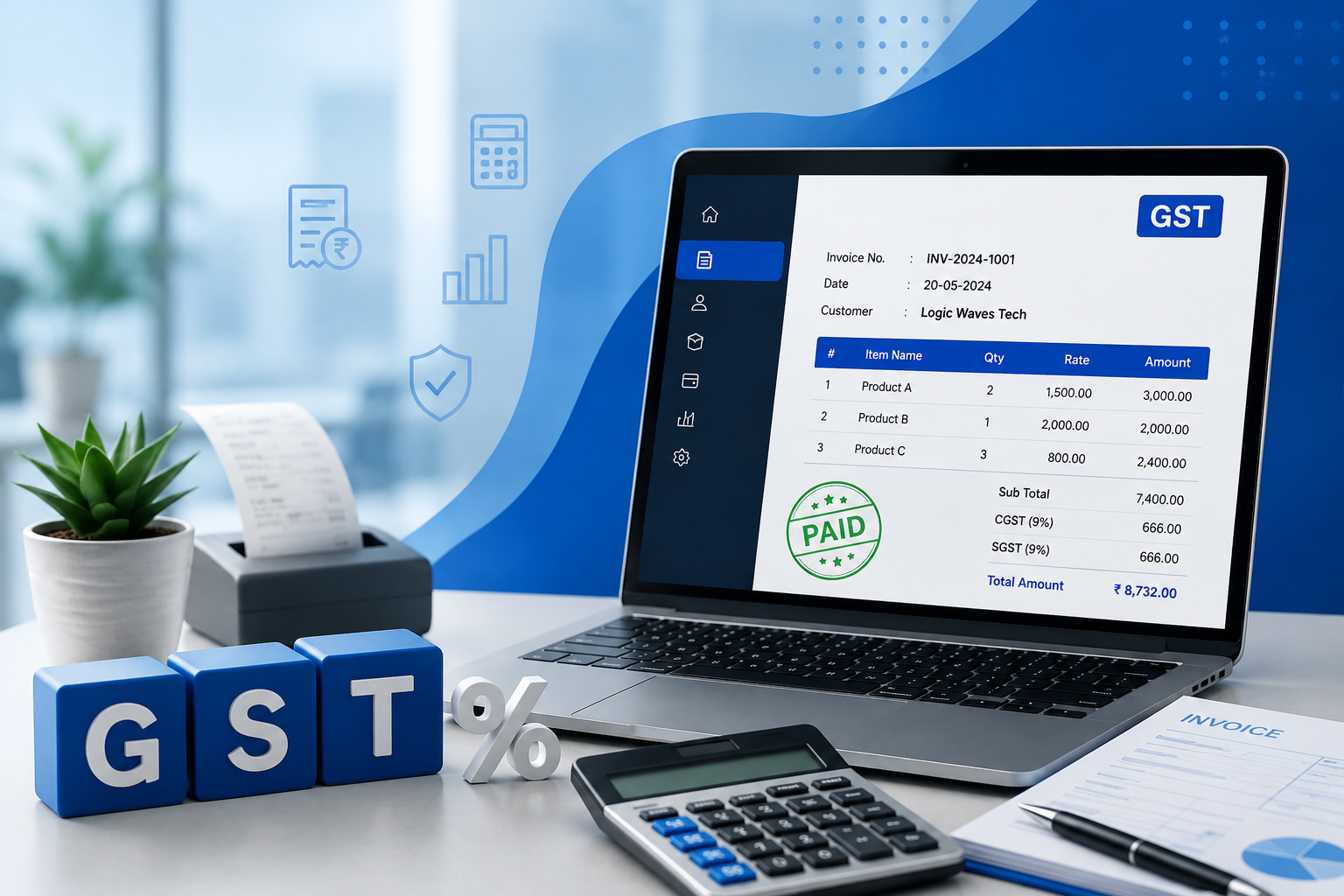
GST billing software is a digital billing solution designed to help businesses create and manage invoices while handling applicable tax information in an organized manner.
Depending on the system, businesses can maintain customer and product details, prepare invoices, manage taxes and discounts, track payments, and generate business reports.
The goal is to reduce repetitive manual work and make the invoicing process faster and more organized.
How GST Billing Software Simplifies Invoicing
1. Faster Invoice Creation
Creating invoices manually can take time, particularly when businesses handle a large number of transactions.
With billing software, product and customer information can be maintained digitally. This makes it easier to prepare invoices without repeatedly entering the same information.
Faster invoice creation can help businesses process customer transactions more efficiently and reduce the time spent on routine billing tasks.
2. Easier Tax and Discount Management
Tax and discount calculations are an important part of business invoicing.
When these calculations are performed manually, businesses need to carefully enter and verify the relevant information for every invoice.
A billing system with tax and discount management can help organize these details and simplify the invoice preparation process.
This can reduce repetitive calculations and make the billing workflow more systematic.
3. Better Invoice Accuracy
Manual data entry and calculations can sometimes result in errors in quantities, prices, taxes, discounts, or invoice totals.
Digital billing software can automate many of the calculations involved in creating an invoice.
This helps reduce repetitive manual calculations and can improve the consistency of invoices.
Businesses should still configure their billing system correctly and review their invoices to ensure that the information used is appropriate for their requirements.
4. Organized Customer Information
GST invoices require accurate customer and transaction information.
Maintaining customer details manually across notebooks, spreadsheets, and separate files can become difficult as the customer base grows.
Billing software with customer management allows businesses to keep customer information organized in one system.
Having customer information readily available can make it easier to create invoices and refer to previous transactions.
5. Easy Product and Inventory Management
Invoicing is closely connected with product and inventory management.
When a product is sold, businesses need to maintain appropriate records of the transaction and stock movement.
Billing software that includes inventory management allows businesses to manage product and billing information together.
This can help business owners maintain better visibility over products and stock while processing sales.
The Logic Waves Tech Billing System specifically includes inventory management along with invoice and customer management.
6. Simplified Payment Tracking
Creating an invoice is only the beginning. Businesses also need to know whether invoices have been paid or whether amounts are still outstanding.
Manual payment records can become difficult to maintain when the number of transactions increases.
Billing software with payment tracking helps businesses record payments and maintain payment history.
This makes it easier to identify outstanding amounts and manage customer payments from a centralized system.
7. Quick Access to Previous Invoices
Businesses often need to access previous invoices for customer queries, internal records, payment follow-ups, or reporting.
Finding old paper invoices can be time-consuming, particularly when a business has been operating for several years.
Digital billing systems provide a more organized way to maintain invoice records, making it easier to locate information when required.
8. Useful Sales and Tax Reports
Business owners need accurate information to understand their sales and billing activities.
Preparing reports manually can require collecting information from different records.
Billing software can organize transaction information and generate reports related to areas such as sales, products, customers, payments, and taxes.
These reports can give business owners a clearer view of business activity and support better decision-making.
The Logic Waves Tech brochure highlights reports and analytics for sales, customers, products, taxes, and other business information.
9. Better Data Organization and Security
Business invoices contain valuable information about customers, products, sales, and payments.
Keeping these records only in physical files can increase the risk of losing or damaging important documents.
A digital billing system can provide a structured environment for maintaining business records. Features such as data backup and security can further help businesses protect important information.
The Logic Waves Tech Billing System includes data backup and security as one of its key features.
GST Billing Software vs Manual Invoicing
| Feature | Manual Invoicing | GST Billing Software |
|---|---|---|
| Invoice Creation | Time-consuming | Faster digital process |
| Calculations | Mostly manual | Automated calculations |
| Tax Management | Manual | Organized digitally |
| Customer Records | Paper files or spreadsheets | Centralized records |
| Product Information | Maintained separately | Integrated with billing |
| Payment Tracking | Manual records | Digital tracking |
| Reports | Prepared manually | Easily generated |
| Previous Invoices | Difficult to locate | Easier to access |
| Data Backup | Requires separate process | Can include backup features |
Who Can Benefit From GST Billing Software?
GST billing software can be useful for businesses that regularly create invoices and need to manage their billing information efficiently.
These may include:
-
Retail shops
-
Wholesalers and distributors
-
Manufacturers
-
Service providers
-
Restaurants and cafés
-
Pharmacies and clinics
-
Schools and institutions
-
Other growing businesses
The Logic Waves Tech Billing System is positioned as an all-in-one billing solution for these types of businesses, combining invoicing with customer management, inventory, payment tracking, reporting, tax and discount management, and data security.
What Should You Look for in GST Billing Software?
Before choosing billing software, businesses should consider whether the system provides the features they actually need.
Important features to consider include:
-
Invoice management
-
Customer management
-
Product and inventory management
-
Tax and discount management
-
Payment tracking
-
Sales and business reports
-
Data backup
-
Security
-
Easy-to-use interface
-
Support for multiple users where required
-
Accessibility across devices where available
Choosing software that combines these functions can help businesses avoid maintaining multiple separate systems.
Conclusion
GST-related invoicing can become complicated when businesses rely heavily on manual calculations, paper records, and disconnected spreadsheets.
GST billing software can simplify the process by bringing invoice creation, customer information, inventory, payments, tax and discount management, reporting, and data security into one organized system.
For small and growing businesses, this can mean less repetitive work, better record management, faster invoicing, and greater visibility into everyday business transactions.
A well-designed billing system can therefore be a practical step toward making business invoicing more efficient and organized.