Table of Contents
- Why Mobile App Development Is Important for Modern Businesses
- What Is Mobile App Development?
- Why Do Businesses Need Mobile Applications?
- Major Benefits of Mobile App Development
- 1. Better Customer Convenience
- 2. Stronger Customer Engagement
- 3. Increased Brand Visibility
- 4. Improved Sales Opportunities
- 5. Better Customer Service
- 6. Customer Loyalty and Retention
- 7. Business Process Automation
- 8. Better Business Data
- Types of Mobile Applications
- Native Applications
- Cross-Platform Applications
- Hybrid Applications
- Progressive Web Applications
- Important Features of a Business Mobile App
- Mobile App Development Process
- 1. Requirement Analysis
- 2. Planning and Strategy
- 3. UI and UX Design
- 4. Application Development
- 5. Testing
- 6. Launch and Deployment
- 7. Maintenance and Updates
- Common Mobile App Development Mistakes
- How to Choose a Mobile App Development Company
- Is Mobile App Development Suitable for Small Businesses?
- Future of Mobile App Development
- Final Thoughts
Why Mobile App Development Is Important for Modern Businesses
Mobile phones have become an essential part of everyday life. People use mobile applications to shop, communicate, make payments, book services, study, manage work and access entertainment. Because customers now expect fast and convenient digital experiences, mobile app development has become an important growth opportunity for modern businesses.
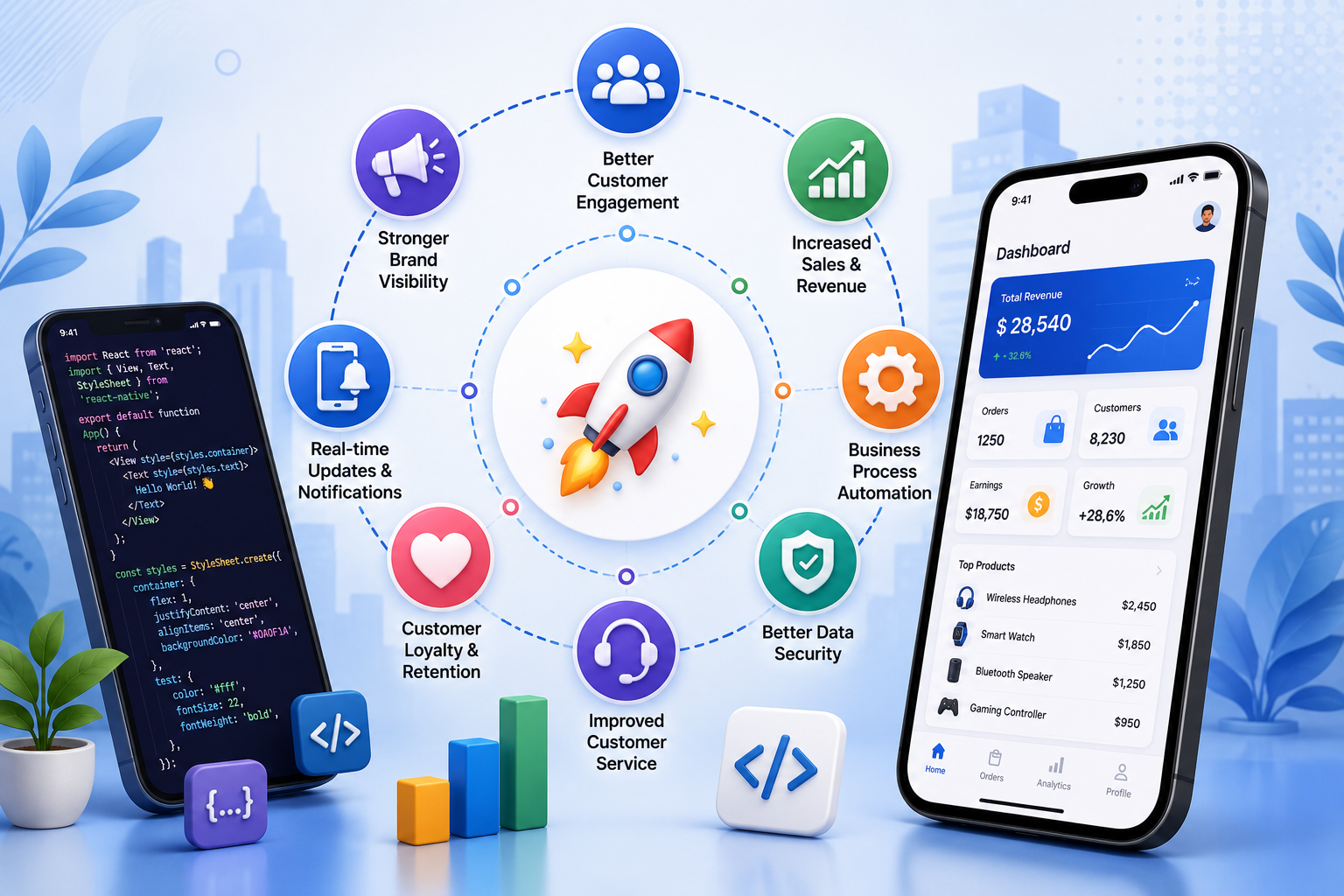
A well-designed mobile application allows a business to stay connected with its customers, simplify services, improve brand visibility and increase sales. Whether a company is a small startup or a large organisation, the right mobile app can support both customer engagement and internal business operations.
What Is Mobile App Development?
Mobile app development is the process of designing, building, testing and maintaining applications for smartphones and tablets.
Mobile applications are commonly developed for:
- Android devices
- Apple iOS devices
- Both Android and iOS platforms
- Internal company operations
- Customer-facing services
Depending on the business requirement, an application may be developed as a native app, hybrid app or cross-platform app.
Why Do Businesses Need Mobile Applications?
Customers prefer services that are easy to access and available whenever they need them. A mobile application gives users direct access to a company’s products, services and support without repeatedly searching for its website.
Businesses can use mobile applications for:
- Online shopping
- Appointment booking
- Service requests
- Customer support
- Digital payments
- Order tracking
- Employee management
- Inventory monitoring
- Customer loyalty programmes
- Notifications and updates
The purpose of an app should be based on a real business need. Developing an application simply because competitors have one may not produce useful results. A successful application solves a customer problem or improves an important business process.
Major Benefits of Mobile App Development
1. Better Customer Convenience
A mobile application allows customers to access services quickly from their phones. Users can browse products, place orders, make payments, check updates or contact support from one platform.
A simple and organised app saves time and makes the customer experience more convenient.
2. Stronger Customer Engagement
Mobile applications help businesses communicate directly with customers through notifications, personalised offers, reminders and important updates.
For example, a business can notify customers about:
- New products
- Special offers
- Appointment reminders
- Order updates
- Payment due dates
- Service announcements
Notifications should be useful and limited. Sending too many unnecessary messages may cause users to disable notifications or uninstall the application.
3. Increased Brand Visibility
When customers install an application, the business logo remains visible on their mobile screen. This repeated visibility can help customers remember the brand.
A professionally designed application also creates a modern and trustworthy business image.
4. Improved Sales Opportunities
A mobile app can make the purchasing process faster by providing simple product search, secure payment options, saved addresses and an easy checkout system.
Businesses can also use personalised product recommendations, discount codes and loyalty rewards to encourage repeat purchases.
However, increasing sales depends on the quality of the app, the value of the products and the overall customer experience.
5. Better Customer Service
Mobile apps can include customer-support features such as:
- Live chat
- Support tickets
- Frequently asked questions
- Chatbots
- Call-back requests
- Complaint tracking
These features make it easier for customers to receive assistance and help businesses manage customer queries in an organised way.
6. Customer Loyalty and Retention
Loyalty programmes can encourage customers to continue using a business’s services. An app may provide reward points, membership benefits, referral bonuses or personalised discounts.
When customers receive a smooth and valuable experience, they are more likely to return.
7. Business Process Automation
Mobile applications are not limited to customer use. Companies can also develop internal applications for employees and management.
Internal business apps can help manage:
- Attendance
- Sales teams
- Field employees
- Inventory
- Deliveries
- Customer records
- Work assignments
- Expense reporting
- Performance tracking
Automation reduces repetitive manual work and helps employees access information from one system.
8. Better Business Data
A mobile application can provide useful information about customer behaviour, such as commonly viewed products, completed purchases, abandoned carts and frequently used features.
Businesses can use this information to improve services and make better decisions. Customer data must always be collected responsibly and protected according to applicable privacy requirements.
Types of Mobile Applications
Native Applications
Native applications are developed specifically for one operating system, such as Android or iOS.
They can provide strong performance and better access to device features. However, separate applications may need to be developed for different platforms.
Cross-Platform Applications
Cross-platform development allows developers to create one application that can work on both Android and iOS.
This approach may reduce development time and cost, although suitability depends on the complexity and performance requirements of the project.
Hybrid Applications
Hybrid applications combine elements of websites and native applications. They can be useful for simpler business requirements and can run on multiple platforms.
Progressive Web Applications
A Progressive Web App, commonly called a PWA, provides an app-like experience through a web browser. Users may be able to add it to their home screen without downloading it from an app store.
The right application type should be selected according to the project’s features, budget, target users and future plans.
Important Features of a Business Mobile App
The features required in an app depend on its purpose. Common features include:
- Simple registration and login
- User profiles
- Product or service listings
- Search and filter options
- Secure payment integration
- Push notifications
- Order or booking management
- Live chat or customer support
- Location and map integration
- Reviews and ratings
- Social-media login
- Admin dashboard
- Reports and analytics
An app should not contain unnecessary features. Too many functions can make it confusing and increase development costs.
Mobile App Development Process
1. Requirement Analysis
The development team first understands the business problem, target users, required features, budget and project goals.
Clear requirements help prevent confusion and unnecessary changes during development.
2. Planning and Strategy
The team prepares the application structure, technology plan, development stages and timeline.
Competitor research and user analysis may also be completed during this stage.
3. UI and UX Design
UI means User Interface, while UX means User Experience.
Designers create the appearance, screens, buttons, navigation and overall user journey. The application should be visually attractive, but it must also be easy to understand and use.
4. Application Development
Developers build the front end, back end, database, integrations and required features.
The front end is what users see, while the back end manages data, security and system operations.
5. Testing
Testing helps identify problems before the app is released.
Developers usually check:
- Functionality
- Performance
- Security
- Compatibility
- Screen responsiveness
- Payment processes
- Login systems
- User experience
Testing should be completed on different devices and screen sizes.
6. Launch and Deployment
After testing, the application is prepared for release on the Google Play Store, Apple App Store or another distribution platform.
Businesses should follow the relevant platform requirements before publishing the app.
7. Maintenance and Updates
App development does not end after launch. Regular maintenance is required to fix technical problems, improve security and keep the application compatible with updated devices and operating systems.
Customer feedback can also help businesses improve the app over time.
Common Mobile App Development Mistakes
Businesses should avoid mistakes such as:
- Developing without a clear purpose
- Adding too many unnecessary features
- Ignoring user experience
- Using a complicated registration process
- Not testing the app properly
- Ignoring data security
- Sending excessive notifications
- Failing to provide regular updates
- Not planning for future growth
Starting with essential features and improving the application gradually is often more effective than trying to build everything at once.
How to Choose a Mobile App Development Company
Before selecting a development partner, businesses should evaluate:
- Previous projects and experience
- Understanding of business requirements
- Design and development skills
- Technology expertise
- Testing process
- Security practices
- Communication and project management
- Maintenance and support services
- Transparent pricing
A reliable development company should explain the process clearly and recommend solutions based on the business requirement rather than adding unnecessary features.
Is Mobile App Development Suitable for Small Businesses?
Mobile application development is not limited to large companies. Small businesses can also benefit when an app solves a genuine customer or operational problem.
For example, a small business may use an application for appointment booking, local delivery, customer loyalty, service requests or employee management.
Before investing, the business should evaluate its target audience, required features, available budget and expected benefits.
Future of Mobile App Development
Mobile applications are becoming more intelligent and personalised. Technologies such as artificial intelligence, automation, voice assistance, cloud computing and data analytics are helping businesses provide faster and more customised experiences.
However, technology should be used only when it adds practical value. The most successful applications are not always the ones with the largest number of advanced features. They are the ones that solve problems simply and reliably.
Final Thoughts
Mobile app development can help businesses improve customer convenience, automate operations, strengthen brand visibility and create new sales opportunities.
A successful application begins with a clear business goal, user-friendly design, secure technology and proper testing. Regular maintenance and customer feedback are also necessary for long-term success.
By working with an experienced mobile app development team, businesses can transform their ideas into practical digital solutions that support customers, employees and future growth.