Table of Contents
- The Role of Event-Driven Architecture in Modern Business Applications
- What Is Event-Driven Architecture?
- The Main Components of Event-Driven Architecture
- 1. Event Producer
- 2. Event
- 3. Event Broker
- 4. Event Consumer
- How Event-Driven Architecture Works
- Traditional Approach
- Event-Driven Approach
- Why Businesses Are Adopting Event-Driven Architecture
- 1. Better Scalability
- 2. Looser Coupling Between Services
- 3. Faster Business Responses
- 4. Easier Integration
- 5. Improved Automation
- Event-Driven Architecture in Different Industries
- E-Commerce
- Banking and Financial Services
- Healthcare
- SaaS Applications
- Event-Driven Architecture and Microservices
- Real-Time Business Applications
- Event-Driven Architecture vs Traditional Request-Response
- Challenges of Event-Driven Architecture
- 1. Debugging Can Be Difficult
- 2. Data Consistency
- 3. Duplicate Events
- 4. Event Ordering
- 5. Monitoring Requirements
- Best Practices for Implementing Event-Driven Systems
- Define Clear Events
- Keep Events Well Structured
- Design for Failure
- Make Important Consumers Idempotent
- Use Monitoring and Distributed Tracing
- Start With the Right Use Case
- How Businesses Can Start
- The Future of Event-Driven Business Applications
- Final Thoughts
The Role of Event-Driven Architecture in Modern Business Applications
Modern businesses increasingly depend on software applications that can respond quickly to customer actions, transactions, system updates, and changing business conditions. As applications become more connected, traditional approaches to handling every process through direct, tightly connected requests can become difficult to scale and maintain.
Event-driven architecture (EDA) offers an alternative approach. Instead of requiring every application component to communicate directly with another component, systems can communicate through events that represent something that has happened.
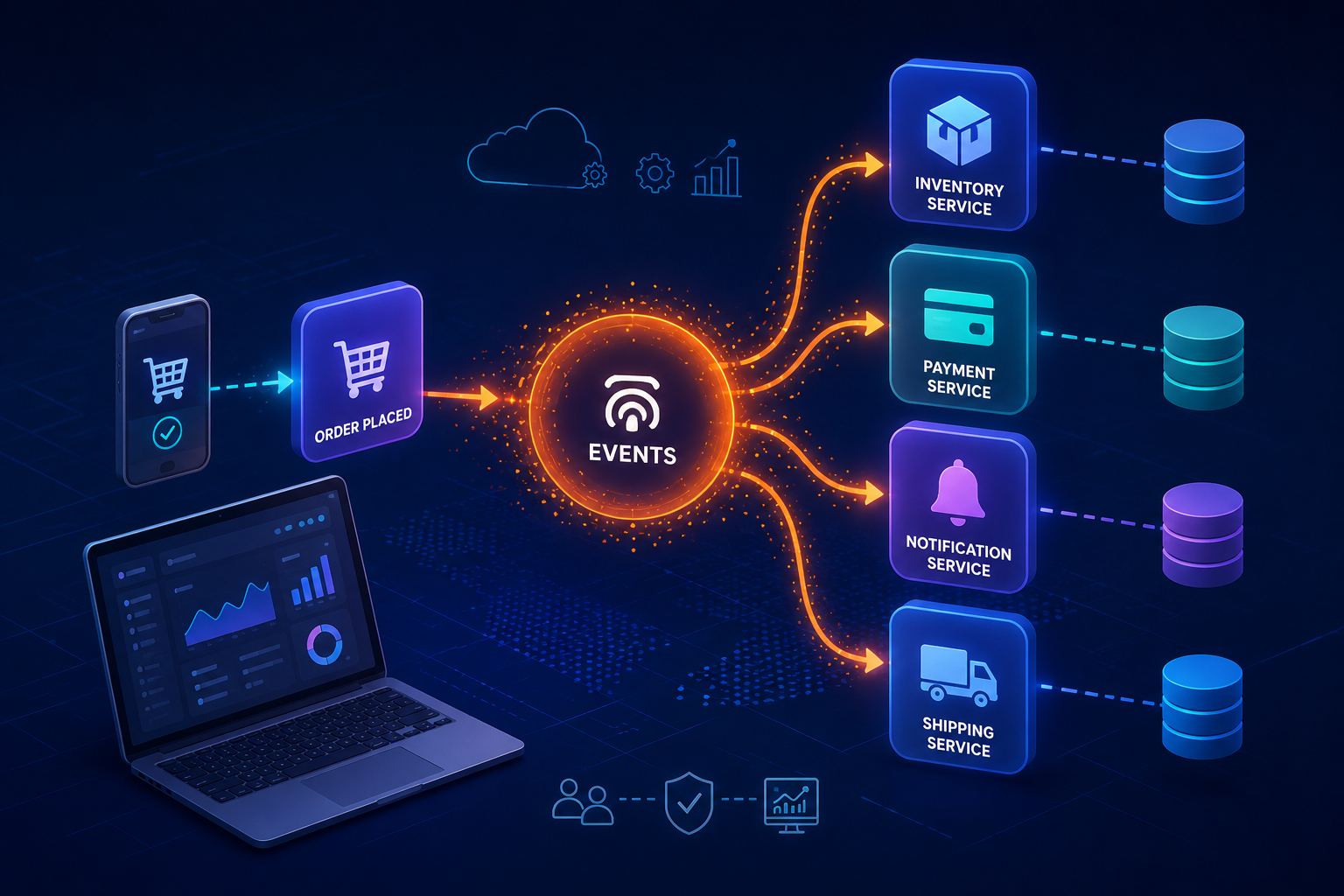
For example, when a customer places an order, the application can publish an event such as “Order Created.” Different services can then respond to that event independently—one may process payment, another may update inventory, and another may send a notification.
This approach can help businesses build applications that are more flexible, scalable, and responsive.
What Is Event-Driven Architecture?
Event-driven architecture is a software design approach in which components communicate by producing and responding to events.
An event is a record that something has happened.
Examples include:
- Customer registered
- Order created
- Payment completed
- Product purchased
- Invoice generated
- Shipment dispatched
- Password changed
- File uploaded
- Subscription renewed
Instead of one application component directly controlling every subsequent action, an event can be published so that other interested components can respond.
A simplified flow looks like this:
User Action → Event → Event Broker → Multiple Services → Business Actions
For example:
Customer places order → “Order Created” event → Inventory + Payment + Notification + Shipping services
Each service can process the event according to its own responsibility.
The Main Components of Event-Driven Architecture
1. Event Producer
The producer is the application or service that generates an event.
For example, an e-commerce application may produce an Order Created event when a customer completes checkout.
2. Event
The event contains information describing something that happened.
An order event might contain information such as:
- Order ID
- Customer ID
- Product details
- Order value
- Timestamp
- Payment status
The exact event structure depends on the application's requirements.
3. Event Broker
An event broker or messaging platform receives events and distributes them to interested consumers.
Common technologies used for event-based systems include Apache Kafka, RabbitMQ, Amazon EventBridge, and cloud messaging services.
The broker helps separate producers from consumers, allowing them to communicate without being tightly connected.
4. Event Consumer
A consumer is a service or application that receives and processes an event.
For example, after receiving an Order Created event:
- Inventory service reduces stock.
- Payment service processes payment.
- Notification service sends confirmation.
- Shipping service prepares fulfillment.
Each consumer can perform its own task independently.
How Event-Driven Architecture Works
Consider a simple online shopping application.
A customer purchases a product.
Traditional Approach
The order service might directly call:
Order Service → Payment Service
Then:
Order Service → Inventory Service
Then:
Order Service → Notification Service
Then:
Order Service → Shipping Service
This creates several direct dependencies.
Event-Driven Approach
The order service creates an event:
Order Created
The event is published to a messaging system.
Then:
Order Created → Payment Service
Order Created → Inventory Service
Order Created → Notification Service
Order Created → Shipping Service
Each service can react independently.
This separation can make the system easier to extend because a new consumer can subscribe to relevant events without requiring major changes to the original order service.
Why Businesses Are Adopting Event-Driven Architecture
1. Better Scalability
Modern business applications may receive thousands or millions of actions.
Event-driven systems can allow individual services to scale according to their workloads.
For example, if an application receives a large number of order events, the order-processing consumers can be scaled independently from other services.
This can be particularly useful for e-commerce platforms, financial applications, SaaS products, and other systems with unpredictable workloads.
2. Looser Coupling Between Services
One of the major advantages of event-driven architecture is reduced dependency between components.
A producer does not necessarily need to know which services will consume its event.
For example, the order service can publish:
Order Created
without directly depending on every service that might be interested in that event.
This makes it easier to add or modify functionality over time.
3. Faster Business Responses
Event-driven applications can respond to changes as they happen.
For example:
Payment Completed → Generate Invoice → Update Customer Account → Send Confirmation
These actions can be triggered automatically after the payment event is received.
This can help businesses create more responsive digital experiences.
4. Easier Integration
Businesses often use multiple systems for different purposes.
For example:
- CRM
- ERP
- Billing system
- Inventory system
- E-commerce platform
- Marketing platform
- Customer support software
Event-driven architecture can provide a mechanism for these systems to exchange information when important events occur.
For example:
New Customer Created → CRM + Marketing + Billing Systems
This can reduce the need for every system to directly communicate with every other system.
5. Improved Automation
Events can trigger automated workflows.
For example:
Invoice Overdue → Payment Reminder
New Customer Registered → Welcome Email
Stock Below Threshold → Inventory Alert
Subscription Expiring → Renewal Notification
These workflows can reduce manual effort and improve operational efficiency.
Event-Driven Architecture in Different Industries
E-Commerce
Event-driven systems can be used for:
- Order processing
- Inventory updates
- Payment processing
- Shipping notifications
- Customer notifications
- Recommendation systems
Banking and Financial Services
Events can represent activities such as:
- Transactions
- Payments
- Account updates
- Fraud alerts
- Customer verification
Because financial applications can involve large numbers of transactions, scalable event-processing systems can be valuable.
Healthcare
Event-based systems may help coordinate:
- Appointment updates
- Patient notifications
- Laboratory results
- Administrative workflows
- System integrations
Healthcare applications require particularly careful attention to privacy, security, and regulatory requirements.
SaaS Applications
Software-as-a-service platforms can use events for:
- User registration
- Subscription changes
- Feature usage
- Billing
- Notifications
- Account management
Event-Driven Architecture and Microservices
Event-driven architecture is commonly associated with microservices, although they are not the same thing.
Microservices divide an application into smaller services that can be developed and deployed independently.
Event-driven communication can help these services exchange information without requiring direct synchronous communication for every operation.
For example:
Customer Service → Customer Registered Event
The event can then be consumed by:
- Email Service
- Analytics Service
- CRM Service
- Notification Service
This combination can create flexible and scalable application architectures.
Real-Time Business Applications
One of the strongest use cases for event-driven systems is real-time processing.
Imagine an online shopping platform where inventory changes immediately after a purchase.
The flow could be:
Purchase Completed → Product Purchased Event → Inventory Updated → Stock Level Recalculated → Low-Stock Alert
This allows business processes to respond quickly instead of waiting for periodic batch processing.
Real-time capabilities can be particularly useful when businesses need immediate visibility into transactions, inventory, customer activity, or operational events.
Event-Driven Architecture vs Traditional Request-Response
Both approaches have important uses.
| Feature | Traditional Request-Response | Event-Driven Architecture |
|---|---|---|
| Communication | Direct | Event-based |
| Coupling | Often higher | Generally lower |
| Processing | Often synchronous | Often asynchronous |
| Scalability | Can require coordinated scaling | Services can scale independently |
| Real-Time Processing | Possible | Well suited |
| Complexity | Usually simpler initially | Can be more complex |
| Debugging | Often straightforward | Requires specialized monitoring |
| Best Use | Simple workflows | Distributed and complex systems |
Event-driven architecture is not automatically better for every application.
For smaller systems, a straightforward request-response design may be easier to build and maintain.
Challenges of Event-Driven Architecture
Despite its advantages, EDA introduces additional complexity.
1. Debugging Can Be Difficult
In a traditional application, a request may follow a relatively clear path.
In an event-driven system, one event can trigger multiple services.
If something fails, developers may need to trace the event through several components.
Strong logging, monitoring, and tracing become important.
2. Data Consistency
Because services may process events asynchronously, data may not be updated everywhere at exactly the same moment.
This can result in eventual consistency, where different services temporarily have different views of the data.
Businesses need to design workflows carefully when immediate consistency is required.
3. Duplicate Events
Distributed systems can sometimes deliver or process events more than once.
Consumers should therefore be designed to handle duplicate events safely when appropriate.
This is often referred to as idempotent processing.
4. Event Ordering
Some business processes depend on events occurring in a specific order.
For example:
Order Created → Payment Completed → Order Shipped
If events arrive out of order, the application may produce unexpected results.
Systems need appropriate strategies when event ordering matters.
5. Monitoring Requirements
A distributed event-driven system may contain many producers, brokers, consumers, queues, and services.
Businesses need good observability tools to monitor:
- Event delivery
- Processing failures
- Latency
- Queue or topic activity
- Consumer health
- Error rates
Without proper monitoring, identifying problems can become difficult.
Best Practices for Implementing Event-Driven Systems
Define Clear Events
Events should represent meaningful business occurrences.
Examples:
CustomerRegistered
OrderCreated
PaymentCompleted
SubscriptionRenewed
Clear event names make systems easier to understand.
Keep Events Well Structured
Event schemas should be consistent and documented.
Changes to event formats should be managed carefully to avoid breaking consumers.
Design for Failure
Networks fail, services become unavailable, and messages can occasionally be delayed.
Applications should have appropriate retry, timeout, and error-handling strategies.
Make Important Consumers Idempotent
If the same event is processed twice, the consumer should avoid creating unintended duplicate results wherever possible.
Use Monitoring and Distributed Tracing
Monitoring can help teams understand where events are delayed or failing.
Distributed tracing can make it easier to follow a business transaction across multiple services.
Start With the Right Use Case
Not every application requires event-driven architecture.
It is often most valuable when an organization has:
- Multiple independent services
- High transaction volumes
- Real-time processing requirements
- Complex integrations
- Asynchronous workflows
- Large-scale automation requirements
How Businesses Can Start
Organizations do not necessarily need to redesign their entire application immediately.
A practical approach is to identify one workflow that would benefit from event-based processing.
For example:
New Customer Registration
Instead of directly connecting the registration service to multiple systems, the application can publish:
Customer Registered
Interested systems can then respond independently.
Once the organization becomes comfortable with event-based processing, additional workflows can be introduced gradually.
The Future of Event-Driven Business Applications
As businesses continue adopting cloud computing, microservices, real-time analytics, automation, and distributed systems, event-driven architecture is likely to remain an important software design approach.
Modern organizations increasingly need applications that can respond to events quickly and integrate with multiple platforms.
Event-driven architecture provides a foundation for building systems where business actions can trigger automated responses across different services.
The future is likely to involve more intelligent event processing, real-time analytics, automated workflows, and AI-powered systems that can react to business events as they occur.
Final Thoughts
Event-driven architecture can help businesses build modern applications that are scalable, responsive, and easier to integrate.
By allowing services to communicate through events, organizations can reduce direct dependencies, automate workflows, respond to changes quickly, and support complex digital ecosystems.
However, event-driven architecture also introduces challenges involving monitoring, data consistency, event ordering, debugging, and system complexity.
The key is not to adopt EDA simply because it is a modern technology trend. Businesses should evaluate their actual requirements and choose an architecture that provides the right balance between performance, scalability, flexibility, reliability, and development complexity.
When implemented thoughtfully, event-driven architecture can become a powerful foundation for modern business applications and digital transformation.