Table of Contents
- Why API Integration Is Essential for Modern Business Applications
- What Is API Integration?
- Why Is API Integration Important for Businesses?
- 1. Automates Repetitive Tasks
- 2. Enables Real-Time Data Exchange
- 3. Improves Customer Experience
- 4. Reduces Manual Data Entry
- 5. Connects Different Business Systems
- 6. Supports Business Automation
- 7. Helps Businesses Scale
- 8. Improves Data Consistency
- 9. Supports Mobile Applications
- 10. Enables Payment Integration
- 11. Enhances Marketing Automation
- 12. Improves Business Analytics
- 13. Reduces Development Time
- 14. Supports Third-Party Services
- 15. Helps Create Connected Digital Ecosystems
- Common Types of APIs
- REST APIs
- GraphQL APIs
- SOAP APIs
- API Integration Challenges
- Security
- Maintenance
- Performance
- Reliability
- Best Practices for API Integration
- Use Proper Authentication
- Protect Sensitive Information
- Monitor API Performance
- Handle Errors Properly
- Follow API Documentation
- Use Rate Limiting Carefully
- Keep Integrations Updated
- How Businesses Can Get Started With API Integration
- Step 1: Identify Repetitive Processes
- Step 2: Identify the Systems Involved
- Step 3: Check API Availability
- Step 4: Define the Data Flow
- Step 5: Consider Security
- Step 6: Develop and Test
- Step 7: Monitor and Maintain
- The Future of API Integration
- Conclusion
Why API Integration Is Essential for Modern Business Applications
Modern businesses rely on multiple software applications to manage their daily operations. From customer relationship management and payment processing to marketing, analytics, inventory, and communication, organizations often use several digital tools at the same time.
However, when these applications operate independently, businesses may face duplicated data, manual work, communication gaps, and inefficient processes. API integration helps solve these challenges by allowing different software systems to communicate and exchange information with each other.
For modern businesses, API integration can improve efficiency, automate workflows, enhance customer experiences, and help organizations build flexible digital solutions.
What Is API Integration?
API stands for Application Programming Interface. An API provides a structured way for different software applications or systems to communicate with each other.
API integration connects two or more applications so they can exchange data or trigger actions automatically.
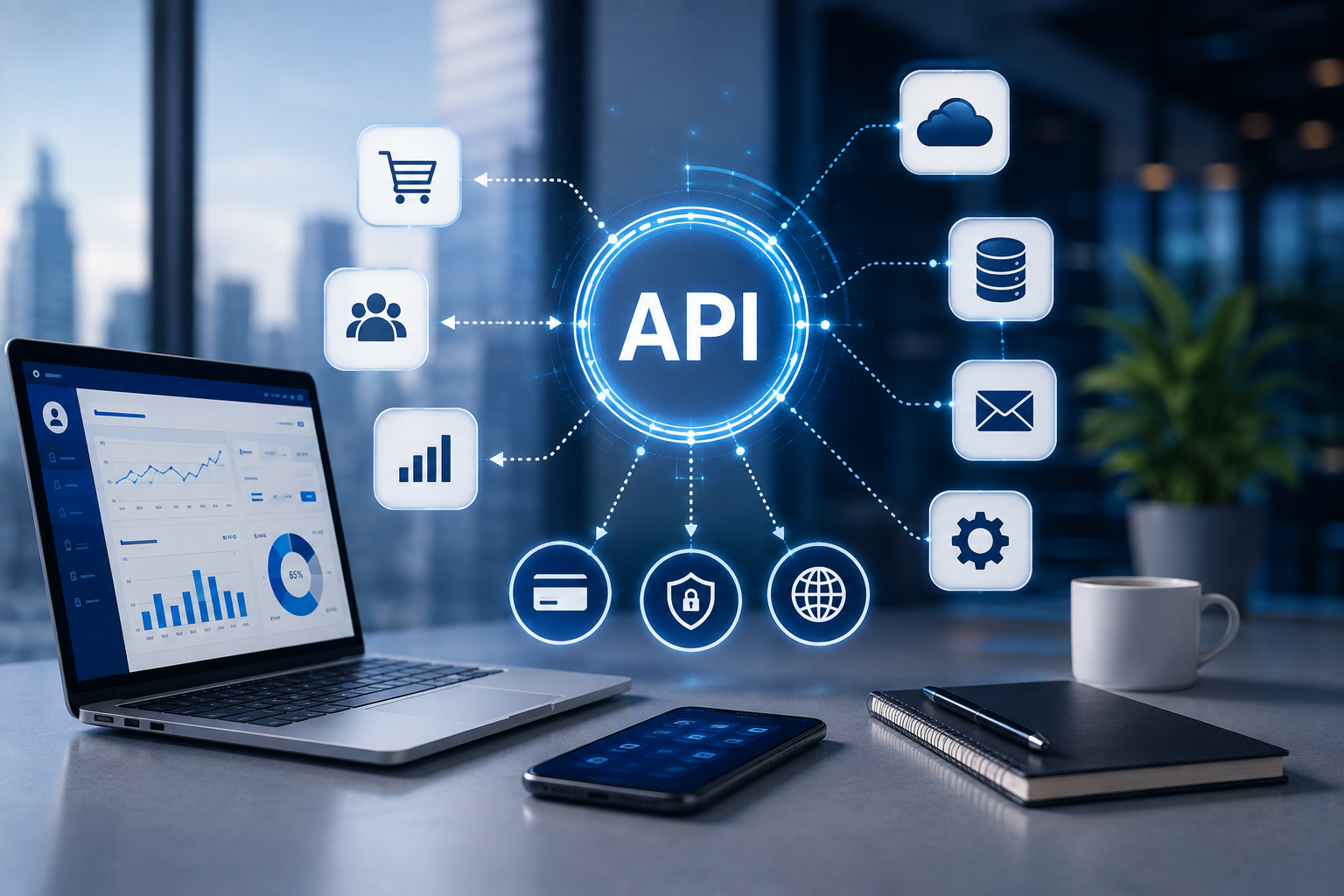
For example, an e-commerce website may use APIs to connect with:
-
Payment gateways
-
Shipping platforms
-
Inventory management systems
-
Customer relationship management software
-
Email marketing platforms
-
Analytics tools
-
Accounting software
Instead of manually transferring information between these systems, APIs can allow the systems to communicate automatically.
Why Is API Integration Important for Businesses?
Businesses use many different applications to manage their operations. Without integration, employees may have to enter the same information into multiple systems.
API integration can connect these systems and create a more efficient technology environment.
Some major benefits include:
-
Automation
-
Improved productivity
-
Real-time data exchange
-
Better customer experiences
-
Reduced manual work
-
Improved scalability
-
Faster business processes
-
Better data consistency
-
Easier software integration
-
More flexible technology infrastructure
1. Automates Repetitive Tasks
One of the biggest benefits of API integration is automation.
Employees often spend considerable time performing repetitive tasks such as transferring customer information, updating inventory, creating reports, or entering transaction details.
APIs can automate many of these processes.
For example, when a customer completes an online purchase, an API can automatically send order information to an inventory system, payment processor, shipping platform, and customer management system.
This reduces manual intervention and allows employees to focus on more valuable activities.
2. Enables Real-Time Data Exchange
Businesses often need access to current information to make effective decisions.
API integration can allow applications to exchange information in real time or near real time, depending on the system and integration design.
For example, an online store can automatically update product availability when inventory changes.
Similarly, a customer support platform can retrieve current customer information from a CRM system when an employee needs it.
Access to timely information can improve operational efficiency and decision-making.
3. Improves Customer Experience
Customers expect fast and convenient digital experiences.
API integration can help businesses provide connected experiences across websites, mobile applications, payment systems, communication platforms, and customer service tools.
For example, a customer may:
-
Create an account.
-
Place an order.
-
Make a payment.
-
Receive an automated confirmation.
-
Track the shipment.
-
Receive delivery updates.
Different systems can work together behind the scenes to support this experience.
A well-integrated technology environment can make customer interactions faster and more consistent.
4. Reduces Manual Data Entry
Manual data entry can consume time and increase the possibility of errors.
When employees repeatedly copy information from one application to another, mistakes can occur.
API integration allows systems to transfer structured information automatically.
For example, customer information entered into a website registration form could be automatically sent to a CRM system.
This reduces duplicate data entry and can improve data accuracy.
5. Connects Different Business Systems
Modern businesses commonly use specialized software for different functions.
A company may use:
-
CRM software
-
Accounting software
-
HR platforms
-
E-commerce systems
-
Marketing tools
-
Payment services
-
Analytics platforms
-
Inventory systems
-
Communication tools
API integration can connect these systems so they can work together as part of a larger digital ecosystem.
This allows businesses to use specialized applications without completely isolating their data.
6. Supports Business Automation
API integration is an important foundation for business automation.
Businesses can create workflows that automatically perform actions when specific events occur.
For example:
Customer submits form → CRM record created → Sales team notified → Email confirmation sent
Another workflow could be:
Order completed → Payment confirmed → Inventory updated → Shipping request created → Customer receives notification
Automated workflows can reduce processing time and improve operational consistency.
7. Helps Businesses Scale
As businesses grow, their technology requirements also become more complex.
A small company may initially manage processes manually, but increasing customers and transactions can make manual processes difficult to maintain.
API integrations can help businesses automate processes and connect additional systems as they grow.
For example, an organization can integrate new payment methods, marketing platforms, analytics tools, or customer support systems without completely rebuilding its existing infrastructure.
Scalable integrations can therefore support long-term business growth.
8. Improves Data Consistency
When multiple applications contain different versions of the same information, businesses may experience data inconsistencies.
For example, a customer's address may be updated in one system but remain outdated in another.
API integration can help synchronize information between connected systems.
Better data consistency can help teams work with more reliable information and reduce confusion.
9. Supports Mobile Applications
Mobile applications often need to communicate with backend systems and external services.
APIs allow mobile applications to request and exchange data with servers and other services.
For example, a mobile banking application may use APIs to retrieve account information, process transactions, verify authentication, and provide notifications.
Similarly, an e-commerce mobile application may use APIs for product information, customer accounts, payments, orders, and delivery tracking.
10. Enables Payment Integration
Online businesses often need secure connections to payment providers.
Payment APIs can allow applications to communicate with payment services for activities such as:
-
Payment processing
-
Transaction verification
-
Refunds
-
Payment status updates
-
Subscription management
API-based payment integration can make it easier for businesses to provide customers with convenient payment options.
Security should always be a major consideration when integrating payment-related services.
11. Enhances Marketing Automation
Marketing teams use multiple tools to manage campaigns, customer data, analytics, and communication.
API integration can connect these systems to create automated marketing workflows.
For example, a website can send customer activity information to a marketing platform. The platform can then use that information to trigger an appropriate communication.
Possible integrations include:
-
CRM and email marketing
-
Website analytics and advertising platforms
-
E-commerce and marketing automation
-
Customer data and personalization systems
Connected marketing tools can help businesses create more efficient campaigns.
12. Improves Business Analytics
Data from different systems can provide valuable insights when combined.
API integrations can help businesses bring information from multiple applications into analytics platforms or data systems.
For example, a business may combine:
-
Sales data
-
Website traffic
-
Customer information
-
Marketing performance
-
Inventory data
-
Support information
Analyzing these sources together can help businesses understand performance and identify opportunities for improvement.
13. Reduces Development Time
Developing every business feature from scratch can be expensive and time-consuming.
APIs allow developers to connect existing services and functionality rather than rebuilding everything internally.
For example, a development team may integrate an existing service for:
-
Payments
-
Maps
-
Email delivery
-
Authentication
-
Messaging
-
Analytics
-
Cloud storage
This can reduce development effort and allow teams to focus on the unique features of their application.
14. Supports Third-Party Services
Businesses often depend on external services to provide specialized functionality.
API integration makes it possible to connect applications with third-party platforms.
Examples include:
-
Payment providers
-
Social media platforms
-
Cloud services
-
Shipping providers
-
Communication services
-
Business software
-
Analytics platforms
Before integrating a third-party API, businesses should review its documentation, pricing, reliability, security requirements, rate limits, and maintenance policies.
15. Helps Create Connected Digital Ecosystems
Modern businesses increasingly operate as connected digital ecosystems rather than isolated applications.
For example, an e-commerce business may have the following technology environment:
Website → API → Payment Gateway
Website → API → Inventory System
Website → API → CRM
CRM → API → Marketing Platform
Order System → API → Shipping Provider
These connections allow different systems to work together and support a smoother overall business process.
Common Types of APIs
Businesses can use different API architectures and approaches depending on their requirements.
REST APIs
REST APIs are widely used for web and mobile applications. They commonly use HTTP methods such as GET, POST, PUT, PATCH, and DELETE.
They are popular because they are relatively simple, flexible, and widely supported.
GraphQL APIs
GraphQL allows clients to request specific data rather than always receiving a predefined response structure.
This can be useful for applications that need flexible data retrieval.
SOAP APIs
SOAP is a protocol-based approach that has been widely used in enterprise environments.
It can be useful in systems where strict standards, structured messaging, and established enterprise technologies are important.
API Integration Challenges
Although API integration provides many benefits, businesses should also consider potential challenges.
Security
APIs can provide access to important data and functionality. Poorly secured APIs may create security risks.
Businesses should consider:
-
Authentication
-
Authorization
-
Encryption
-
Access controls
-
Input validation
-
Rate limiting
-
Monitoring
-
Secure API keys and credentials
Maintenance
APIs can change over time.
Third-party providers may release new versions, change endpoints, update authentication requirements, or discontinue older versions.
Organizations should monitor their integrations and plan for updates.
Performance
Poorly designed integrations can create unnecessary requests and increase application response times.
Developers should consider efficient data retrieval, caching, request limits, error handling, and appropriate architecture.
Reliability
If an application depends heavily on an external API, an outage or service interruption can affect the business.
Developers should design appropriate error-handling and fallback strategies where necessary.
Best Practices for API Integration
Businesses can improve the reliability and security of their integrations by following good development practices.
Use Proper Authentication
Protect API access with appropriate authentication and authorization mechanisms.
Protect Sensitive Information
Avoid exposing sensitive information unnecessarily and use secure communication methods.
Monitor API Performance
Track API requests, errors, response times, and failures.
Handle Errors Properly
Applications should be designed to handle API failures gracefully rather than completely breaking when an external service is unavailable.
Follow API Documentation
Always understand the provider's documentation, request formats, authentication methods, limitations, and versioning policies.
Use Rate Limiting Carefully
Respect API rate limits and design applications to avoid unnecessary requests.
Keep Integrations Updated
Regularly review API versions and update integrations when necessary.
How Businesses Can Get Started With API Integration
Businesses interested in API integration can begin with a clear assessment of their existing processes.
Step 1: Identify Repetitive Processes
Find tasks that require employees to repeatedly transfer or update information between systems.
Step 2: Identify the Systems Involved
Determine which applications need to communicate with each other.
Step 3: Check API Availability
Review whether the applications provide APIs or other supported integration methods.
Step 4: Define the Data Flow
Determine what information should move between systems and when it should be transferred.
Step 5: Consider Security
Identify authentication, authorization, encryption, and data protection requirements.
Step 6: Develop and Test
Build the integration and test it under different conditions.
Step 7: Monitor and Maintain
Monitor performance and errors and update the integration when APIs or business requirements change.
The Future of API Integration
As businesses continue adopting cloud applications, artificial intelligence, automation, mobile applications, and digital platforms, the importance of APIs is likely to continue growing.
APIs provide the connectivity needed to build flexible digital ecosystems where applications can exchange information and work together.
Businesses that invest in well-designed integrations can create technology environments that are more automated, scalable, and adaptable.
Conclusion
API integration is an essential part of modern business applications because it allows different software systems to communicate and work together.
From automating repetitive tasks and synchronizing data to improving customer experiences and connecting third-party services, APIs can provide significant advantages for businesses of different sizes.
However, successful API integration requires more than simply connecting two applications. Businesses should consider security, performance, reliability, documentation, monitoring, and long-term maintenance.
As digital transformation continues, API integration will remain an important technology for businesses that want to create connected, efficient, and scalable applications.
For companies looking to improve their digital infrastructure, API integration can be a valuable step toward building smarter and more connected business operations.