Table of Contents
- Why Observability Is Becoming Essential for Modern Software Systems
- What Is Observability?
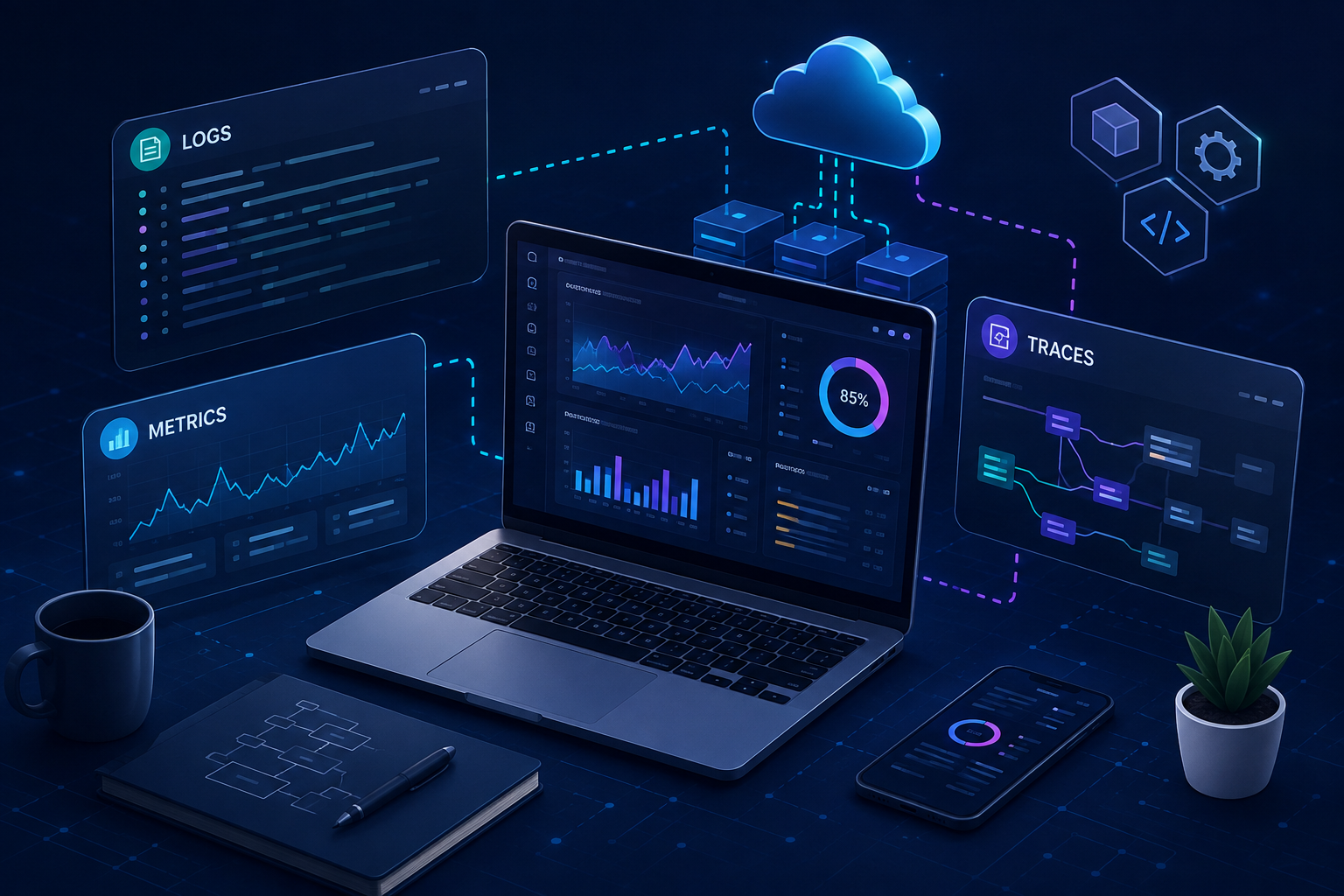
- The Three Main Components
- 1. Logs
- 2. Metrics
- 3. Traces
- Why Businesses Need Observability
- Faster Troubleshooting
- Better Application Performance
- Improved Reliability
- Better User Experience
- Easier Microservices Management
- Observability vs. Monitoring
- Challenges to Consider
- The Future of Observability
- Final Thoughts
Why Observability Is Becoming Essential for Modern Software Systems
Modern software applications are becoming increasingly complex. Businesses now depend on cloud platforms, APIs, microservices, databases, containers, and third-party services. When something goes wrong, finding the exact cause can be difficult.
Observability helps development and operations teams understand what is happening inside their systems by analyzing the data those systems produce. It commonly brings together logs, metrics, and traces to provide a clearer picture of application behavior.
What Is Observability?
Observability is the ability to understand a software system's internal behavior through its external outputs.
It helps teams answer questions such as:
- Why is the application slow?
- Which service is causing an error?
- Where did a request fail?
- Which users are affected?
- What changed before the problem occurred?
Unlike basic monitoring, which can alert teams that something is wrong, observability provides deeper information for investigating why the problem occurred.
The Three Main Components
1. Logs
Logs record events, warnings, and errors within an application. They can provide detailed information when developers investigate a specific problem.
2. Metrics
Metrics are numerical measurements such as:
- Response time
- Error rate
- CPU usage
- Memory usage
- Request volume
They help teams identify performance trends and unusual behavior.
3. Traces
Traces follow a request as it moves through different services. This is particularly useful for microservices and distributed applications because it can show where a request becomes slow or fails.
Why Businesses Need Observability
Faster Troubleshooting
Observability gives developers more context when investigating production issues, helping them identify the affected service and potential root cause faster.
Better Application Performance
Teams can identify slow APIs, database queries, infrastructure bottlenecks, and other performance problems.
Improved Reliability
Early detection of unusual error rates, latency, or resource usage can help teams respond before small issues become major outages.
Better User Experience
Technical problems often directly affect customers. Observability can help businesses identify issues with slow pages, failed transactions, login problems, or unreliable services.
Easier Microservices Management
A single request can pass through multiple services. Distributed tracing helps teams understand these relationships and locate problems more efficiently.
Observability vs. Monitoring
Monitoring might tell a team:
"API response time has increased."
Observability can help answer:
"Why has the response time increased, and which service is responsible?"
This deeper visibility is especially valuable as applications become more distributed and complex.
Challenges to Consider
Implementing observability also creates challenges. Businesses may collect very large amounts of logs, metrics, and traces, which can increase storage and processing costs.
Teams should therefore focus on collecting useful telemetry, creating meaningful alerts, protecting sensitive information, and establishing appropriate data-retention policies.
The Future of Observability
As cloud-native applications, microservices, AI systems, and distributed architectures continue to grow, observability is becoming increasingly important. Modern approaches are also moving toward correlating telemetry data and using AI to reduce alert noise and assist with incident investigation.
Final Thoughts
Observability helps businesses move beyond simply knowing that a software problem exists. By combining logs, metrics, and traces, teams can better understand application behavior, troubleshoot problems, improve performance, and maintain reliable digital services.
For modern businesses running cloud-based and distributed applications, observability is becoming an essential part of building reliable, scalable, and high-performing software systems.