Table of Contents
- Benefits of AI-Powered Business Solutions
- What Are AI-Powered Business Solutions?
- 1. Automating Repetitive Tasks
- 2. Improved Customer Service
- Benefits include:
- 3. Better Decision-Making Through Data
- 4. Increased Productivity
- 5. Cost Savings
- 6. Personalized Customer Experiences
- 7. Smarter Marketing Strategies
- 8. Enhanced Cybersecurity
- 9. Scalable Business Operations
- 10. Competitive Advantage
- Industries Benefiting from AI
- Challenges to Consider
- Tips for Successfully Adopting AI
- Future of AI in Business
- Frequently Asked Questions (FAQs)
- What are AI-powered business solutions?
- Can small businesses benefit from AI?
- Does AI replace employees?
- Is AI expensive to implement?
- Is AI secure?
- Final Thoughts
Benefits of AI-Powered Business Solutions
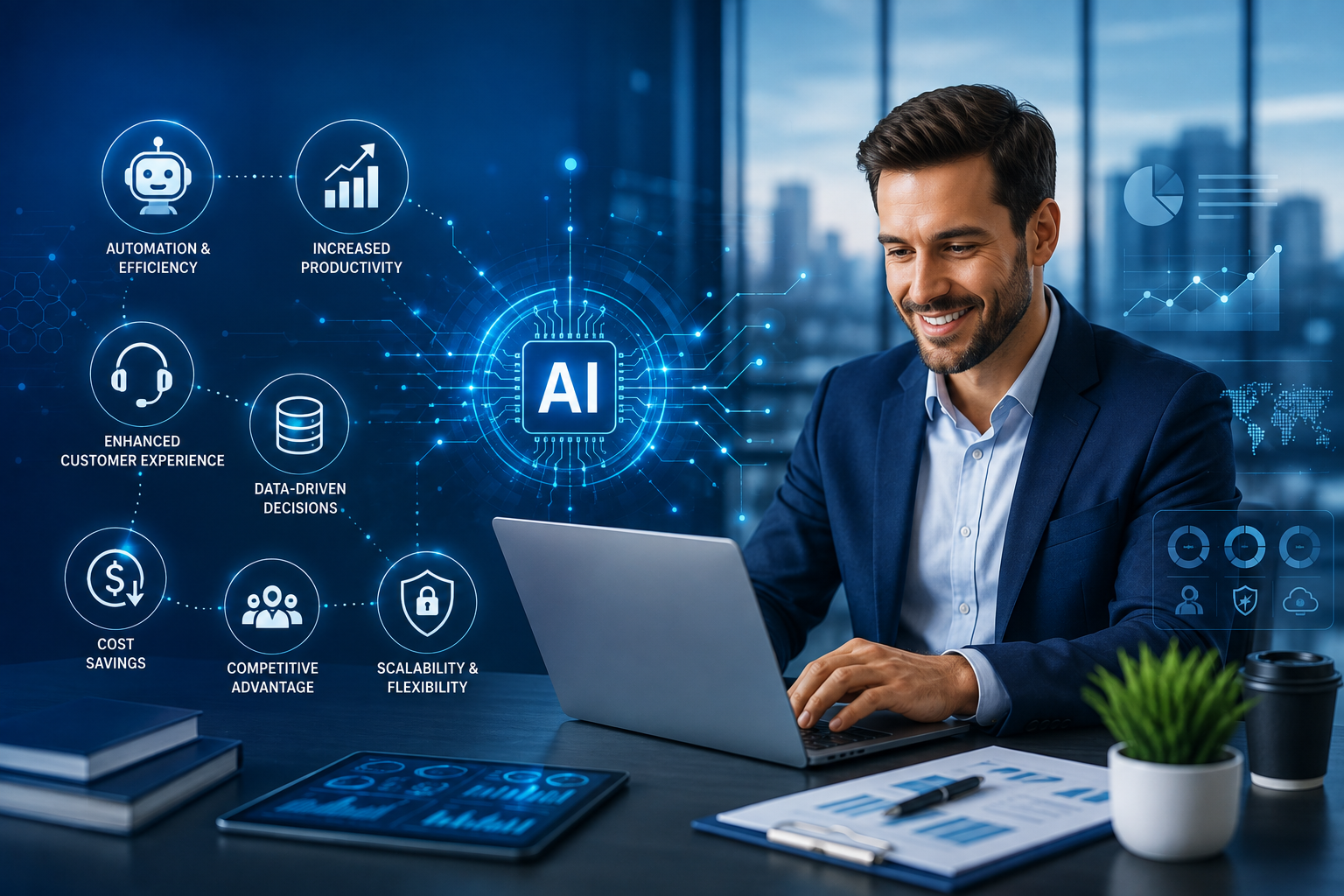
Artificial Intelligence (AI) is transforming the way businesses operate across industries. From automating repetitive tasks to improving customer experiences and providing valuable insights through data analysis, AI-powered business solutions are helping organizations become more efficient, productive, and competitive.
Whether you're a startup, small business, or large enterprise, integrating AI into your operations can streamline workflows, reduce costs, and support smarter decision-making. In this guide, we'll explore the key benefits of AI-powered business solutions and how they can contribute to long-term business success.
What Are AI-Powered Business Solutions?
AI-powered business solutions are software applications and technologies that use artificial intelligence to perform tasks that typically require human intelligence. These tasks may include:
- Data analysis
- Customer support
- Predictive analytics
- Workflow automation
- Content generation
- Sales forecasting
- Inventory management
- Fraud detection
AI helps businesses process large amounts of information quickly, enabling faster and more informed decisions.
1. Automating Repetitive Tasks
One of the biggest advantages of AI is automation.
AI can handle repetitive and time-consuming tasks such as:
- Data entry
- Appointment scheduling
- Email responses
- Invoice processing
- Report generation
- Inventory tracking
By automating routine work, employees can focus on strategic activities that require creativity, problem-solving, and human interaction.
2. Improved Customer Service
AI-powered chatbots and virtual assistants can provide instant support to customers around the clock.
Benefits include:
- Faster response times
- 24/7 customer assistance
- Reduced waiting times
- Personalized customer interactions
- Efficient handling of common queries
Human support teams can then focus on more complex customer issues, improving overall service quality.
3. Better Decision-Making Through Data
Businesses generate large amounts of data every day. AI can analyze this data to identify patterns, trends, and opportunities.
AI supports decision-making by helping businesses:
- Understand customer behavior
- Forecast sales trends
- Identify operational inefficiencies
- Detect market opportunities
- Reduce business risks
Data-driven insights enable leaders to make more informed strategic decisions.
4. Increased Productivity
AI-powered tools can significantly improve workplace productivity.
Examples include:
- Automated scheduling
- Smart document management
- Workflow optimization
- Task prioritization
- Meeting summaries
Employees spend less time on administrative work and more time on activities that drive business growth.
5. Cost Savings
Although implementing AI may require an initial investment, it can reduce long-term operational costs by:
- Automating manual processes
- Reducing human errors
- Optimizing resource allocation
- Improving operational efficiency
- Minimizing downtime
These savings can contribute to improved profitability over time.
6. Personalized Customer Experiences
Today's customers expect personalized experiences.
AI helps businesses deliver:
- Product recommendations
- Personalized marketing campaigns
- Customized content
- Tailored customer support
- Individualized shopping experiences
Personalization can improve customer satisfaction and strengthen brand loyalty.
7. Smarter Marketing Strategies
AI enhances digital marketing by analyzing customer behavior and campaign performance.
Businesses can use AI to:
- Optimize advertising campaigns
- Improve email marketing
- Identify target audiences
- Generate marketing insights
- Predict customer preferences
This allows marketing teams to make better use of their budgets and improve campaign effectiveness.
8. Enhanced Cybersecurity
AI can strengthen cybersecurity by monitoring systems for unusual activity and identifying potential threats.
AI-powered security solutions can:
- Detect suspicious behavior
- Monitor network activity
- Identify fraud patterns
- Support threat detection
- Respond more quickly to security incidents
AI complements, but does not replace, comprehensive cybersecurity practices.
9. Scalable Business Operations
As businesses grow, managing operations becomes more complex.
AI-powered solutions can scale with business needs by helping manage:
- Customer inquiries
- Inventory
- Business processes
- Data management
- Reporting
This flexibility allows businesses to expand without proportionally increasing manual workloads.
10. Competitive Advantage
Businesses that adopt AI responsibly may gain advantages by:
- Improving operational efficiency
- Delivering faster customer service
- Making better business decisions
- Responding more quickly to market changes
- Supporting innovation
Using AI strategically can help organizations remain competitive in an evolving digital landscape.
Industries Benefiting from AI
AI is transforming many sectors, including:
- Healthcare
- Retail
- Manufacturing
- Finance
- Education
- Real Estate
- Logistics
- E-commerce
- Hospitality
- Information Technology
Each industry applies AI differently based on its unique needs and challenges.
Challenges to Consider
While AI offers many benefits, businesses should also plan for challenges such as:
- Initial implementation costs
- Employee training
- Data privacy and security
- Integration with existing systems
- Ongoing maintenance
- Ethical use of AI
A thoughtful implementation strategy helps maximize benefits while minimizing risks.
Tips for Successfully Adopting AI
To make the most of AI-powered solutions:
- Identify business processes that can benefit from automation.
- Start with small, manageable AI projects.
- Choose solutions that integrate with existing systems.
- Train employees on new technologies.
- Monitor performance and adjust as needed.
- Prioritize data security and responsible AI use.
Gradual adoption often leads to smoother implementation and better long-term results.
Future of AI in Business
AI continues to evolve rapidly. Emerging trends include:
- Generative AI for content and coding
- AI-powered business intelligence
- Predictive analytics
- Intelligent workflow automation
- Voice-enabled business applications
- AI-assisted customer service
- Advanced data analytics
- Hyper-personalized customer experiences
Businesses that stay informed about these developments will be better positioned for future growth.
Frequently Asked Questions (FAQs)
What are AI-powered business solutions?
AI-powered business solutions are software tools and systems that use artificial intelligence to automate tasks, analyze data, improve decision-making, and enhance business operations.
Can small businesses benefit from AI?
Yes. Many AI tools are designed for businesses of all sizes and can help improve efficiency, customer service, and productivity.
Does AI replace employees?
AI is generally used to automate repetitive tasks and support employees, allowing them to focus on higher-value work. The impact on roles varies depending on the business and how AI is implemented.
Is AI expensive to implement?
Costs vary depending on the solution and business requirements. Many cloud-based AI tools offer scalable pricing, making them accessible to businesses with different budgets.
Is AI secure?
AI solutions can support security efforts, but businesses should also implement strong cybersecurity practices, protect sensitive data, and follow applicable privacy regulations.
Final Thoughts
AI-powered business solutions are reshaping the modern workplace by helping organizations automate routine tasks, improve customer experiences, analyze data more effectively, and increase overall productivity. From startups to large enterprises, businesses across industries are discovering new ways to use AI to support growth and innovation.
Successful AI adoption requires careful planning, employee training, and a focus on responsible implementation. Rather than replacing human expertise, AI works best as a tool that enhances decision-making and streamlines operations.
By embracing AI thoughtfully and aligning it with business goals, organizations can improve efficiency, remain competitive, and prepare for the future of digital transformation.