Table of Contents
- Building a Scalable Digital Management System for Growing Businesses
- What Is a Scalable Digital Management System?
- Why Growing Businesses Need Scalable Systems
- Moving Beyond Spreadsheets
- Centralizing Business Information
- Designing the System Around Workflows
- Purchase Workflow
- Employee Onboarding
- Customer Service
- Automation for Repetitive Processes
- Building a Centralized Dashboard
- Real-Time Operational Visibility
- Role-Based Access
- Planning for More Users
- Managing Growing Amounts of Data
- Integrating Existing Business Tools
- Supporting Multiple Departments
- Managing Projects and Jobs
- Improving Accountability
- Improving Internal Communication
- Document Management
- Reporting and Business Analytics
- Designing for Mobile and Remote Access
- Security Should Scale with the Business
- Designing for Customization
- Avoiding Over-Engineering
- Building the System in Phases
- Phase 1: Core Management
- Phase 2: Automation
- Phase 3: Integrations
- Phase 4: Advanced Analytics
- Measuring the Success of the System
- Common Mistakes to Avoid
- Trying to Automate Everything
- Ignoring User Experience
- Building Without Understanding Workflows
- Poor Data Structure
- Ignoring Security
- Failing to Plan for Growth
- A Practical Roadmap for Growing Businesses
- The Long-Term Benefits of Scalability
- Conclusion
Building a Scalable Digital Management System for Growing Businesses
As a business grows, its operations become more complex. What works for a small team may not work when the organization has more employees, customers, departments, projects, and daily transactions.
Businesses often begin with spreadsheets, email, messaging applications, and separate software tools. Over time, these systems can become difficult to manage. Information gets scattered, employees repeat the same work, and managers spend more time coordinating operations.
A scalable digital management system can help businesses create a structured foundation for growth. Instead of simply adding more tools as the company expands, businesses can build a connected system that supports employees, workflows, data, reporting, and decision-making.
What Is a Scalable Digital Management System?
A scalable digital management system is a technology platform designed to support business operations as an organization grows.
It can bring different activities into a centralized environment, including:
- Employee management
- Task management
- Project management
- Customer management
- Job tracking
- Document management
- Approvals
- Workflow automation
- Reporting
- Business dashboards
- Content management
The important part is scalability. The system should be able to handle increasing users, data, workflows, and business requirements without requiring the organization to completely rebuild its processes.
Why Growing Businesses Need Scalable Systems
Growth usually creates additional operational complexity.
A business may start with five employees and a few customers. Later, it may have several departments, hundreds of customers, multiple projects, and a large volume of daily transactions.
Without an appropriate management system, businesses may experience:
- Duplicate data
- Manual reporting
- Communication gaps
- Delayed approvals
- Unclear responsibilities
- Difficult document management
- Limited operational visibility
- Repetitive administrative work
A scalable system helps businesses prepare for this increasing complexity.
Moving Beyond Spreadsheets
Spreadsheets are useful for many business activities, especially during the early stages of an organization.
However, as the volume of information increases, spreadsheets can become difficult to maintain.
Common challenges include:
- Multiple versions of the same file
- Accidental data changes
- Manual calculations
- Limited workflow automation
- Difficult access management
- Time-consuming reporting
- Lack of real-time visibility
A centralized digital system can provide structured records, controlled access, automated workflows, and dashboards while still allowing businesses to export information when necessary.
Centralizing Business Information
One of the most important characteristics of a scalable system is centralized information.
Instead of storing business data across multiple disconnected locations, organizations can create a structured environment where authorized users can access relevant information.
For example, a customer record could connect with:
Customer → Orders → Payments → Support Requests → Documents → Communication
Similarly, an employee record could connect with:
Employee → Department → Tasks → Projects → Attendance → Documents
Connecting related information makes business processes easier to manage.
Designing the System Around Workflows
A digital management system should not simply store information. It should help employees complete work.
Businesses should identify important workflows and define their stages.
For example:
Purchase Workflow
Request → Approval → Procurement → Purchase → Invoice → Completed
Employee Onboarding
Registration → Document Verification → IT Setup → Department Assignment → Orientation → Completed
Customer Service
New Request → Assigned → In Progress → Review → Resolved
Clear workflows help employees understand what needs to happen and who is responsible for each step.
Automation for Repetitive Processes
Growing businesses often experience an increase in repetitive administrative tasks.
Examples include:
- Sending notifications
- Assigning tasks
- Updating statuses
- Creating reports
- Requesting approvals
- Sending reminders
- Updating records
Automation can reduce the manual effort required for these activities.
For example, when a new request is submitted, the system can automatically assign it to the appropriate department and notify the responsible employee.
This allows employees to focus on activities that require human judgment.
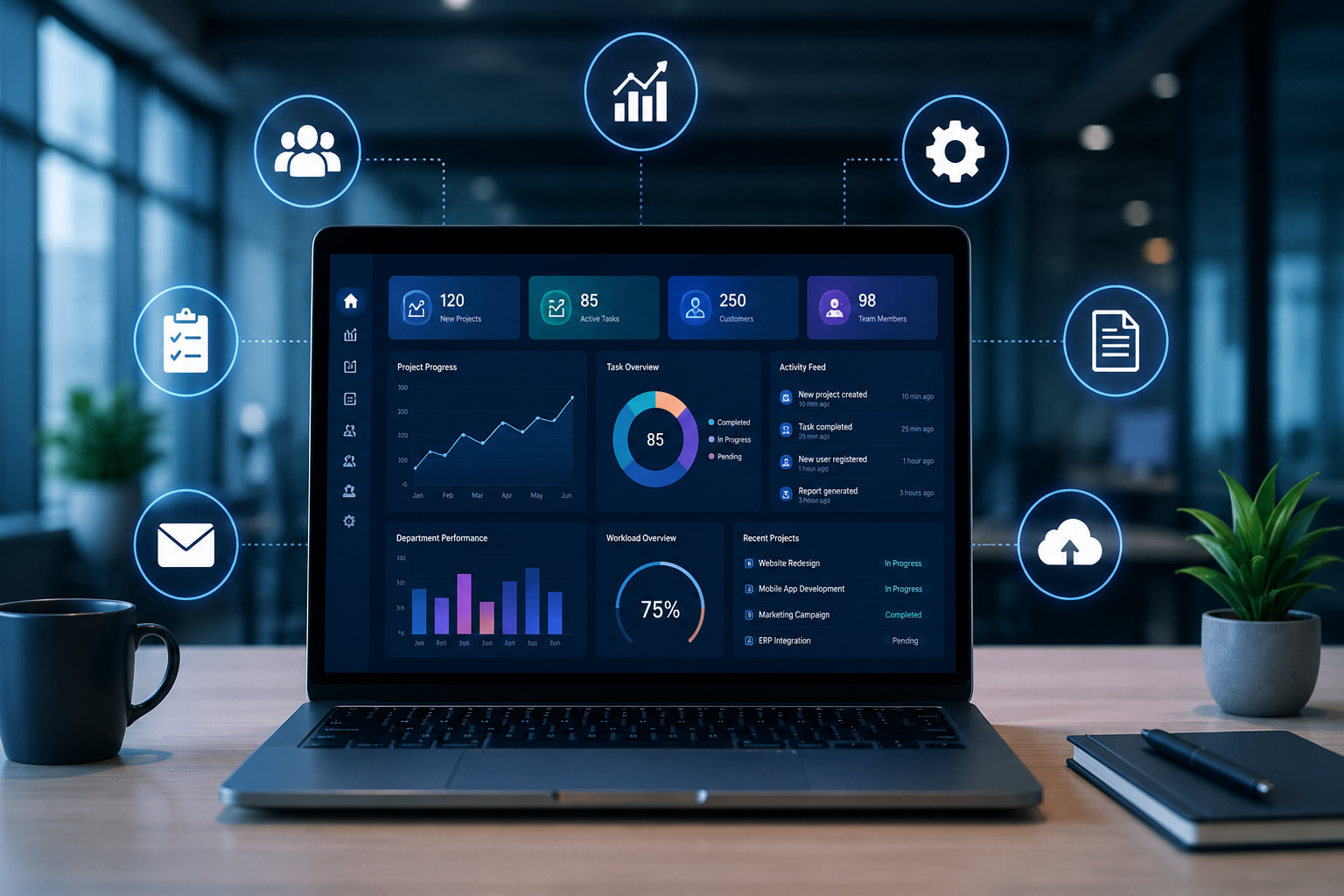
Building a Centralized Dashboard
Management needs visibility as a business grows.
A centralized dashboard can provide a summary of important business information.
For example:
Active Projects: 35
Pending Tasks: 82
Open Customer Requests: 27
Pending Approvals: 14
Completed Jobs: 218
Monthly Revenue: ₹18.6 Lakh
The exact metrics will depend on the business, but the goal is to provide management with a quick understanding of current operations.
Real-Time Operational Visibility
Historical reports are useful for understanding what happened, but managers also need to know what is happening now.
A digital management system can provide current information about:
- Sales
- Tasks
- Projects
- Customer requests
- Payments
- Inventory
- Employee activities
- Pending approvals
Real-time visibility can help managers identify problems earlier and respond before they become larger operational issues.
Role-Based Access
As an organization grows, not every employee should have access to every piece of information.
A scalable system should support role-based access.
For example:
Administrator: Full system access
Management: Business-wide reports and dashboards
Department Head: Department-level information
Employee: Assigned tasks and relevant records
Finance Team: Financial information
HR Team: Employee-related records
This provides a balance between accessibility and security.
Planning for More Users
A system that works for ten employees should not become unusable when the company reaches one hundred or one thousand employees.
Businesses should consider:
- User management
- Department structures
- Permission levels
- Multiple locations
- Employee roles
- Login security
- User activity tracking
The system architecture should make it easy to add new users without manually rebuilding workflows.
Managing Growing Amounts of Data
Business data can grow quickly.
Customer records, transactions, documents, employee records, tasks, projects, and reports can eventually create large databases.
A scalable system should have an organized data structure that supports:
- Efficient searching
- Filtering
- Sorting
- Reporting
- Data backups
- Archiving
- Secure access
Good database design is particularly important when the system is expected to support long-term business growth.
Integrating Existing Business Tools
A scalable management system does not always need to replace every tool the business already uses.
Instead, integrations can connect existing applications.
Possible integrations include:
- CRM systems
- Accounting software
- Payment gateways
- HR platforms
- Email services
- Inventory systems
- Marketing platforms
- Analytics tools
- Website systems
APIs can allow information to move between systems, reducing duplicate data entry and creating more connected workflows.
Supporting Multiple Departments
Growing businesses often create specialized departments.
For example:
- Sales
- Marketing
- Finance
- HR
- Operations
- Customer Support
- IT
Each department may have different workflows, but they still need to work together.
A scalable management system can provide department-specific features while maintaining a common business structure.
For example, sales can manage leads while finance handles payments and operations manages fulfillment.
Managing Projects and Jobs
Project and job management become increasingly important as businesses grow.
A digital system can allow managers to create projects and divide them into smaller jobs or tasks.
For example:
Project: Website Launch
- UI Design
- Content Preparation
- Development
- Testing
- SEO
- Client Review
- Launch
Each task can have an assigned employee, deadline, status, and priority.
This makes it easier to monitor both individual work and overall project progress.
Improving Accountability
Scalability is not only about handling more data. It is also about maintaining accountability as the organization becomes larger.
A digital system can record:
- Who created a task
- Who was assigned
- When the task changed status
- Who approved a request
- When a document was uploaded
- When the task was completed
This activity history creates transparency and makes it easier to understand how work moves through the organization.
Improving Internal Communication
As teams become larger, communication becomes more difficult.
Employees may not know who is responsible for a particular task or where to find the latest information.
A centralized platform can connect communication with the relevant work.
For example, project comments, instructions, files, and status updates can remain connected to the project rather than being scattered across different conversations.
Document Management
Businesses generate a large amount of digital content.
This can include:
- Contracts
- Invoices
- Employee documents
- Project files
- Marketing materials
- Reports
- Policies
- Customer documents
A scalable management system can organize these documents according to departments, customers, projects, or workflows.
Version management and access controls can also help reduce the risk of employees using outdated or unauthorized documents.
Reporting and Business Analytics
As businesses grow, management needs more than raw data.
They need meaningful information that can support decisions.
A scalable system can generate reports covering:
- Sales performance
- Employee workload
- Project status
- Revenue
- Expenses
- Customer activity
- Task completion
- Department performance
Dashboards can then turn these reports into easy-to-understand visual information.
Designing for Mobile and Remote Access
Employees may need to access business information outside the office.
A modern management system should consider responsive interfaces and appropriate mobile access.
Employees may need to:
- Check tasks
- Update statuses
- Approve requests
- View documents
- Respond to notifications
- Review project information
This is particularly useful for businesses with remote teams, field employees, or multiple locations.
Security Should Scale with the Business
Security becomes increasingly important as more employees and systems are connected.
A scalable digital management system should consider:
- Strong authentication
- Role-based permissions
- Secure data storage
- Activity logs
- Regular backups
- Controlled access
- Data protection policies
Security should be part of the system architecture from the beginning rather than treated as an afterthought.
Designing for Customization
Every business has different processes.
A system that works for one organization may not perfectly fit another.
Scalable platforms should therefore allow reasonable customization, such as:
- Custom fields
- Custom workflows
- Department-specific dashboards
- Approval rules
- User roles
- Notifications
- Reports
However, customization should be controlled. Too many unnecessary customizations can make a system difficult to maintain.
Avoiding Over-Engineering
Building a scalable system does not mean building every possible feature from day one.
Over-engineering can increase development costs and make the system unnecessarily complicated.
A better approach is to identify the most important business requirements and build the system in stages.
Start with essential features, measure their effectiveness, and add functionality as business needs evolve.
Building the System in Phases
A phased approach can make digital transformation easier.
Phase 1: Core Management
Start with:
- User management
- Departments
- Tasks
- Basic workflows
- Dashboard
Phase 2: Automation
Add:
- Notifications
- Approvals
- Reminders
- Automated assignments
- Scheduled reports
Phase 3: Integrations
Connect:
- CRM
- Accounting
- Payment systems
- HR software
- Other business applications
Phase 4: Advanced Analytics
Introduce:
- KPI dashboards
- Historical analysis
- Performance reports
- Department comparisons
- Business intelligence
This approach allows the system to grow alongside the organization.
Measuring the Success of the System
A digital management system should produce measurable improvements.
Businesses can monitor:
- Time saved on administrative tasks
- Faster approval times
- Reduced duplicate data
- Improved task completion
- Fewer missed deadlines
- Faster report generation
- Better employee collaboration
These measurements help determine whether the system is actually improving operations.
Common Mistakes to Avoid
Businesses should avoid several common mistakes when developing a digital management system.
Trying to Automate Everything
Not every process needs automation. Some decisions require human involvement.
Ignoring User Experience
A complicated system may be technically powerful but difficult for employees to use.
Building Without Understanding Workflows
Technology should support business processes, not force employees into unnecessarily complicated procedures.
Poor Data Structure
Weak database design can create performance and reporting problems later.
Ignoring Security
Access controls and security should be planned from the beginning.
Failing to Plan for Growth
The system should account for future users, data, departments, and integrations.
A Practical Roadmap for Growing Businesses
Businesses considering a scalable management system can follow a simple roadmap:
1. Identify operational challenges
Find the processes that consume the most time.
2. Map current workflows
Understand how information moves between employees and departments.
3. Define business requirements
Decide which features are actually needed.
4. Build a centralized foundation
Create users, departments, data structures, and core workflows.
5. Introduce automation
Automate repetitive activities where appropriate.
6. Connect existing systems
Use APIs and integrations to reduce disconnected data.
7. Create management dashboards
Give decision-makers visibility into important metrics.
8. Monitor and improve
Use system data and employee feedback to continuously improve operations.
The Long-Term Benefits of Scalability
A scalable digital management system can provide long-term benefits as an organization expands.
These include:
- Easier employee management
- Better workflow organization
- Improved operational visibility
- Reduced administrative work
- Faster decision-making
- Better accountability
- Improved collaboration
- More consistent processes
- Easier reporting
- Greater automation
- Better data management
- Easier integration with future technologies
The biggest advantage is that the business can grow without allowing administrative complexity to grow at the same rate.
Conclusion
Building a scalable digital management system is about preparing a business for growth while keeping its operations organized.
The right system can connect employees, workflows, projects, documents, data, dashboards, and business applications in one structured environment.
Businesses should focus on building a strong foundation rather than trying to create every feature immediately. Clear workflows, reliable data, appropriate automation, strong security, and a simple user experience are more important than having a long list of features.
As the organization grows, the system can evolve with it.
A well-designed digital management system ultimately helps businesses spend less time dealing with administrative complexity and more time focusing on customers, employees, innovation, and sustainable growth.