Table of Contents
- Financial Reporting Using ERP Dashboards
- Introduction
- What Is an ERP Financial Dashboard?
- Why Financial Reporting Matters
- Key Features of ERP Financial Dashboards
- 1. Real-Time Financial Data
- 2. Interactive Dashboards
- 3. Automated Financial Reports
- 4. Budget Monitoring
- 5. Cash Flow Analysis
- 6. Accounts Receivable and Payable Tracking
- 7. Financial KPI Monitoring
- Benefits of Financial Reporting Using ERP Dashboards
- Improved Accuracy
- Faster Report Generation
- Better Decision-Making
- Enhanced Compliance
- Increased Productivity
- Centralized Financial Information
- Industries That Benefit from ERP Financial Dashboards
- Real-World Example
- Best Practices for Effective ERP Financial Reporting
- Common Challenges
- Future of ERP Financial Dashboards
- Conclusion
- Frequently Asked Questions (FAQs)
- 1. What is an ERP financial dashboard?
- 2. How do ERP dashboards improve financial reporting?
- 3. Which financial reports can ERP dashboards generate?
- 4. What are the key benefits of ERP financial dashboards?
- 5. Which industries benefit from ERP financial dashboards?
Financial Reporting Using ERP Dashboards
Introduction
Accurate financial reporting is essential for every business, regardless of its size or industry. Financial reports help organizations monitor cash flow, evaluate profitability, manage expenses, ensure compliance, and make informed strategic decisions. However, relying on spreadsheets and manual reporting processes can be time-consuming, error-prone, and inefficient.
Modern Enterprise Resource Planning (ERP) systems solve these challenges by offering powerful financial dashboards that provide real-time visibility into an organization's financial performance. ERP dashboards consolidate financial data from multiple departments into a single interface, enabling finance teams and business leaders to monitor key metrics, generate reports instantly, and make data-driven decisions.
This guide explores how ERP dashboards improve financial reporting, their key features, benefits, best practices, and why they have become an essential tool for modern businesses.
What Is an ERP Financial Dashboard?
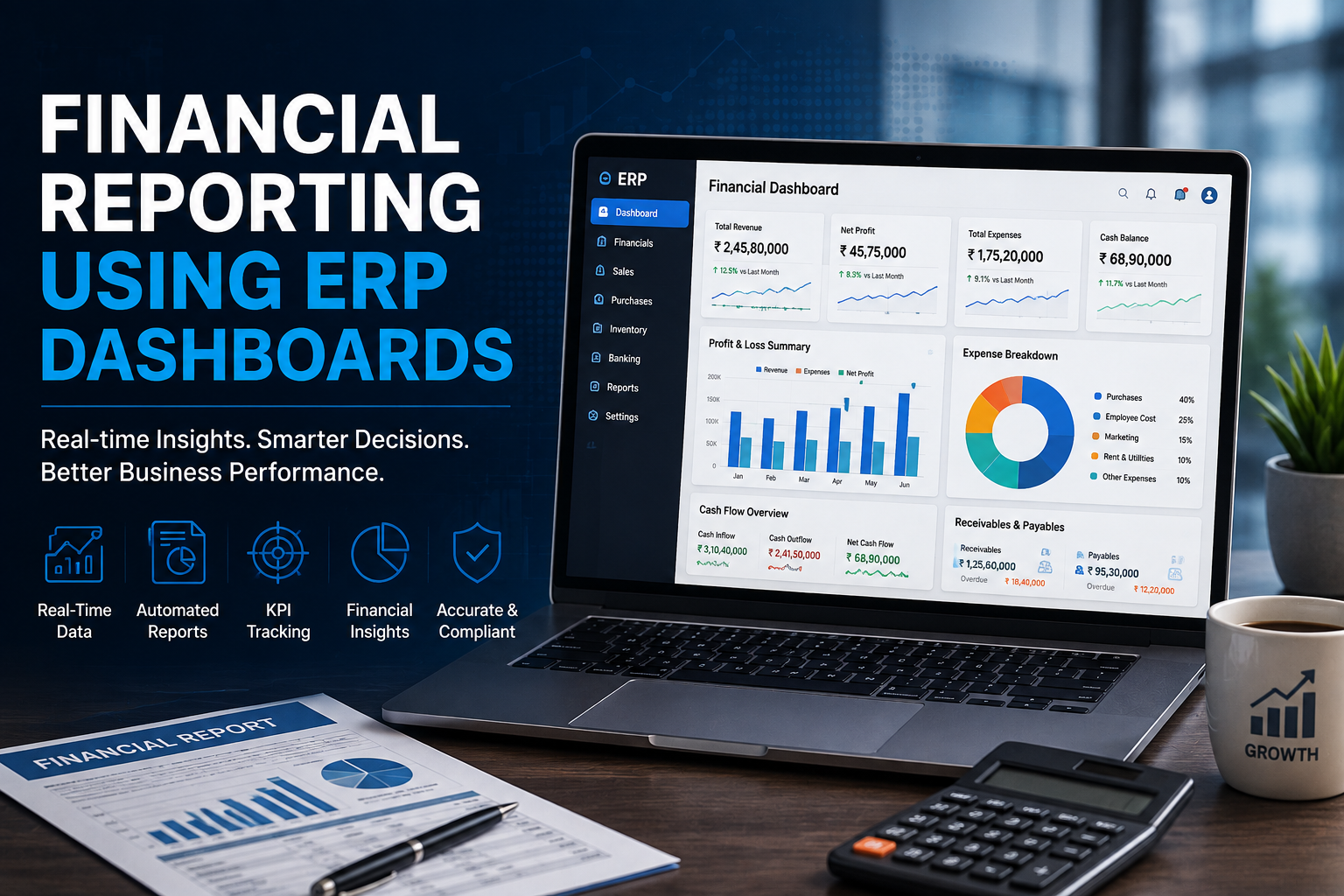
An ERP financial dashboard is a visual reporting interface within an ERP system that displays real-time financial data through charts, graphs, tables, and key performance indicators (KPIs).
Instead of manually compiling reports from different systems, ERP dashboards automatically collect and organize financial information from various business functions, including:
-
Accounting
-
Sales
-
Purchasing
-
Inventory
-
Payroll
-
Banking
-
Tax Management
-
Budgeting
This centralized view enables businesses to monitor financial performance quickly and accurately.
Why Financial Reporting Matters
Financial reporting helps organizations:
-
Track revenue and expenses
-
Monitor profitability
-
Manage cash flow
-
Analyze business performance
-
Prepare tax reports
-
Ensure regulatory compliance
-
Support budgeting and forecasting
-
Improve investment decisions
Timely and accurate reports help businesses respond quickly to financial challenges and opportunities.
Key Features of ERP Financial Dashboards
1. Real-Time Financial Data
ERP dashboards update financial information automatically as transactions occur.
This allows businesses to monitor:
-
Revenue
-
Expenses
-
Profit margins
-
Cash flow
-
Outstanding invoices
-
Accounts payable
-
Accounts receivable
Real-time reporting eliminates delays caused by manual data collection.
2. Interactive Dashboards
Modern ERP systems present financial information using:
-
Charts
-
Pie graphs
-
Line graphs
-
Bar charts
-
KPI widgets
-
Trend reports
Interactive dashboards make complex financial data easier to understand.
3. Automated Financial Reports
ERP software can automatically generate reports such as:
-
Profit & Loss Statement
-
Balance Sheet
-
Cash Flow Statement
-
Trial Balance
-
General Ledger
-
Tax Reports
-
Expense Reports
-
Budget Reports
Automation saves significant time for finance teams.
4. Budget Monitoring
ERP dashboards help businesses compare:
-
Planned budgets
-
Actual spending
-
Department-wise expenses
-
Project costs
Managers can quickly identify overspending and adjust budgets accordingly.
5. Cash Flow Analysis
Cash flow is one of the most critical aspects of financial management.
ERP dashboards provide visibility into:
-
Incoming payments
-
Outgoing expenses
-
Cash balance
-
Upcoming liabilities
-
Payment due dates
This helps businesses maintain healthy cash flow.
6. Accounts Receivable and Payable Tracking
Finance teams can monitor:
Accounts Receivable
-
Outstanding customer invoices
-
Payment reminders
-
Customer balances
Accounts Payable
-
Vendor payments
-
Due invoices
-
Payment schedules
Better tracking improves working capital management.
7. Financial KPI Monitoring
ERP dashboards allow organizations to monitor important financial KPIs, including:
-
Gross Profit Margin
-
Net Profit Margin
-
Revenue Growth
-
Operating Expenses
-
Return on Investment (ROI)
-
Cash Conversion Cycle
-
Working Capital
-
Debt-to-Equity Ratio
KPIs help management evaluate financial performance at a glance.
Benefits of Financial Reporting Using ERP Dashboards
Improved Accuracy
ERP systems eliminate manual data entry by automatically collecting financial information from connected modules.
This reduces:
-
Duplicate entries
-
Calculation errors
-
Reporting inconsistencies
Accurate data improves business confidence.
Faster Report Generation
Traditional reporting may take hours or days.
ERP dashboards generate reports instantly, enabling faster decision-making.
Better Decision-Making
Real-time financial insights allow managers to:
-
Identify profitable products
-
Control expenses
-
Improve budgeting
-
Optimize investments
-
Monitor business growth
Data-driven decisions improve overall business performance.
Enhanced Compliance
ERP systems help organizations comply with financial regulations by maintaining:
-
Accurate records
-
Audit trails
-
Tax reports
-
Financial documentation
Compliance reduces legal and financial risks.
Increased Productivity
Automation reduces repetitive accounting tasks, allowing finance professionals to focus on:
-
Financial planning
-
Business analysis
-
Risk management
-
Strategic growth
Centralized Financial Information
ERP dashboards combine financial data from multiple departments into one platform.
Users no longer need to switch between different software applications.
Industries That Benefit from ERP Financial Dashboards
Financial reporting dashboards are valuable across many industries, including:
-
Manufacturing
-
Retail
-
E-commerce
-
Healthcare
-
Education
-
Logistics
-
Construction
-
Hospitality
-
Wholesale Distribution
-
Professional Services
Every organization benefits from accurate financial visibility.
Real-World Example
Imagine a manufacturing company using an ERP system.
Every day:
-
Sales orders update revenue automatically.
-
Purchase orders update expenses.
-
Inventory transactions adjust stock values.
-
Payroll updates employee expenses.
-
Tax calculations update automatically.
-
Management views all financial KPIs from one dashboard.
Instead of waiting until the end of the month, decision-makers can monitor financial performance in real time and respond immediately to changes.
Best Practices for Effective ERP Financial Reporting
To maximize the benefits of ERP dashboards:
-
Define clear financial KPIs.
-
Customize dashboards for different departments.
-
Automate recurring financial reports.
-
Review dashboards regularly.
-
Ensure accurate data entry.
-
Restrict access using role-based permissions.
-
Integrate all financial systems.
-
Train employees on dashboard usage.
Following these practices improves reporting accuracy and efficiency.
Common Challenges
Businesses may encounter challenges such as:
-
Poor data quality
-
Incomplete system integration
-
Lack of employee training
-
Outdated reporting processes
-
Resistance to digital transformation
Proper ERP implementation and ongoing support help overcome these issues.
Future of ERP Financial Dashboards
As technology advances, ERP financial dashboards are becoming more intelligent through:
-
Artificial Intelligence (AI)
-
Predictive Analytics
-
Machine Learning
-
Automated Forecasting
-
Natural Language Reporting
-
Cloud-Based ERP
-
Mobile Financial Dashboards
-
Real-Time Business Intelligence
These innovations help organizations make smarter and faster financial decisions.
Conclusion
ERP dashboards have transformed financial reporting by providing real-time visibility, automated reporting, and centralized financial management. They eliminate manual reporting processes, improve accuracy, enhance compliance, and empower businesses to make informed decisions based on reliable financial data.
Whether you're a small business or a large enterprise, implementing ERP financial dashboards can streamline accounting operations, improve cash flow management, and support long-term business growth. As organizations continue embracing digital transformation, ERP dashboards will remain an essential tool for efficient financial management and strategic decision-making.
Frequently Asked Questions (FAQs)
1. What is an ERP financial dashboard?
An ERP financial dashboard is a visual reporting tool that displays real-time financial data, KPIs, and reports from an ERP system to help businesses monitor their financial performance.
2. How do ERP dashboards improve financial reporting?
ERP dashboards automate data collection, generate real-time reports, reduce manual errors, and provide centralized financial insights for faster and more accurate decision-making.
3. Which financial reports can ERP dashboards generate?
ERP dashboards can generate Profit & Loss Statements, Balance Sheets, Cash Flow Statements, Trial Balances, General Ledger reports, Tax Reports, Budget Reports, and Expense Reports.
4. What are the key benefits of ERP financial dashboards?
The main benefits include real-time reporting, improved accuracy, faster report generation, better cash flow management, enhanced compliance, increased productivity, and data-driven decision-making.
5. Which industries benefit from ERP financial dashboards?
Industries such as manufacturing, retail, e-commerce, healthcare, logistics, education, hospitality, construction, wholesale distribution, and professional services can all benefit from ERP financial dashboards for efficient financial management and reporting.