Table of Contents
- Why Businesses Should Replace Excel-Based Billing With Dedicated Software
- 1. Excel Requires More Manual Work
- 2. Manual Calculations Can Lead to Errors
- 3. Managing Large Numbers of Invoices Becomes Difficult
- 4. Customer Information Can Be Better Organized
- 5. Payment Tracking Becomes Easier
- 6. Inventory and Billing Can Work Together
- 7. Business Reports Are Easier to Manage
- 8. Tax and Discount Management Can Be More Structured
- 9. Data Management Becomes More Organized
- 10. Excel Is Not Designed Specifically for Billing
- Excel vs Dedicated Billing Software
- When Should You Move From Excel to Billing Software?
- Why the Change Can Benefit a Growing Business
- Final Thoughts
Why Businesses Should Replace Excel-Based Billing With Dedicated Software
Excel is one of the most commonly used tools for managing business records. For a small business with a limited number of products and transactions, an Excel spreadsheet may initially seem like a practical solution for creating invoices and tracking sales.
However, as a business grows, billing becomes more complicated. More customers, products, invoices, payments, employees, and reports mean that maintaining everything in spreadsheets can become time-consuming and difficult to control.
This is where dedicated billing software can provide a more organized approach.
1. Excel Requires More Manual Work
When billing is managed through Excel, employees often need to enter product details, quantities, prices, discounts, taxes, and customer information manually.
Every additional transaction creates more data-entry work.
A dedicated billing system can store frequently used information such as products, prices, and customer details, making the billing process faster and more consistent.
Instead of repeatedly creating calculations and formats in spreadsheets, businesses can use a structured billing workflow.
2. Manual Calculations Can Lead to Errors
Excel can perform calculations, but the accuracy of the final result still depends on how the spreadsheet is created and maintained.
A wrong formula, incorrect cell entry, or accidentally modified value can affect an invoice or report.
Common problems may include:
-
Incorrect quantities
-
Wrong product prices
-
Incorrect discounts
-
Tax calculation mistakes
-
Duplicate entries
-
Incorrect invoice totals
Dedicated billing software is designed specifically for transaction processing, helping businesses standardize calculations and reduce repetitive manual work.
3. Managing Large Numbers of Invoices Becomes Difficult
A spreadsheet may work well when there are only a few invoices.
But imagine managing hundreds or thousands of transactions. Finding a particular invoice, checking its status, or reviewing an older customer transaction can become increasingly difficult.
A dedicated billing system provides a structured environment for invoice management.
Businesses can maintain invoice records systematically instead of depending on multiple Excel sheets or files.
4. Customer Information Can Be Better Organized
Billing is closely connected with customer management.
Businesses may need to maintain customer names, contact information, purchase history, invoices, and payment details.
With Excel, this information may be spread across different sheets or workbooks.
A dedicated billing system can bring customer and invoice information together, making it easier for employees to access relevant transaction records when required.
This can also improve the customer experience because staff can respond more quickly to questions about previous purchases or invoices.
5. Payment Tracking Becomes Easier
Businesses need to know which invoices have been paid and which amounts are still outstanding.
When payment information is maintained manually in Excel, employees may have to update several records whenever a payment is received.
As transaction volumes increase, keeping these records synchronized can become difficult.
A dedicated billing solution with payment tracking can help businesses maintain payment information along with invoice records.
The Logic Waves Tech Billing System includes Payment Tracking as one of its core features, allowing businesses to record payments, track outstanding amounts, and maintain payment history.
6. Inventory and Billing Can Work Together
For businesses that sell products, billing and inventory are closely connected.
When a product is sold, the available stock needs to be updated. Managing these processes separately in Excel can increase the chances of missed or incorrect entries.
A dedicated system can connect billing with inventory management.
The Logic Waves Tech Billing System includes Inventory Management, allowing businesses to track products and stock while managing their billing operations.
This can be particularly useful for retail shops, wholesalers, distributors, manufacturers, pharmacies, restaurants, and other product-based businesses.
7. Business Reports Are Easier to Manage
Excel can be used to create reports, but preparing detailed business reports often requires formulas, filters, charts, and manual data preparation.
As the amount of data increases, creating accurate reports can consume considerable time.
Dedicated billing software can organize transaction information and provide reporting tools designed around business activities.
The Logic Waves Tech Billing System includes Reports & Analytics, providing businesses with reports related to sales, customers, products, taxes, and other business information.
This can help business owners get a clearer view of their daily and overall business activity.
8. Tax and Discount Management Can Be More Structured
Businesses may need to apply different taxes and discounts to their transactions.
Managing these calculations manually in Excel requires careful data entry and consistent formulas.
A dedicated billing system can provide specific tools for managing tax and discount requirements.
The Logic Waves Tech Billing System includes Tax & Discount Management as part of its billing functionality, helping businesses handle GST, discounts, and other applicable charges within the billing process.
9. Data Management Becomes More Organized
Excel files can be duplicated, renamed, moved, or accidentally modified. As different employees work with different versions of files, maintaining a single reliable record can become challenging.
Dedicated software provides a centralized environment for managing business information.
The Logic Waves Tech Billing System also includes Data Backup & Security, with automatic backups and secure data storage highlighted among its features.
This provides businesses with a more structured approach to protecting important billing information.
10. Excel Is Not Designed Specifically for Billing
Excel is a powerful spreadsheet application, but it is a general-purpose tool.
Businesses can use it for many tasks, including calculations, lists, analysis, and record keeping. However, billing software is specifically designed around business transactions.
A dedicated billing system can bring together:
-
Invoice management
-
Customer management
-
Inventory management
-
Payment tracking
-
Reports and analytics
-
Tax and discount management
-
Data backup and security
These functions are included in the Logic Waves Tech Billing System, which is positioned as an all-in-one billing solution for different types of businesses.
Excel vs Dedicated Billing Software
| Feature | Excel-Based Billing | Dedicated Billing Software |
|---|---|---|
| Invoice Creation | Mostly manual | Structured billing workflow |
| Calculations | Formula dependent | Automated billing calculations |
| Customer Management | Separate sheets may be required | Integrated customer records |
| Payment Tracking | Manual updates | Built-in payment tracking |
| Inventory | Usually managed separately | Can be integrated with billing |
| Reports | Often require manual preparation | Dedicated reporting tools |
| Tax & Discounts | Formula/manual setup | Built-in management |
| Data Backup | Depends on user's process | Dedicated backup functionality |
| Scalability | Becomes harder with large data | Designed for growing operations |
When Should You Move From Excel to Billing Software?
Not every business needs dedicated billing software from its first day.
Excel can be useful during the early stages when transaction volumes are low and business processes are simple.
However, it may be time to consider a dedicated billing system when:
-
Your number of invoices is increasing
-
Employees spend too much time preparing bills
-
Billing errors are becoming common
-
Customer records are difficult to manage
-
Payment tracking is becoming complicated
-
Stock records are difficult to maintain
-
Preparing reports takes too much time
-
Multiple employees need access to billing information
-
Your business is expanding and needs better organization
The decision should ultimately depend on the complexity and requirements of the business.
Why the Change Can Benefit a Growing Business
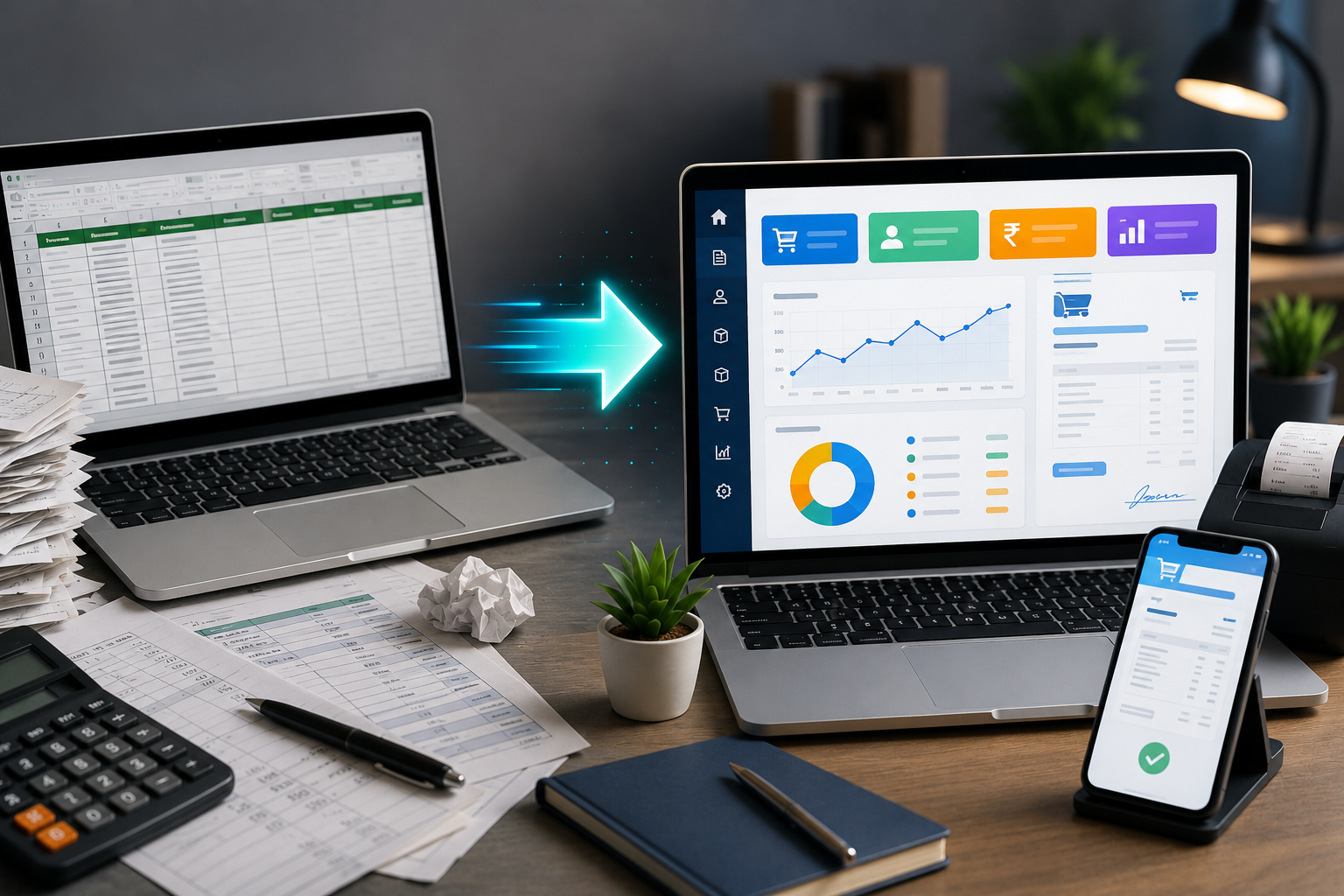
Moving away from Excel is not simply about using newer technology. It is about creating a more organized billing process.
A dedicated billing system can reduce repetitive work, connect different business functions, improve access to transaction information, and make it easier to monitor daily operations.
For businesses that are growing, these improvements can become increasingly valuable.
Final Thoughts
Excel can be a useful starting point for managing business records, but growing businesses often need more specialized tools.
As transaction volumes increase, maintaining invoices, customers, payments, inventory, taxes, discounts, and reports through spreadsheets can become increasingly difficult.
A dedicated billing system provides a more structured way to manage these activities in one place.
The Logic Waves Tech Billing System combines invoice management, customer management, inventory management, payment tracking, reports and analytics, tax and discount management, and data backup and security. It is designed for a range of businesses including retail shops, wholesalers and distributors, manufacturers, service providers, restaurants and cafés, pharmacies and clinics, and educational institutions.
For a growing business, the right billing software can turn billing from a spreadsheet-based task into a more organized and efficient business process.