Table of Contents
- WordPress vs. Custom PHP: Which Website Approach Fits Your Business?
- What Is WordPress?
- What Is Custom PHP Development?
- WordPress vs. Custom PHP: Key Differences
- When WordPress May Be a Good Choice
- Business Websites
- Blogs and Content Websites
- Small Business Websites
- E-Commerce Websites
- When Custom PHP May Be a Better Fit
- Complex Business Logic
- Custom ERP or CRM
- Unique Booking Systems
- Custom Dashboards
- Development Cost
- Performance Considerations
- Security Considerations
- Ease of Content Management
- Scalability
- Which One Should Your Business Choose?
- Choose WordPress when you need:
- Consider Custom PHP when you need:
- Can WordPress and Custom PHP Work Together?
- Questions to Ask Before Choosing
- Final Thoughts
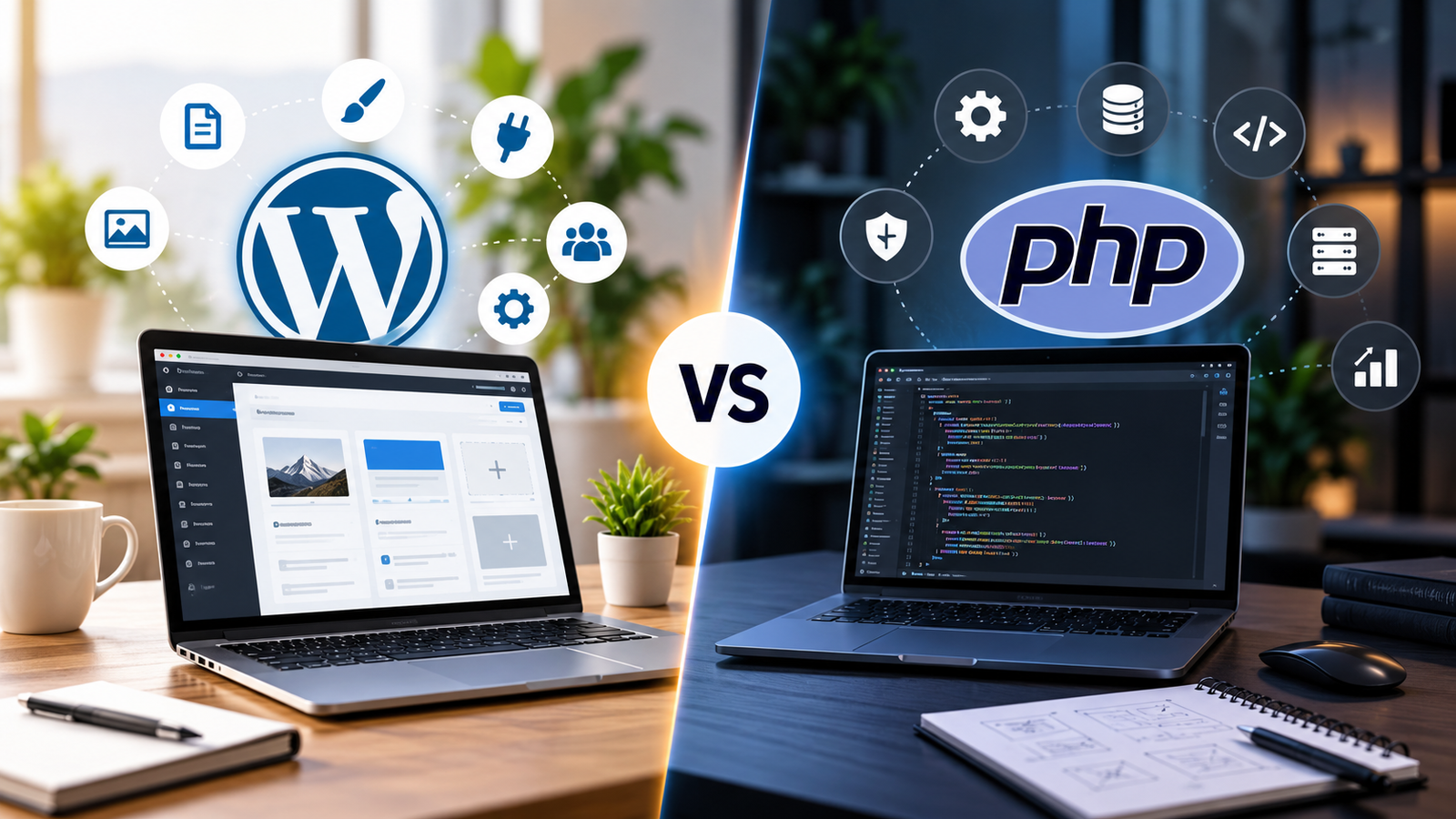
WordPress vs. Custom PHP: Which Website Approach Fits Your Business?
Choosing the right technology for a business website is an important decision. A website needs to do more than simply look good. It should be easy to manage, secure, scalable, fast, and capable of supporting the business as it grows.
Two common approaches for building websites are WordPress and custom PHP development. Both can be effective, but they are designed for different types of requirements.
WordPress provides a ready-made content management system with themes, plugins, and an administrative interface. Custom PHP development gives developers greater control over the website's functionality, database structure, user roles, and business logic.
Understanding the differences can help businesses choose an approach that matches their goals and budget.
What Is WordPress?
WordPress is an open-source content management system used to create websites, blogs, business websites, online stores, and many other types of digital platforms.
One of its biggest advantages is that businesses can manage website content through an administrative dashboard without needing to edit code for every change.
WordPress also has a large ecosystem of:
-
Themes
-
Plugins
-
Page builders
-
SEO tools
-
Security tools
-
E-commerce extensions
-
Forms and marketing integrations
This makes it possible to launch many types of websites relatively quickly.
What Is Custom PHP Development?
Custom PHP development involves building a website or web application specifically for a business using PHP and related technologies.
Instead of relying primarily on existing themes and plugins, developers can create the required functionality according to the project's specifications.
A custom PHP website can include:
-
Custom dashboards
-
User management
-
Business-specific workflows
-
Custom databases
-
Payment integrations
-
Booking systems
-
ERP modules
-
CRM functionality
-
Inventory management
-
Role-based access
-
Custom reports
This approach is particularly useful when a business requires functionality that does not fit neatly into an existing CMS structure.
WordPress vs. Custom PHP: Key Differences
| Feature | WordPress | Custom PHP |
|---|---|---|
| Development Speed | Usually faster | Depends on requirements |
| Initial Setup | Relatively simple | Requires development |
| Content Management | Built-in | Usually developed separately |
| Themes | Large selection | Fully custom |
| Plugins | Large ecosystem | Custom integrations |
| Custom Functionality | Possible with plugins/development | Highly flexible |
| Database Control | Structured around WordPress | Fully customizable |
| Maintenance | Updates required | Developer-managed |
| Scalability | Suitable for many websites | Highly customizable |
| Technical Knowledge | Lower for content management | Higher |
| Best For | Content-driven websites | Custom business applications |
When WordPress May Be a Good Choice
WordPress can be a practical option for businesses that need a professional website without extensive custom functionality.
Business Websites
Companies that primarily need pages such as:
-
Home
-
About
-
Services
-
Products
-
Portfolio
-
Blog
-
Contact
can often build and manage these efficiently with WordPress.
Blogs and Content Websites
WordPress was originally designed as a blogging platform and remains widely used for content publishing.
Businesses that regularly publish articles, news, guides, or resources can benefit from its content management features.
Small Business Websites
A small business may not need a complex custom application. WordPress can provide an affordable way to establish an online presence while allowing the business owner or staff to manage content.
E-Commerce Websites
With solutions such as WooCommerce, WordPress can also support online stores.
However, larger e-commerce operations may eventually require more specialized architecture depending on their traffic, integrations, inventory complexity, and business workflows.
When Custom PHP May Be a Better Fit
Custom PHP becomes more relevant when the website is actually a business application.
Complex Business Logic
If the website needs specialized calculations, approval processes, workflows, or user permissions, custom development can provide more control.
Custom ERP or CRM
Businesses requiring modules for employees, inventory, sales, finance, customers, or reporting may benefit from a custom application rather than trying to combine many plugins.
Unique Booking Systems
A business with specific booking rules may require a custom system.
For example, a rental business might need:
-
Vehicle availability
-
Location management
-
Booking schedules
-
Customer accounts
-
Owner accounts
-
Payments
-
Cancellation rules
-
KYC verification
Building these workflows specifically for the business can provide greater flexibility.
Custom Dashboards
A custom PHP application can provide dashboards designed around the exact metrics and workflows used by the organization.
Instead of adapting the business process to an existing plugin, the software can be developed around the actual business process.
Development Cost
Cost depends heavily on the project.
A basic WordPress website can often be launched with relatively limited development work. However, costs can increase when businesses require premium themes, plugins, custom development, integrations, or ongoing maintenance.
Custom PHP development usually requires more development time at the beginning because the system is built specifically for the business.
However, comparing only the initial development cost can be misleading.
Businesses should also consider:
-
Hosting
-
Plugin licenses
-
Maintenance
-
Security updates
-
Development changes
-
Third-party services
-
Future scalability
The right solution is the one that provides appropriate functionality without creating unnecessary long-term complexity.
Performance Considerations
Website performance depends on many factors, not simply whether a website uses WordPress or PHP.
A poorly optimized WordPress website with excessive plugins can become slow.
Likewise, poorly written custom PHP code can create performance problems.
Performance can be improved through:
-
Optimized images
-
Efficient database queries
-
Caching
-
Proper hosting
-
Minified resources
-
Optimized PHP code
-
Content delivery networks
-
Reduced third-party scripts
The quality of implementation matters significantly.
Security Considerations
Both approaches require proper security practices.
WordPress websites need regular updates for the WordPress core, themes, and plugins. Unnecessary or outdated plugins can increase security risks.
Custom PHP applications require developers to implement secure coding practices from the beginning.
Important areas include:
-
Input validation
-
Authentication
-
Authorization
-
Password protection
-
SQL injection prevention
-
Cross-site scripting protection
-
Secure file uploads
-
Session management
-
Regular backups
Security should be considered throughout development rather than added as an afterthought.
Ease of Content Management
This is one area where WordPress has a clear practical advantage for many content-focused websites.
Website administrators can generally:
-
Create pages
-
Publish blogs
-
Upload images
-
Manage menus
-
Edit content
-
Add categories
-
Manage media
through the WordPress dashboard.
A custom PHP website can also have an administration panel, but that panel normally needs to be developed according to the project's requirements.
Scalability
Both WordPress and custom PHP applications can scale, but scalability depends on architecture and implementation.
A well-configured WordPress website can handle substantial traffic with suitable hosting, caching, CDN configuration, and optimization.
Custom PHP applications can be designed around specific scaling requirements, including custom database structures, caching systems, APIs, background processes, and other architectural approaches.
The important question is not simply which technology scales better. It is whether the chosen architecture matches the expected growth and workload.
Which One Should Your Business Choose?
There is no single answer for every business.
Choose WordPress when you need:
-
A company website
-
A blog
-
A service website
-
A portfolio
-
A content-focused website
-
A relatively quick launch
-
Easy content management
-
Standard business functionality
Consider Custom PHP when you need:
-
ERP software
-
CRM systems
-
Custom dashboards
-
Complex booking systems
-
Specialized business workflows
-
Custom user roles
-
Advanced reporting
-
Unique database structures
-
Extensive third-party integrations
Can WordPress and Custom PHP Work Together?
Yes.
A business does not always need to choose one technology for everything.
For example, a company might use WordPress for its public-facing website and a separate custom PHP application for internal operations.
The public website could handle:
Content → SEO → Marketing → Lead Generation
while the custom application could handle:
Customers → Orders → Inventory → Employees → Reports
These systems can communicate through APIs when required.
This approach can allow businesses to use the strengths of different technologies for different purposes.
Questions to Ask Before Choosing
Before starting development, businesses should consider:
-
What is the primary purpose of the website?
-
Who will manage the content?
-
Does the website require custom workflows?
-
Will customers need user accounts?
-
Are there complex payment or booking requirements?
-
Does the business need an ERP or CRM?
-
How much customization will be required?
-
What is the expected traffic?
-
What integrations will be needed?
-
Who will maintain the system after launch?
Answering these questions can make the technology decision much clearer.
Final Thoughts
WordPress and custom PHP are both useful approaches, but they solve different types of problems.
WordPress is often suitable for businesses that need a content-driven website with an easy-to-use management system. Custom PHP is more suitable when a business requires specialized functionality, complex workflows, custom dashboards, or software built around its specific operations.
The goal should not be to choose the technology that sounds more advanced. The goal is to choose the technology that fits the business requirements, budget, workflow, scalability needs, and long-term plans.
A well-planned WordPress website can be highly effective, while a well-developed custom PHP application can provide extensive flexibility. The right choice depends on what the business actually needs from its website or web application.