
How School Management Software Helps Schools Manage 1,000+ Students Efficiently

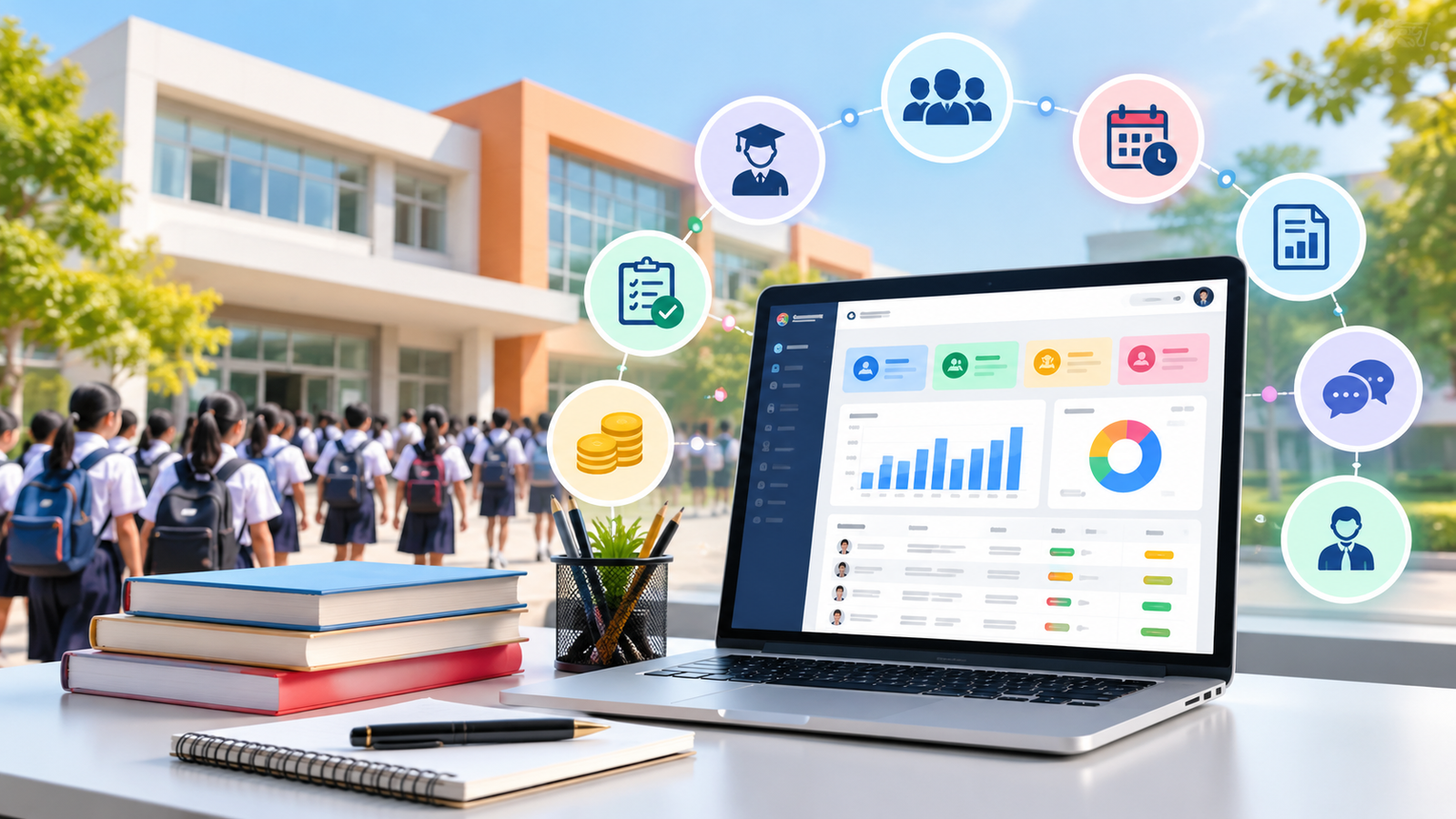
Managing a school with more than 1,000 students involves much more than classroom teaching. School administrators must handle admissions, attendance, examinations, fee collection, staff records, parent communication, and student performance. When these tasks are managed manually, they can consume valuable time, increase paperwork, and lead to errors.
This is where school management software becomes an essential tool. It helps schools organize daily operations, centralize student information, automate repetitive administrative tasks, and improve communication between teachers, parents, and school management.
In this article, we will explore how school management software helps schools manage 1,000+ students efficiently and create a more organized learning environment.
1. Centralized Student Information Management
Maintaining accurate records for more than 1,000 students can be challenging when information is stored in registers, spreadsheets, and separate files.
School management software provides a centralized database where administrators can maintain student details, admission records, class assignments, parent contact information, academic history, and other important documents.
With a centralized system, authorized staff can access the information they need without searching through multiple files. It also becomes easier to update records and reduce duplicate entries.
Key benefits:
-
Easy access to student records.
-
Faster admission and registration processes.
-
Reduced paperwork and manual data entry.
-
Better organization of academic and personal information.
2. Automated Attendance Tracking
Taking attendance manually across multiple classes every day can become time-consuming, particularly in large schools.
School management software allows teachers to record attendance digitally. Depending on the system, attendance can also be integrated with biometric devices, RFID cards, or other supported technologies.
Administrators can view attendance reports by student, class, or date. The system can also help schools identify frequent absences and notify parents when suitable notification features are available.
This makes attendance monitoring faster, more accurate, and easier to manage across the entire school.
3. Simplified Fee Management and Payment Tracking
Fee collection is one of the most important administrative responsibilities for schools with large student populations. Managing tuition fees, transport charges, examination fees, late fees, and outstanding balances manually can lead to confusion.
A school management system helps automate fee calculations, generate receipts, maintain payment histories, and track pending dues.
If online payment integration is available, parents can pay fees digitally without visiting the school office. Administrators can also generate reports to understand total collections, outstanding payments, and fee-related transactions.
How it helps:
-
Reduces manual accounting work.
-
Makes fee records easier to maintain.
-
Helps identify outstanding payments.
-
Improves transparency in financial reporting.
-
Saves time for administrative and accounts staff.
4. Better Timetable and Classroom Management
Creating timetables for multiple classes, subjects, and teachers requires careful coordination. Manual scheduling can result in overlapping classes, teacher conflicts, or inefficient classroom allocation.
School management software can help administrators create and manage timetables based on teacher availability, subject requirements, classroom capacity, and school schedules.
When changes are required, authorized staff can update the timetable and communicate the changes more efficiently.
This is especially useful for schools with multiple sections, laboratories, activity rooms, and shared teaching resources.
5. Efficient Examination and Result Management
Examinations involve several activities, including scheduling exams, recording marks, calculating results, preparing report cards, and tracking academic progress.
School management software brings these tasks into one organized system. Teachers can enter marks, while the software can calculate totals, percentages, grades, and other results according to the school's configured rules.
The system can also generate report cards and academic performance reports, depending on its features.
This reduces repetitive calculations and helps teachers and administrators identify students who may need additional academic support.
6. Improved Communication Between Schools and Parents
Parents want timely updates about their children's attendance, academic progress, examination schedules, fee payments, and school activities.
Without a centralized communication system, schools may depend on paper notices, phone calls, or individual messaging groups. Important information can easily be missed.
School management software can provide parent portals, SMS notifications, email alerts, app notifications, or other communication options, depending on the selected plan.
Parents can receive relevant updates without having to contact the school office for every enquiry.
Better communication also builds trust between parents and school management.
7. Simplified Teacher and Staff Management
A school with 1,000+ students often has a substantial teaching and administrative team. Managing employee records, attendance, assigned subjects, leave requests, and payroll information can become complicated.
A school management system can maintain staff profiles, organize responsibilities, record attendance, and support leave and payroll workflows when those modules are included.
This allows school administrators to manage staff information more consistently and spend less time maintaining separate registers.
8. Real-Time Reports and Better Decision-Making
School management is more effective when administrators have access to accurate and timely information.
Instead of preparing reports manually from multiple registers, school management software can generate reports on student attendance, fee collection, academic results, admissions, class strength, and other operational activities.
For example, the principal can review attendance trends, the accounts department can check pending fees, and class coordinators can monitor academic performance.
These reports help management identify problems early and make decisions based on available data.
9. Improved Data Security and Record Accessibility
Student records contain important personal and academic information. Keeping these records in unsecured files or scattered spreadsheets can make them difficult to protect and maintain.
A well-designed school management system can provide role-based access, secure authentication, data backups, and activity logs where supported.
For example, teachers may access the records of their assigned classes, while accounts staff can manage fee-related information. Administrators can receive broader access according to their responsibilities.
Schools should also evaluate backup procedures, data privacy practices, recovery options, and security controls before choosing a software provider.
10. Scalability as the School Grows
A school that manages 1,000 students today may expand to 1,500 or 2,000 students in the future. A manual process that works for a small institution may become inefficient as student numbers increase.
School management software helps schools manage growing volumes of student records, attendance entries, fee transactions, examinations, and communication.
A scalable solution can also support additional classes, branches, departments, and users, depending on its design and licensing plan.
Choosing software that can grow with the institution helps reduce the need to replace systems as administrative requirements increase.
11. Reduced Administrative Work and Operating Costs
Manual school administration requires substantial time for data entry, report preparation, document handling, fee reconciliation, and record verification.
Automating these repetitive tasks can free staff to focus on more important responsibilities, such as student support, parent communication, academic planning, and school development.
Although software requires an initial investment and ongoing maintenance, schools should evaluate the potential savings in staff time, printing, paperwork, and administrative effort when assessing its overall value.
The actual savings depend on the school's existing processes, the features implemented, and how effectively staff use the system.
12. How to Choose the Right School Management Software for 1,000+ Students
Not every school management system offers the same capabilities. Before selecting a solution, school management should evaluate its requirements carefully.
Consider the following factors:
-
Student capacity: Ensure the software can comfortably support the school's current and expected student population.
-
Essential modules: Look for admissions, attendance, fees, examinations, timetable management, and reporting.
-
User access: Check whether separate permissions are available for administrators, teachers, accounts staff, students, and parents.
-
Ease of use: Choose a system that staff can learn and use without unnecessary complexity.
-
Data security: Review access controls, backup policies, and data protection measures.
-
Support and maintenance: Confirm how technical issues, updates, training, and system maintenance will be handled.
-
Customization: Check whether the system can accommodate the school's fee structure, grading methods, academic calendar, and operational requirements.
-
Pricing: Compare setup charges, annual or monthly subscription fees, maintenance costs, and additional module charges.
A demonstration using the school's actual workflows can help management understand whether the software meets its requirements.
Conclusion
Managing more than 1,000 students efficiently requires accurate records, organized administrative processes, reliable communication, and timely reporting. School management software brings these functions together in one system, helping schools reduce manual work and manage their daily operations more effectively.
From attendance tracking and fee collection to examinations, staff management, and parent communication, the right software can help create a more structured and transparent school environment.
For schools planning to expand or modernize their operations, investing in a suitable school management system is a practical step toward better administrative efficiency and long-term growth.
Looking for a school management solution for your institution? Choose a system that fits your school's requirements, supports future growth, and provides dependable technical support.
Want this for your business?
Talk to our team — free consultation, clear advice.