Table of Contents
- 7 Signs Your Business Has Outgrown Manual Billing
- 1. Your Billing Process Is Taking Too Much Time
- 2. Billing Errors Are Becoming More Common
- 3. Finding Old Invoices Has Become Difficult
- 4. You Are Struggling to Track Customer Payments
- 5. Your Stock Records Do Not Match Your Actual Stock
- 6. Preparing Business Reports Takes Hours
- 7. Your Business Is Growing, but Your Billing Process Has Not
- What Changes After Moving to a Digital Billing System?
- How to Know If It Is Time to Switch
- Final Thoughts
7 Signs Your Business Has Outgrown Manual Billing
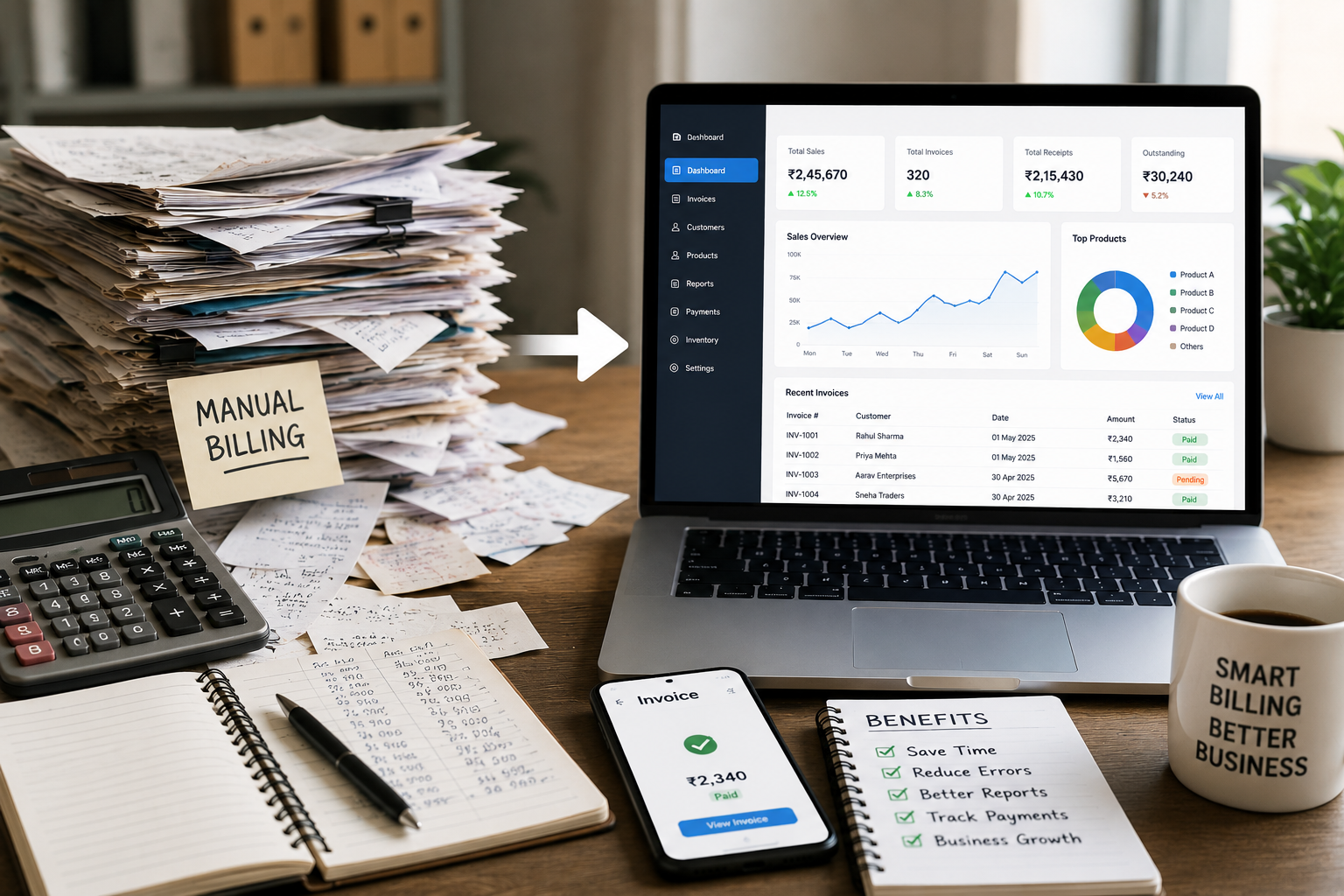
Manual billing may be sufficient when a business is small and handles only a few transactions each day. A simple notebook, spreadsheet, calculator, or handwritten invoice can seem convenient in the beginning.
But as sales increase, customers grow, products become more numerous, and employees become involved in billing, the same manual process can start creating delays and errors. Research and industry guidance also point to increasing transaction volume, hiring, record management, and operational complexity as common reasons businesses move toward digital invoicing and billing systems.
The important question is not whether manual billing is bad. It is whether it is still suitable for the current size and requirements of your business.
Here are seven signs that your business may have outgrown manual billing.
1. Your Billing Process Is Taking Too Much Time
One of the first signs is that employees are spending a significant part of their working day creating bills, calculating totals, entering product details, and checking invoices.
When every invoice has to be prepared manually, the time required increases with every transaction. During busy hours, this can result in slower service and longer customer waiting times.
A digital billing system can store product information, prices, customer details, taxes, and other billing information so that invoices can be generated more efficiently.
For a growing business, saving a few minutes on each transaction can make a noticeable difference over an entire working day.
2. Billing Errors Are Becoming More Common
Manual calculations create opportunities for mistakes.
Common problems may include:
-
Incorrect quantities
-
Wrong product prices
-
Calculation mistakes
-
Incorrect discounts
-
Tax calculation errors
-
Duplicate or missing invoice information
-
Incorrect customer details
As the number of transactions increases, checking every invoice manually becomes more difficult.
Automated billing can reduce repetitive calculations and standardize the way invoices are created. Modern billing systems can also handle tax and discount information more consistently.
3. Finding Old Invoices Has Become Difficult
Think about a customer asking for an invoice from several months ago.
If your records are stored in multiple registers, files, spreadsheets, or folders, finding the correct document can take valuable time. Paper records can also become difficult to organize as the number of transactions increases.
An organized digital billing system allows businesses to maintain transaction records in one place. Instead of searching through stacks of documents, staff can use the system to locate relevant billing information more efficiently.
This is particularly useful for businesses that regularly need to review previous transactions or respond to customer queries.
4. You Are Struggling to Track Customer Payments
Creating an invoice is only one part of the billing process. Businesses also need to know whether customers have paid, how much is outstanding, and which payments are still pending.
When payment records are maintained manually, it can become difficult to keep information updated, particularly when the business has many customers or allows credit transactions.
A billing system with payment tracking can help maintain payment records and outstanding amounts alongside customer information.
This gives business owners a clearer view of their transactions and reduces dependence on separate notebooks or spreadsheets.
5. Your Stock Records Do Not Match Your Actual Stock
Another major warning sign is when the quantity shown in your records does not match the physical stock available in your business.
If billing and inventory are maintained separately, employees may have to update stock records manually after every sale. Missed entries, returns, damaged products, or incorrect quantities can gradually create differences.
An integrated billing and inventory system can connect sales with stock management. When a product is sold, the corresponding stock information can be updated as part of the billing process.
This is especially useful for retail stores, wholesalers, distributors, pharmacies, manufacturers, restaurants, and other businesses that handle regular product transactions.
6. Preparing Business Reports Takes Hours
A growing business needs more than individual invoices. Owners need to understand what is happening across the business.
For example:
-
How much did we sell today?
-
Which products are selling the most?
-
What are our monthly sales?
-
How much has been collected?
-
Which customers have outstanding payments?
-
What products need attention?
-
How are sales changing over time?
With manual records, answering these questions may require collecting information from multiple sources and calculating the results separately.
A digital billing system can make reporting more convenient by organizing transaction information and generating reports from stored data. Reports and analytics are among the key capabilities highlighted in the Logic Waves Tech Billing System, along with invoice, customer, inventory, and payment management.
7. Your Business Is Growing, but Your Billing Process Has Not
Perhaps the biggest sign is simple: your business has grown, but your billing process is still the same one you used when you started.
You may now have:
-
More customers
-
More products
-
More daily transactions
-
More employees
-
Multiple types of business operations
-
Higher sales volume
-
More payment transactions
-
Greater reporting requirements
A process that worked for 10 transactions a day may become difficult to manage when the business handles hundreds.
This does not mean every small business needs complicated software immediately. The right time to upgrade depends on transaction volume, operational complexity, staff requirements, and how much visibility the owner needs.
What Changes After Moving to a Digital Billing System?
Moving from manual billing to a dedicated billing system can help bring several daily activities together.
Instead of maintaining separate records for different processes, businesses can manage important information through a centralized system.
The Logic Waves Tech Billing System is designed around several connected functions, including:
-
Invoice Management
-
Customer Management
-
Inventory Management
-
Payment Tracking
-
Reports and Analytics
-
Tax and Discount Management
-
Data Backup and Security
The system is also positioned for different types of businesses, including retail shops, wholesalers and distributors, manufacturers, service providers, restaurants and cafés, pharmacies and clinics, and educational institutions.
How to Know If It Is Time to Switch
You do not need to wait until manual billing becomes a serious problem.
If your team is regularly spending too much time creating invoices, correcting errors, searching for records, checking stock, tracking payments, or preparing reports, it may be time to consider a digital billing solution.
The goal is not simply to replace a paper invoice with a digital invoice. A good billing system should help bring different parts of your daily business operations into a more organized workflow.
Final Thoughts
Manual billing can work well during the early stages of a business. However, growth brings more transactions, customers, products, payments, and records to manage.
If billing is becoming slower, errors are increasing, records are difficult to find, stock information is unreliable, or reports take too much time to prepare, these are strong indications that your business has outgrown its current billing process.
Moving to a suitable billing system can help businesses manage invoices, customers, inventory, payments, taxes, discounts, and reports in a more organized way.
If your business is growing, your billing system should grow with it.
For businesses looking for an all-in-one billing solution, Logic Waves Tech Billing System provides tools designed to simplify billing and support day-to-day business management.