Table of Contents
- How ERP Improves Inventory Management for Businesses
- Introduction
- What Is ERP Inventory Management?
- Real-Time Inventory Tracking
- Reduces Stockouts and Overstocking
- Automated Inventory Updates
- Better Demand Forecasting
- Improved Warehouse Management
- Faster Order Processing
- Improved Purchasing Decisions
- Multi-Location Inventory Management
- Better Inventory Reporting
- Reduced Operational Costs
- Enhanced Customer Satisfaction
- Improved Business Decision-Making
- Best Practices for ERP Inventory Management
- Benefits of ERP Inventory Management
- Conclusion
How ERP Improves Inventory Management for Businesses
Introduction
Efficient inventory management is essential for businesses that deal with physical products. Whether you're a manufacturer, retailer, wholesaler, or distributor, keeping the right amount of stock at the right time can significantly impact profitability and customer satisfaction. Managing inventory manually or using disconnected systems often leads to stock shortages, overstocking, inaccurate records, and operational inefficiencies.
Enterprise Resource Planning (ERP) software helps businesses overcome these challenges by integrating inventory management with purchasing, sales, finance, and warehouse operations. With real-time data and automated processes, ERP enables businesses to manage inventory more accurately and efficiently.
What Is ERP Inventory Management?
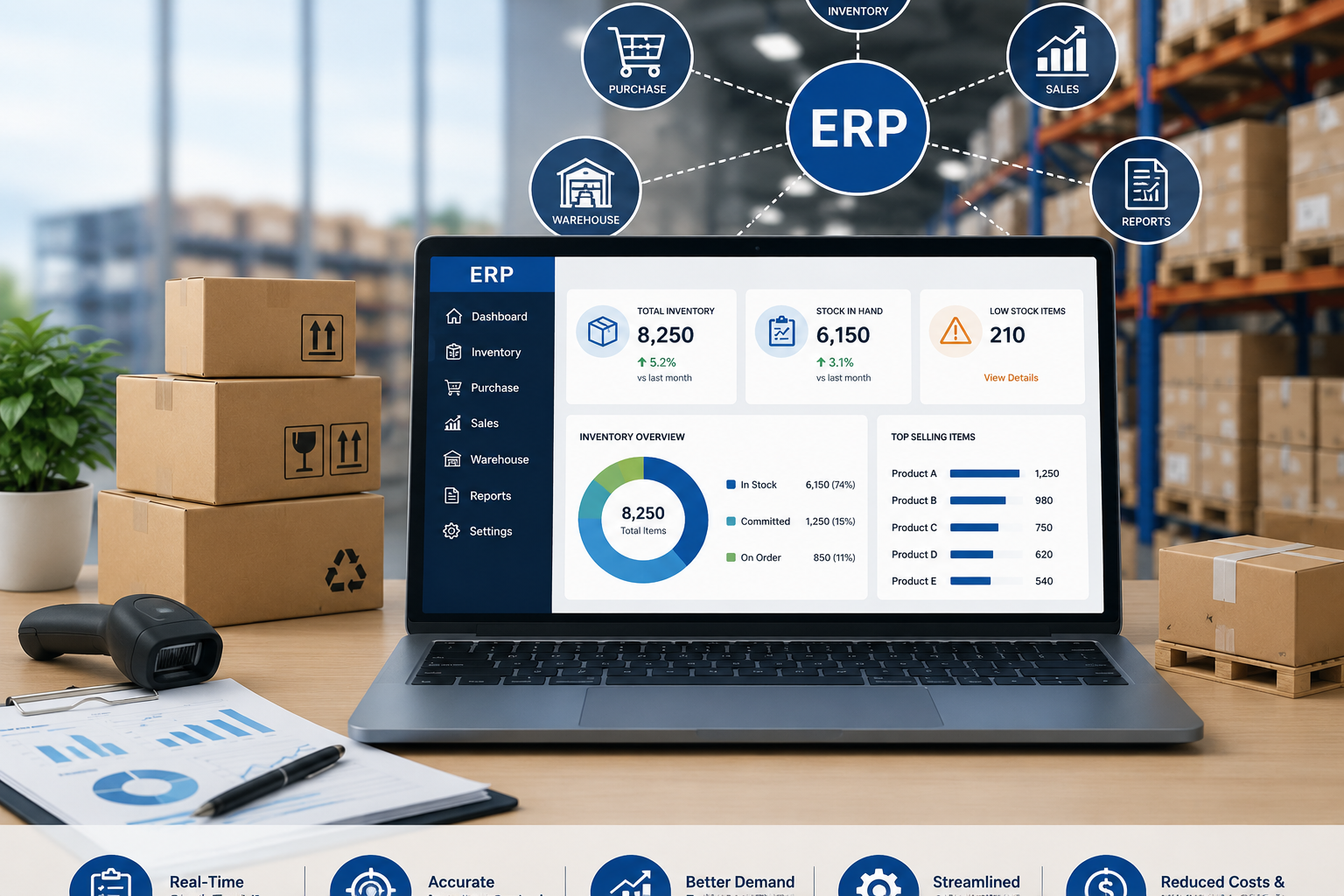
ERP inventory management is a feature within an Enterprise Resource Planning system that helps businesses monitor, control, and optimize inventory throughout the supply chain. Instead of using separate tools for inventory, purchasing, and sales, ERP combines all inventory-related information into one centralized platform.
This integration ensures that inventory data is updated automatically whenever products are purchased, sold, returned, or transferred between locations.
Real-Time Inventory Tracking
One of the biggest advantages of ERP is real-time inventory visibility. Every inventory movement is recorded instantly, allowing businesses to know exactly how much stock is available at any given time.
Real-time tracking helps businesses:
-
Monitor current stock levels.
-
Track inventory across multiple warehouses.
-
Identify fast-moving and slow-moving products.
-
Reduce inventory discrepancies.
-
Improve stock accuracy.
Having accurate inventory information allows businesses to respond quickly to customer demands.
Reduces Stockouts and Overstocking
Poor inventory management often results in either too little stock or too much inventory.
ERP software helps businesses maintain optimal inventory levels by:
-
Monitoring stock availability.
-
Setting minimum and maximum stock levels.
-
Generating automatic reorder alerts.
-
Forecasting future demand.
This helps prevent lost sales caused by stock shortages while reducing the costs associated with excess inventory.
Automated Inventory Updates
Manual inventory updates can be slow and prone to errors. ERP software automatically updates inventory whenever transactions occur, including:
-
Sales orders
-
Purchase orders
-
Goods received
-
Product returns
-
Warehouse transfers
-
Manufacturing consumption
Automation minimizes manual data entry, reduces human errors, and ensures inventory records remain accurate.
Better Demand Forecasting
ERP systems use historical sales data, purchasing trends, and seasonal patterns to forecast future inventory requirements.
Accurate demand forecasting enables businesses to:
-
Prepare for seasonal demand.
-
Reduce unnecessary inventory.
-
Improve purchasing decisions.
-
Minimize waste.
-
Increase customer satisfaction.
Better forecasting allows businesses to plan inventory more efficiently.
Improved Warehouse Management
Many ERP systems include warehouse management features that improve storage and inventory movement.
These features may include:
-
Warehouse location tracking.
-
Barcode scanning.
-
Batch and serial number tracking.
-
Stock transfers.
-
Picking and packing management.
-
Inventory audits.
Organized warehouse operations help reduce delays and improve order accuracy.
Faster Order Processing
ERP integrates inventory with sales and order management. As soon as a customer places an order, the system checks inventory availability automatically.
This integration helps businesses:
-
Confirm product availability instantly.
-
Process orders faster.
-
Reduce shipping delays.
-
Improve customer satisfaction.
-
Minimize manual coordination between departments.
Faster order fulfillment strengthens customer trust and loyalty.
Improved Purchasing Decisions
ERP provides purchasing teams with real-time inventory information and supplier data.
Businesses can:
-
Create purchase orders automatically.
-
Monitor supplier performance.
-
Track delivery schedules.
-
Avoid unnecessary purchases.
-
Maintain optimal stock levels.
Smarter purchasing decisions help reduce costs and improve inventory efficiency.
Multi-Location Inventory Management
Businesses operating from multiple warehouses or retail locations often face inventory visibility challenges.
ERP software allows organizations to:
-
Track inventory across multiple locations.
-
Transfer stock between warehouses.
-
Monitor branch-level inventory.
-
Consolidate inventory reports.
-
Optimize product distribution.
This centralized visibility improves operational efficiency across the organization.
Better Inventory Reporting
ERP systems generate detailed inventory reports that help management understand inventory performance.
Common reports include:
-
Stock availability reports.
-
Inventory valuation.
-
Fast-moving products.
-
Slow-moving inventory.
-
Dead stock analysis.
-
Purchase history.
-
Sales trends.
These reports help businesses make informed inventory decisions and improve profitability.
Reduced Operational Costs
Efficient inventory management helps businesses reduce unnecessary expenses by:
-
Minimizing excess inventory.
-
Reducing storage costs.
-
Preventing product shortages.
-
Lowering manual labor.
-
Improving warehouse efficiency.
Lower operating costs contribute to higher profit margins.
Enhanced Customer Satisfaction
Customers expect products to be available and delivered on time. ERP helps businesses meet these expectations by ensuring accurate inventory information and faster order processing.
Benefits include:
-
Fewer order cancellations.
-
Faster deliveries.
-
Improved product availability.
-
Better customer experience.
-
Increased customer loyalty.
Reliable inventory management directly supports stronger customer relationships.
Improved Business Decision-Making
ERP provides managers with real-time inventory dashboards and performance reports that support informed decision-making.
Business leaders can:
-
Identify inventory trends.
-
Monitor stock turnover.
-
Plan purchasing strategies.
-
Reduce inventory risks.
-
Improve profitability.
Accurate information enables smarter business decisions based on real data rather than assumptions.
Best Practices for ERP Inventory Management
To maximize the benefits of ERP inventory management, businesses should:
-
Keep inventory records updated regularly.
-
Train employees on ERP processes.
-
Conduct routine inventory audits.
-
Use barcode or QR code scanning.
-
Set appropriate reorder levels.
-
Monitor inventory reports frequently.
-
Integrate inventory with purchasing, sales, and finance.
-
Review demand forecasts regularly.
Following these best practices helps businesses maintain accurate inventory and improve operational efficiency.
Benefits of ERP Inventory Management
Businesses that implement ERP inventory management often experience:
-
Real-time inventory visibility.
-
Improved stock accuracy.
-
Reduced stockouts and overstocking.
-
Faster order fulfillment.
-
Better warehouse organization.
-
Improved purchasing efficiency.
-
Lower inventory costs.
-
Better demand forecasting.
-
Enhanced customer satisfaction.
-
Smarter business decisions.
These advantages help businesses operate more efficiently while supporting long-term growth.
Conclusion
Inventory management plays a critical role in business success, and ERP software provides the tools needed to manage inventory efficiently. By automating inventory processes, improving stock visibility, integrating business operations, and providing real-time insights, ERP helps businesses reduce costs, improve customer satisfaction, and make better decisions.
As businesses continue to grow and supply chains become more complex, implementing an ERP system for inventory management can provide a significant competitive advantage. Investing in the right ERP solution enables organizations to streamline operations, optimize inventory levels, and build a stronger foundation for sustainable business growth.