Table of Contents
- The Role of ERP in Financial Management and Accounting
- Introduction
- What Is ERP in Financial Management?
- Centralized Financial Data
- Automated Accounting Processes
- Real-Time Financial Reporting
- Better Budget Planning
- Improved Cash Flow Management
- Regulatory Compliance
- Enhanced Financial Security
- Better Decision-Making
- Integration with Other Business Functions
- Scalability for Growing Businesses
- Benefits of ERP in Financial Management
- Best Practices for ERP Financial Management
- Conclusion
The Role of ERP in Financial Management and Accounting
Introduction
In today's competitive business environment, managing finances accurately and efficiently is essential for long-term success. As businesses grow, handling accounting tasks through spreadsheets or separate software systems can become time-consuming and prone to errors. This is where Enterprise Resource Planning (ERP) software plays a vital role.
An ERP system integrates financial management and accounting with other business functions such as inventory, sales, purchasing, human resources, and customer management. By bringing all business data into one centralized platform, ERP helps organizations improve financial accuracy, streamline operations, and make informed business decisions.
What Is ERP in Financial Management?
Enterprise Resource Planning (ERP) is a software solution that connects different business departments into a single system. In financial management, ERP automates accounting processes, records financial transactions, generates reports, and provides real-time visibility into a company's financial performance.
Instead of managing separate databases for different departments, ERP ensures that financial information is updated automatically whenever business activities occur.
Centralized Financial Data
One of the biggest advantages of ERP is centralized financial data. Every transaction—from sales and purchases to payroll and inventory updates—is recorded in one integrated system.
This centralized approach helps businesses:
-
Eliminate duplicate data entry.
-
Reduce accounting errors.
-
Improve data consistency.
-
Access financial information from a single platform.
-
Improve collaboration between departments.
Having one reliable source of financial data makes reporting faster and more accurate.
Automated Accounting Processes
Manual accounting tasks often require significant time and effort. ERP software automates many routine accounting activities, including:
-
Recording financial transactions
-
Managing accounts payable
-
Managing accounts receivable
-
Processing invoices
-
Bank reconciliation
-
Tax calculations
-
Journal entries
-
Payroll integration
Automation reduces repetitive work, minimizes human error, and allows finance teams to focus on strategic planning.
Real-Time Financial Reporting
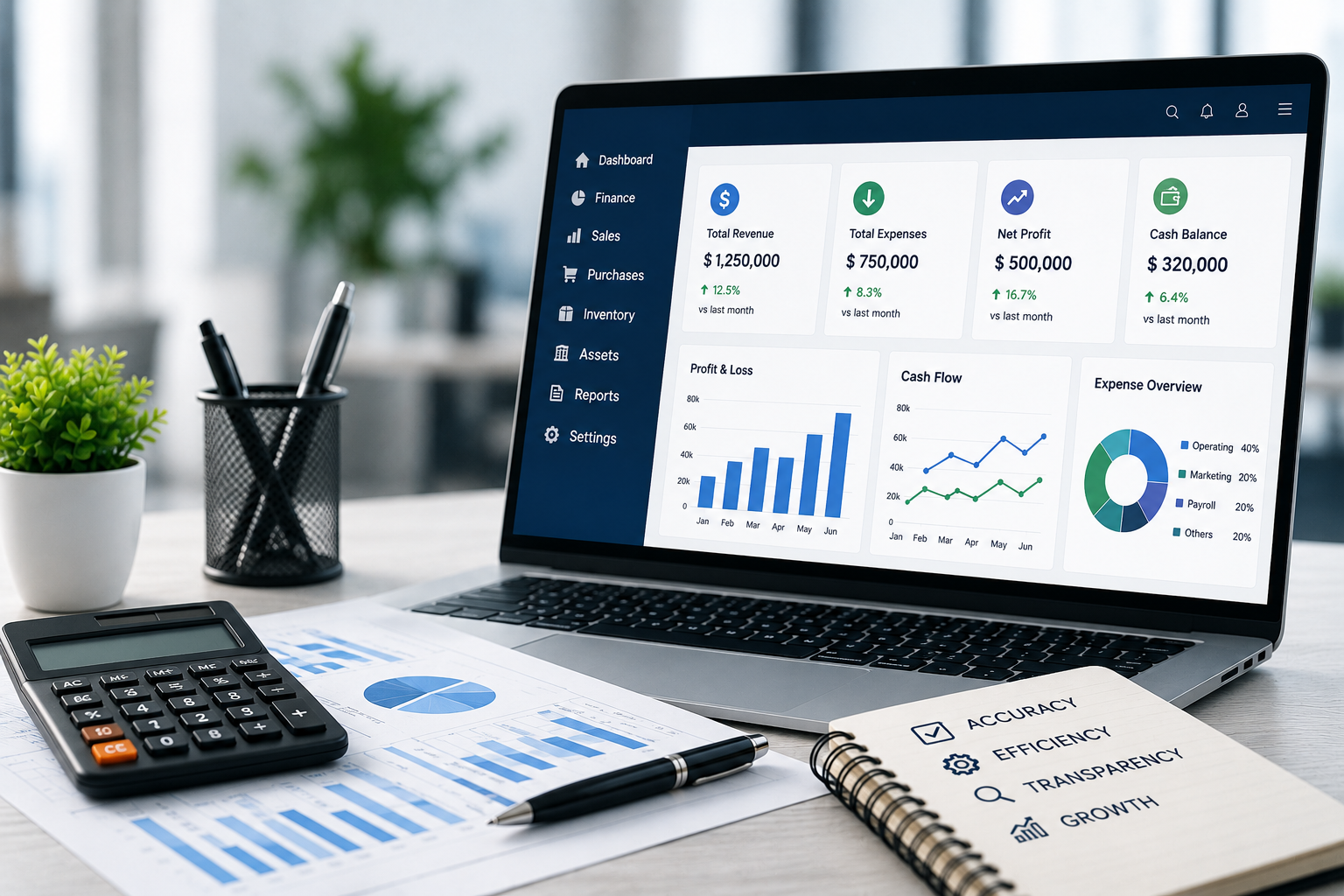
Traditional financial reporting often relies on manually collecting data from multiple systems. ERP provides real-time financial reports that help management understand the company's current financial position.
Common reports include:
-
Profit and loss statements
-
Balance sheets
-
Cash flow reports
-
Budget analysis
-
Revenue reports
-
Expense tracking
-
Financial performance dashboards
Real-time reporting enables faster and more confident decision-making.
Better Budget Planning
ERP software helps businesses create, monitor, and manage budgets more effectively. Managers can compare actual expenses with planned budgets and identify areas where spending exceeds expectations.
This allows organizations to:
-
Improve financial planning.
-
Control operational costs.
-
Allocate resources more efficiently.
-
Make informed investment decisions.
Accurate budgeting contributes to stronger financial stability.
Improved Cash Flow Management
Healthy cash flow is essential for business success. ERP systems help organizations monitor incoming and outgoing payments in real time.
Businesses can:
-
Track customer payments.
-
Monitor supplier invoices.
-
Schedule payment reminders.
-
Analyze cash flow trends.
-
Forecast future cash requirements.
Improved cash flow visibility helps businesses avoid financial shortages and maintain smoother operations.
Regulatory Compliance
Businesses must comply with accounting standards, tax regulations, and financial reporting requirements. ERP systems help maintain compliance by automatically recording transactions and generating standardized reports.
Many ERP solutions also maintain audit trails that record every financial activity, making audits simpler and more transparent.
Compliance features help reduce the risk of financial errors and regulatory penalties.
Enhanced Financial Security
Financial information is one of the most valuable assets of any organization. ERP systems include security features that protect sensitive financial data.
These may include:
-
User role-based access
-
Multi-level approvals
-
Data encryption
-
Audit logs
-
Backup and recovery options
These features help ensure that only authorized personnel can access confidential financial information.
Better Decision-Making
ERP provides business leaders with accurate and up-to-date financial information. Instead of relying on outdated reports, managers can make decisions based on real-time insights.
With reliable financial data, businesses can:
-
Identify profitable products and services.
-
Reduce unnecessary expenses.
-
Monitor business performance.
-
Plan future investments.
-
Respond quickly to market changes.
Data-driven decisions improve both efficiency and profitability.
Integration with Other Business Functions
One of ERP's greatest strengths is its ability to integrate accounting with other departments.
For example:
-
Sales automatically update revenue records.
-
Inventory updates affect inventory valuation.
-
Purchasing records supplier expenses.
-
Payroll integrates employee salary information.
-
Customer orders generate invoices automatically.
This integration eliminates duplicate work and ensures financial data remains accurate across the organization.
Scalability for Growing Businesses
As businesses expand, their financial operations become more complex. ERP systems are designed to grow alongside the business.
Whether opening new branches, managing multiple locations, or handling larger transaction volumes, ERP software can support increasing business requirements without disrupting financial operations.
This flexibility makes ERP a valuable long-term investment.
Benefits of ERP in Financial Management
Businesses using ERP systems often experience several key advantages:
-
Improved financial accuracy
-
Faster accounting processes
-
Real-time financial insights
-
Better budgeting and forecasting
-
Stronger cash flow management
-
Reduced operational costs
-
Improved regulatory compliance
-
Enhanced data security
-
Better decision-making
-
Increased business efficiency
These benefits contribute to stronger financial control and sustainable business growth.
Best Practices for ERP Financial Management
To maximize the value of an ERP system, businesses should:
-
Define clear financial objectives before implementation.
-
Keep financial records updated regularly.
-
Train employees on ERP features and processes.
-
Use role-based permissions to protect sensitive data.
-
Regularly review financial reports and dashboards.
-
Integrate ERP with all relevant business departments.
-
Keep the ERP system updated with the latest features and security improvements.
Following these practices helps organizations achieve the best return on their ERP investment.
Conclusion
ERP software has transformed financial management and accounting by providing businesses with centralized data, automated processes, real-time reporting, and better financial control. It enables organizations to improve accuracy, reduce manual work, strengthen compliance, and make smarter business decisions.
As businesses continue to embrace digital transformation, ERP systems have become an essential tool for managing financial operations efficiently. Investing in the right ERP solution can help businesses streamline accounting processes, improve productivity, and build a strong foundation for long-term success.