Table of Contents
- How Predictive Analytics Can Improve Business Decision-Making
- What Is Predictive Analytics?
- Why Predictive Analytics Matters for Businesses
- 1. Better Sales Forecasting
- 2. Improved Customer Understanding
- 3. Customer Churn Prediction
- 4. Smarter Inventory Management
- 5. More Effective Marketing
- 6. Identifying Potential Business Risks
- 7. Improving Financial Planning
- 8. Supporting Dynamic Pricing
- 9. Optimizing Business Operations
- 10. Predictive Maintenance
- How Predictive Analytics Works
- Step 1: Collect Data
- Step 2: Prepare the Data
- Step 3: Identify Relevant Patterns
- Step 4: Build a Predictive Model
- Step 5: Test the Model
- Step 6: Generate Predictions
- Step 7: Use Insights in Business Decisions
- Predictive Analytics and Artificial Intelligence
- Benefits of Predictive Analytics
- More Informed Decisions
- Improved Planning
- Reduced Risk
- Better Customer Experiences
- Greater Operational Efficiency
- Competitive Advantage
- Challenges Businesses Should Consider
- Data Quality
- Privacy
- Model Bias
- Overreliance on Predictions
- Implementation Costs
- Best Practices for Businesses
- Start With a Clear Business Problem
- Use Relevant Data
- Monitor Model Performance
- Combine Predictions With Human Expertise
- The Future of Predictive Analytics
- Final Thoughts
How Predictive Analytics Can Improve Business Decision-Making
Businesses today generate enormous amounts of data from websites, applications, sales systems, customer interactions, financial platforms, and operational processes. The challenge is no longer simply collecting information—it is understanding what that information can reveal about the future.
Predictive analytics helps businesses analyze historical and current data to identify patterns, estimate future outcomes, and make more informed decisions. Instead of relying entirely on assumptions or intuition, organizations can use data-driven predictions to prepare for potential opportunities and risks.
From forecasting sales to predicting customer behavior and identifying operational problems, predictive analytics is becoming an important tool for modern businesses.
What Is Predictive Analytics?
Predictive analytics is a data-analysis approach that uses historical data, statistical techniques, and machine learning models to estimate what may happen in the future.
For example, an e-commerce business could analyze:
- Previous purchases
- Product searches
- Seasonal trends
- Customer demographics
- Website activity
- Marketing interactions
The business could then use these patterns to estimate which products may experience increased demand.
A simplified process looks like:
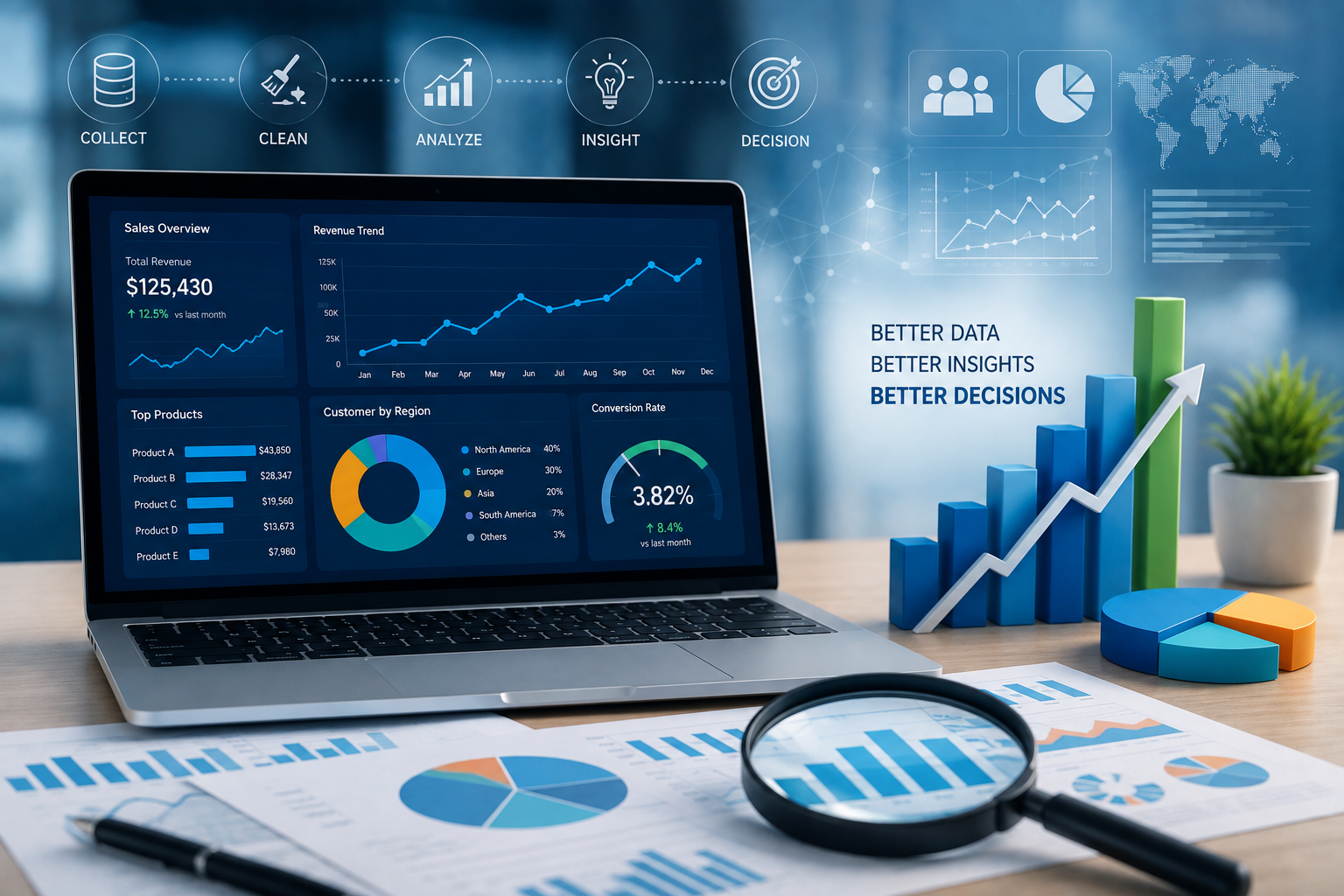
Historical Data → Analysis → Pattern Identification → Predictive Model → Future Insight → Business Decision
Predictive analytics does not guarantee that a particular event will happen. Instead, it provides an evidence-based estimate that can help businesses prepare and plan.
Why Predictive Analytics Matters for Businesses
Traditional business decisions often depend on historical reports.
For example:
"Sales increased by 15% last quarter."
That information is useful, but predictive analytics asks a different question:
"Based on current trends and historical patterns, what could sales look like next quarter?"
This shift from simply understanding the past to estimating potential future outcomes can help organizations become more proactive.
1. Better Sales Forecasting
Sales forecasting is one of the most common applications of predictive analytics.
Businesses can analyze factors such as:
- Previous sales
- Seasonal demand
- Customer purchasing patterns
- Product performance
- Market trends
- Promotional campaigns
A predictive model can then estimate future sales.
For example, a retail company may discover that demand for certain products consistently increases before major holidays.
The business can use this insight to prepare inventory and marketing campaigns earlier.
2. Improved Customer Understanding
Predictive analytics can help businesses understand what customers may do next.
For example, an online platform could identify customers who are likely to:
- Make another purchase
- Stop using a service
- Upgrade a subscription
- Respond to a promotion
- Need customer support
This allows businesses to create more targeted strategies rather than treating every customer the same way.
3. Customer Churn Prediction
Customer retention is important for subscription-based businesses and other companies that depend on repeat customers.
Predictive analytics can identify behavioral patterns associated with customers who eventually leave.
Possible indicators could include:
- Reduced login frequency
- Decreased product usage
- Fewer purchases
- Unresolved support issues
- Reduced engagement
- Subscription inactivity
A business could use these signals to identify customers who may be at risk of leaving and take appropriate action.
For example:
Reduced Activity → Churn Risk Identified → Customer Support or Retention Strategy → Continued Engagement
The goal is not to assume that a customer will leave, but to identify situations where additional attention may be useful.
4. Smarter Inventory Management
Maintaining the right amount of inventory can be challenging.
Too much inventory can increase storage costs, while too little inventory can lead to stockouts and missed sales.
Predictive analytics can analyze:
- Historical demand
- Seasonal patterns
- Product popularity
- Sales trends
- Promotions
- Regional demand
Businesses can use these insights to improve inventory planning.
For example, a retailer may predict increased demand for a particular product during a specific period and increase stock before demand rises.
5. More Effective Marketing
Marketing teams can use predictive analytics to understand which customers are more likely to respond to particular campaigns.
For example, a business may analyze previous campaign data to identify customer segments that are more likely to engage with:
- Email campaigns
- Product recommendations
- Discounts
- New product announcements
- Personalized offers
This can help businesses allocate marketing resources more effectively.
Instead of sending the same message to everyone, companies can use data to create more relevant campaigns.
6. Identifying Potential Business Risks
Predictive analytics can also help businesses identify potential risks.
Depending on the industry, models can analyze patterns associated with:
- Fraud
- Payment failures
- Equipment problems
- Customer churn
- Supply disruptions
- Unusual transactions
For example, a financial platform may identify unusual transaction patterns and flag them for additional review.
Predictive systems can support human decision-making by drawing attention to potentially important situations.
7. Improving Financial Planning
Financial decisions often depend on forecasts.
Predictive analytics can help organizations estimate:
- Revenue
- Expenses
- Cash flow
- Customer demand
- Payment behavior
- Financial risks
For example, a company can use historical revenue and expense data to build different financial scenarios.
This can help management prepare for possible changes instead of relying on a single fixed forecast.
8. Supporting Dynamic Pricing
Some businesses need to adjust pricing based on demand and market conditions.
Predictive models can analyze factors such as:
- Customer demand
- Historical prices
- Product availability
- Seasonal patterns
- Market activity
This can help businesses determine when pricing changes may be appropriate.
Dynamic pricing is already used in various industries, but businesses must implement it carefully to avoid creating customer dissatisfaction or unfair outcomes.
9. Optimizing Business Operations
Predictive analytics is not limited to sales and marketing.
It can also improve internal operations.
For example, businesses can analyze operational data to estimate:
- Equipment failures
- Staffing requirements
- Delivery times
- Customer service volume
- Processing workloads
A company may discover that customer support requests increase significantly after a particular product update.
The support team can prepare additional resources during future releases.
10. Predictive Maintenance
Businesses that depend on machinery and equipment can use predictive analytics to identify potential maintenance needs.
Instead of waiting for equipment to fail, organizations can analyze information such as:
- Machine usage
- Temperature
- Vibration
- Operating hours
- Error records
- Maintenance history
When patterns indicate a possible problem, maintenance can be scheduled proactively.
This approach can help reduce unexpected downtime and improve operational planning.
How Predictive Analytics Works
Although predictive systems can be highly sophisticated, the overall process can be understood through several steps.
Step 1: Collect Data
Businesses gather relevant historical and current information.
Sources can include:
- CRM systems
- ERP platforms
- Websites
- Mobile applications
- Sales systems
- Customer support platforms
- Financial software
- IoT devices
Step 2: Prepare the Data
Raw data often contains:
- Missing values
- Duplicate records
- Incorrect information
- Inconsistent formats
Data needs to be cleaned and prepared before reliable analysis can be performed.
Step 3: Identify Relevant Patterns
Analysts and data scientists examine historical information to identify relationships and trends.
Step 4: Build a Predictive Model
Statistical techniques or machine learning algorithms can be used to create a model based on historical data.
Step 5: Test the Model
The model should be evaluated using appropriate data to determine how well it performs.
Step 6: Generate Predictions
Once the model is sufficiently reliable for its intended use, it can generate estimates based on new information.
Step 7: Use Insights in Business Decisions
The final step is turning predictions into action.
For example:
Demand Forecast → Inventory Adjustment
Churn Risk → Customer Retention Strategy
Equipment Risk → Maintenance Schedule
Sales Forecast → Resource Planning
Predictive Analytics and Artificial Intelligence
Predictive analytics and artificial intelligence are closely connected, but they are not identical.
Predictive analytics can use traditional statistical methods as well as machine learning.
AI and machine learning can help analyze large and complex datasets and identify patterns that may be difficult to detect manually.
For example, a machine learning model may analyze thousands of customer interactions to estimate the likelihood of a customer making a purchase.
The technology is powerful, but the quality of the prediction depends heavily on the quality and relevance of the underlying data.
Benefits of Predictive Analytics
When implemented appropriately, predictive analytics can provide several benefits.
More Informed Decisions
Business leaders can use evidence and forecasts alongside their experience and judgment.
Improved Planning
Organizations can prepare for potential changes in demand, staffing, inventory, and other business requirements.
Reduced Risk
Early identification of potential problems can provide more time to respond.
Better Customer Experiences
Understanding customer behavior can help businesses provide more relevant services and support.
Greater Operational Efficiency
Predictive insights can help organizations allocate resources where they are most needed.
Competitive Advantage
Businesses that effectively turn data into actionable insights may respond more quickly to changing market conditions.
Challenges Businesses Should Consider
Predictive analytics is not without challenges.
Data Quality
Poor-quality data can produce unreliable predictions.
If historical records are incomplete or inaccurate, the resulting model may not provide useful insights.
Privacy
Customer and employee data should be handled responsibly.
Organizations need appropriate privacy, security, access controls, and data-governance practices.
Model Bias
Predictive models can reproduce biases present in the data used to train them.
Businesses should evaluate models carefully, particularly when predictions influence important decisions.
Overreliance on Predictions
A prediction is not a guarantee.
Unexpected events, market changes, economic conditions, and other factors can affect real-world outcomes.
Human judgment should remain part of important decision-making processes.
Implementation Costs
Building reliable predictive systems can require investment in:
- Data infrastructure
- Analytics tools
- Cloud computing
- Data professionals
- Software development
- Security
- Ongoing monitoring
Businesses should therefore begin with clearly defined use cases where predictive analytics can provide measurable value.
Best Practices for Businesses
Start With a Clear Business Problem
Do not begin with the technology.
Start by asking:
What business problem are we trying to solve?
For example:
"Can we identify customers who may be at risk of leaving?"
is more useful than:
"We want to use AI."
Use Relevant Data
More data is not always better.
The data should be relevant to the business question being addressed.
Monitor Model Performance
Business conditions change over time.
A model that performs well today may become less accurate as customer behavior, markets, or products change.
Models should therefore be monitored and reviewed regularly.
Combine Predictions With Human Expertise
Predictive analytics should support decision-makers rather than automatically replace them in every situation.
Business knowledge can provide important context that a model may not capture.
The Future of Predictive Analytics
As businesses continue to generate larger amounts of digital information, predictive analytics is likely to become increasingly accessible.
Cloud platforms, machine learning tools, business intelligence systems, and AI-powered analytics are making advanced analysis available to more organizations.
Future systems may provide increasingly real-time predictions, allowing businesses to respond to customer behavior, operational conditions, and market changes more quickly.
However, successful predictive analytics will depend on more than advanced algorithms.
Businesses will also need:
- Reliable data
- Strong data governance
- Skilled teams
- Responsible AI practices
- Clear business objectives
- Continuous monitoring
Final Thoughts
Predictive analytics gives businesses an opportunity to move beyond simply understanding what happened in the past.
By analyzing historical and current data, organizations can estimate potential future outcomes and use those insights to improve sales forecasting, customer retention, inventory management, marketing, financial planning, risk management, and operations.
The most important part of predictive analytics is not the prediction itself. It is how businesses use that prediction to make better decisions.
When combined with quality data, human expertise, responsible technology, and clear business goals, predictive analytics can become a valuable tool for building more proactive, efficient, and data-driven organizations.