Table of Contents
- How Real-Time Data Helps Managers Make Better Business Decisions
- What Is Real-Time Data?
- Why Traditional Reports May Not Be Enough
- 1. Managers Can Make Faster Decisions
- 2. Problems Can Be Identified Earlier
- 3. Inventory Management Becomes More Efficient
- 4. Sales Managers Can Respond to Trends
- 5. Marketing Decisions Can Become More Responsive
- 6. Customer Service Can Improve
- 7. Managers Get Better Visibility Across Departments
- 8. Real-Time Data Supports Proactive Management
- 9. Managers Can Compare Actual Performance With Targets
- 10. Real-Time Data Can Improve Risk Management
- Real-Time Data Is Not the Same as More Data
- Real-Time Data Needs Reliable Data
- Does Every Business Need Second-by-Second Data?
- How Businesses Can Start Using Real-Time Data
- Step 1: Identify an Important Decision
- Step 2: Identify the Data Source
- Step 3: Define the Important KPIs
- Step 4: Build the Dashboard
- Step 5: Connect and Refresh the Data
- Step 6: Create an Action Process
- Final Thoughts
How Real-Time Data Helps Managers Make Better Business Decisions
Business decisions often depend on one simple question:
“What is happening right now?”
A manager may want to know how many sales were completed today, which products are selling fastest, whether a marketing campaign is performing well, how much inventory is available, or whether a department is meeting its targets.
If the answer comes from a report prepared yesterday or last week, the information may already be outdated.
This is where real-time data becomes valuable. Real-time data refers to information that becomes available for analysis shortly after it is generated or collected. It allows businesses to understand current conditions and respond while there is still time to act.
What Is Real-Time Data?
Real-time data is information that is collected, processed and made available with very little delay.
For example, when a customer purchases a product online, a real-time system could immediately update:
- Sales figures
- Inventory levels
- Revenue dashboards
- Customer order status
- Product performance
- Payment information
Instead of waiting for an end-of-day report, managers can see the change much sooner.
Real-time data can come from ERP systems, CRM platforms, websites, mobile applications, point-of-sale systems, databases, IoT devices and other business applications.
Why Traditional Reports May Not Be Enough
Traditional reporting is still useful for many business activities. Monthly financial statements, historical analysis and long-term performance reports do not necessarily need second-by-second updates.
However, some decisions are time-sensitive.
Consider an online retailer that discovers through a weekly report that one product sold much faster than expected. By the time the report is reviewed, the business may already have lost several days of potential sales.
With current inventory and sales data, the manager could identify the trend much earlier and take action.
The key difference is simple:
Historical reporting tells managers what happened.
Real-time reporting helps them understand what is happening now.
1. Managers Can Make Faster Decisions
One of the biggest advantages of real-time data is speed.
When managers have access to current information, they do not have to wait for someone to collect, clean and prepare a report before responding.
For example:
Without real-time data:
Sales decline → Report prepared → Manager reviews report → Problem investigated → Action taken
With real-time data:
Sales decline → Dashboard shows change → Manager investigates → Action taken
Real-time analytics is particularly useful when delays can affect revenue, customer experience, inventory or operational performance.
2. Problems Can Be Identified Earlier
A good reporting system should not only tell managers about success. It should also help them identify problems.
A real-time dashboard could reveal:
- Sudden sales declines
- Inventory shortages
- Increased customer complaints
- Payment failures
- Unexpected expenses
- Delivery delays
- Website conversion drops
- Production problems
Early visibility gives managers an opportunity to investigate before a small problem becomes a larger one.
For example, if a company's dashboard shows that order cancellations suddenly increased, the manager can investigate immediately rather than discovering the issue at the end of the month.
3. Inventory Management Becomes More Efficient
Inventory is one area where current information can make a significant difference.
Managers need to know:
- What is currently in stock?
- Which products are selling quickly?
- Which products are not moving?
- Which items are close to reaching their reorder level?
- Which locations have excess inventory?
Real-time inventory information can help businesses respond to changing demand and avoid unnecessary stockouts or overstocking. IBM identifies inventory optimization and operational efficiency as important applications of real-time data.
For example:
Product A: High demand + low stock
This could trigger a purchasing decision before the product becomes unavailable.
4. Sales Managers Can Respond to Trends
Sales performance can change throughout the day.
A manager looking only at a monthly report may see that sales increased, but a real-time dashboard can provide additional context.
It may show:
- Which salesperson is performing best
- Which product is generating the most revenue
- Which region is growing
- Which customer segment is responding
- Whether today's sales are above or below target
This information can help managers adjust sales strategies while campaigns and sales activities are still active.
5. Marketing Decisions Can Become More Responsive
Marketing campaigns can generate large amounts of data.
Managers may want to monitor:
- Website visits
- Leads
- Conversion rates
- Cost per lead
- Advertising spend
- Customer engagement
- Campaign performance
Suppose one campaign is generating significantly better results than another.
Instead of waiting until the end of the campaign, managers can review current performance and consider reallocating resources.
Real-time analytics can help organizations identify trends as they develop and respond more quickly to changing customer behavior.
6. Customer Service Can Improve
Customers increasingly expect quick responses.
Real-time information can help customer service teams see current information about:
- Orders
- Payments
- Delivery status
- Available products
- Customer interactions
- Support requests
For example, if a customer asks about an order, the employee can check its current status instead of relying on yesterday's database export.
This creates a smoother customer experience and can reduce unnecessary delays.
7. Managers Get Better Visibility Across Departments
In many organizations, data is scattered across different departments.
Sales may use one system.
Finance may use another.
HR may maintain separate records.
Operations may have its own software.
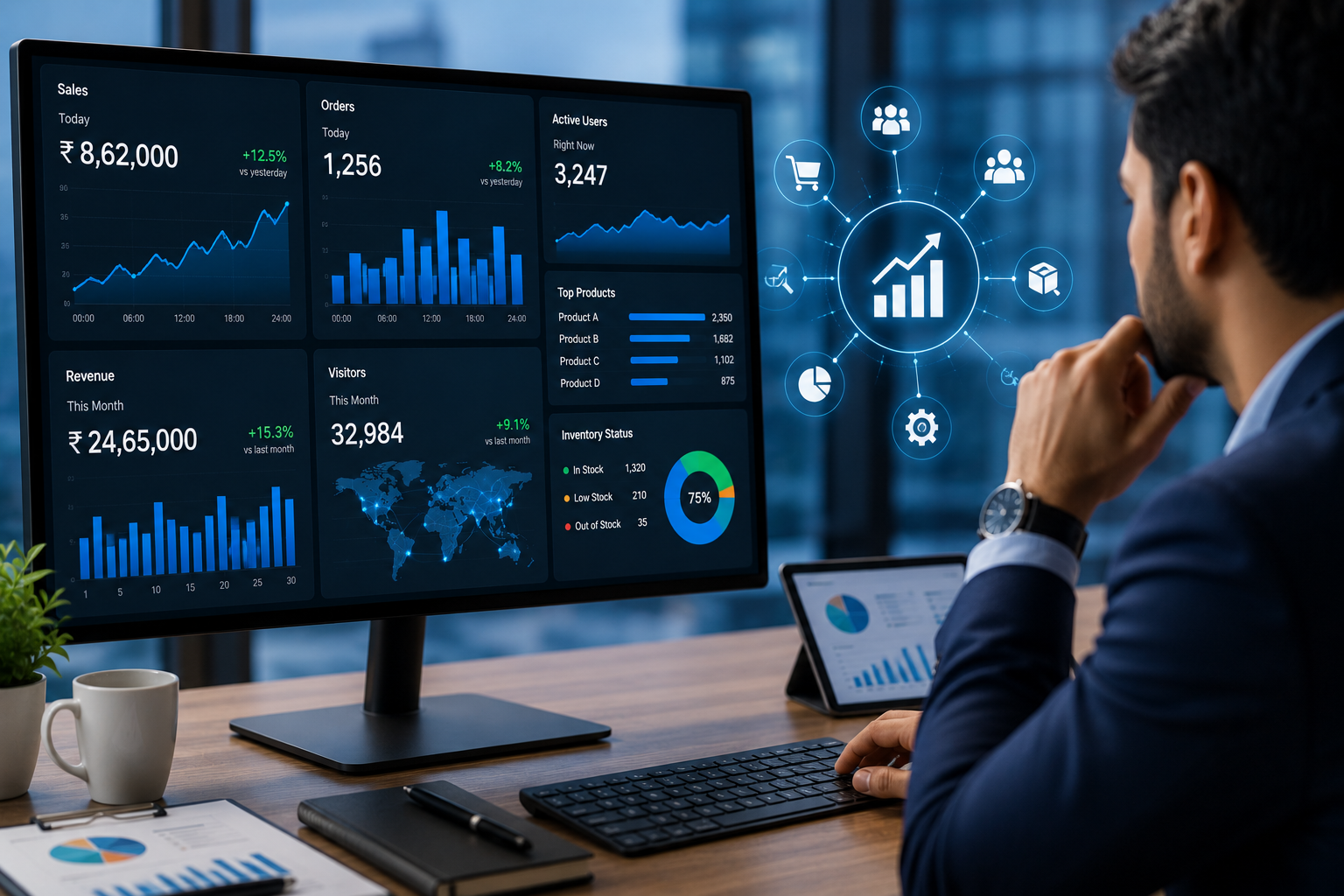
When these systems are connected to a business intelligence environment, managers can bring important information together in dashboards.
A manager might see:
Revenue + Expenses + Sales + Inventory + Customers
in one place.
Business intelligence dashboards can consolidate information and help users identify trends, patterns and anomalies without depending entirely on technical teams.
8. Real-Time Data Supports Proactive Management
Traditional management can sometimes be reactive.
A problem occurs, a report is generated, and then management responds.
Real-time data encourages a more proactive approach.
For example:
Inventory falling rapidly → Manager receives alert → Purchase order initiated
or
Website conversions declining → Marketing team investigates → Campaign adjusted
or
Customer complaints increasing → Manager identifies issue → Service process reviewed
The goal is not simply to react faster. It is to recognize signals early enough to prevent larger problems.
9. Managers Can Compare Actual Performance With Targets
A dashboard can continuously compare actual performance with predefined targets.
For example:
| KPI | Target | Current | Status |
|---|---|---|---|
| Monthly Sales | ₹50 Lakh | ₹47 Lakh | Needs Attention |
| New Leads | 1,000 | 1,120 | On Track |
| Conversion Rate | 5% | 4.2% | Needs Attention |
| Customer Complaints | <100 | 72 | On Track |
Instead of waiting for the monthly review meeting, managers can identify where performance is falling behind.
This makes performance management more continuous.
10. Real-Time Data Can Improve Risk Management
Some business risks require immediate attention.
Real-time monitoring can help organizations detect unusual activity, operational problems, security events or other risks sooner.
IBM notes that real-time data can support areas such as fraud detection, risk management and cybersecurity by allowing organizations to identify suspicious activity or changing conditions more quickly.
Earlier detection can give managers more time to investigate and respond.
Real-Time Data Is Not the Same as More Data
Having thousands of numbers on a dashboard does not automatically lead to better decisions.
Managers need relevant information, not simply more information.
A useful real-time dashboard should focus on important KPIs such as:
- Revenue
- Sales
- Profit
- Inventory
- Leads
- Conversion rate
- Customer satisfaction
- Operational efficiency
- Employee performance
The dashboard should answer practical questions:
What is happening?
Why is it happening?
What requires attention?
What action should we consider?
Real-Time Data Needs Reliable Data
There is an important limitation to remember.
Real-time data is only useful when the underlying data is accurate and reliable.
Poor-quality data can result from:
- Missing records
- Duplicate entries
- Incorrect calculations
- System integration problems
- Delayed data transmission
- Inconsistent definitions
- Poor data governance
IBM highlights data quality, latency and security as important considerations when implementing real-time data systems.
Therefore, businesses should focus on accurate and useful real-time information, not simply fast information.
Does Every Business Need Second-by-Second Data?
Not necessarily.
This is an important point.
Some decisions genuinely require real-time information.
Others do not.
For example:
Real-time may be useful for:
- E-commerce inventory
- Live sales monitoring
- Fraud detection
- Website performance
- Delivery tracking
- Customer support
Daily or weekly reporting may be sufficient for:
- Long-term strategy
- Monthly financial analysis
- Annual planning
- Historical performance
- Certain HR reports
The right goal is not always real-time.
The goal is the right information at the right time for the decision being made.
How Businesses Can Start Using Real-Time Data
Businesses don't need to transform every system at once.
A practical approach is to begin with one important business process.
Step 1: Identify an Important Decision
Ask:
Which decisions are currently being delayed because information is outdated?
Step 2: Identify the Data Source
Determine where the required information comes from.
It could be:
- ERP
- CRM
- Website
- POS
- Database
- Accounting software
- Marketing platform
Step 3: Define the Important KPIs
Avoid putting every available metric on the dashboard.
Choose the numbers that actually influence decisions.
Step 4: Build the Dashboard
Present information using:
- Charts
- Tables
- KPI cards
- Trend lines
- Alerts
- Filters
Step 5: Connect and Refresh the Data
The system should automatically collect or refresh information according to the business requirement.
Step 6: Create an Action Process
A dashboard becomes more valuable when there is a clear response to important changes.
For example:
Low stock → Notify purchasing team
Sales drop → Notify sales manager
Payment failure increases → Alert finance team
This turns reporting into an operational decision-support system.
Final Thoughts
Real-time data can change the way managers run a business.
Instead of waiting for yesterday's report, managers can see current performance, identify problems earlier, monitor important KPIs and respond to changing conditions more quickly.
The real value is not simply having a dashboard that updates continuously.
It is having relevant, accurate information available when a decision needs to be made.
When implemented properly, real-time data can help businesses become more responsive, improve operational visibility and make decisions based on current evidence rather than outdated assumptions.