Table of Contents
- Why Centralized Employee Management Makes Growing Businesses More Efficient
- What Is Centralized Employee Management?
- 1. Keeps Employee Information in One Place
- 2. Reduces Duplicate Data Entry
- 3. Makes Attendance and Leave Management Easier
- 4. Simplifies Payroll Management
- 5. Improves HR Reporting
- 6. Saves HR Teams Time
- 7. Gives Employees Self-Service Access
- 8. Helps Managers Make Faster Decisions
- 9. Improves Data Accuracy and Consistency
- 10. Makes Business Growth Easier to Manage
- Centralized Employee Management vs. Manual Management
- What Should a Centralized Employee Management System Include?
- Employee Database
- Attendance Management
- Leave Management
- Payroll Integration
- Employee Self-Service
- Document Management
- Reporting and Dashboards
- Role-Based Access
- Notifications and Approvals
- How Businesses Can Start Centralizing Employee Management
- Step 1: Identify Existing Problems
- Step 2: Centralize Employee Records
- Step 3: Automate Repetitive Processes
- Step 4: Add Employee Self-Service
- Step 5: Connect Related Systems
- Step 6: Use Reports for Decision-Making
- Centralized Employee Management Is More Than HR Software
- Final Thoughts
Why Centralized Employee Management Makes Growing Businesses More Efficient
As a business grows, managing employees becomes more complicated. A small company may be able to manage employee information, attendance, leave, payroll, and documents using spreadsheets, emails, and separate files. But as the number of employees and departments increases, these methods can become difficult to maintain.
This is where centralized employee management can make a major difference.
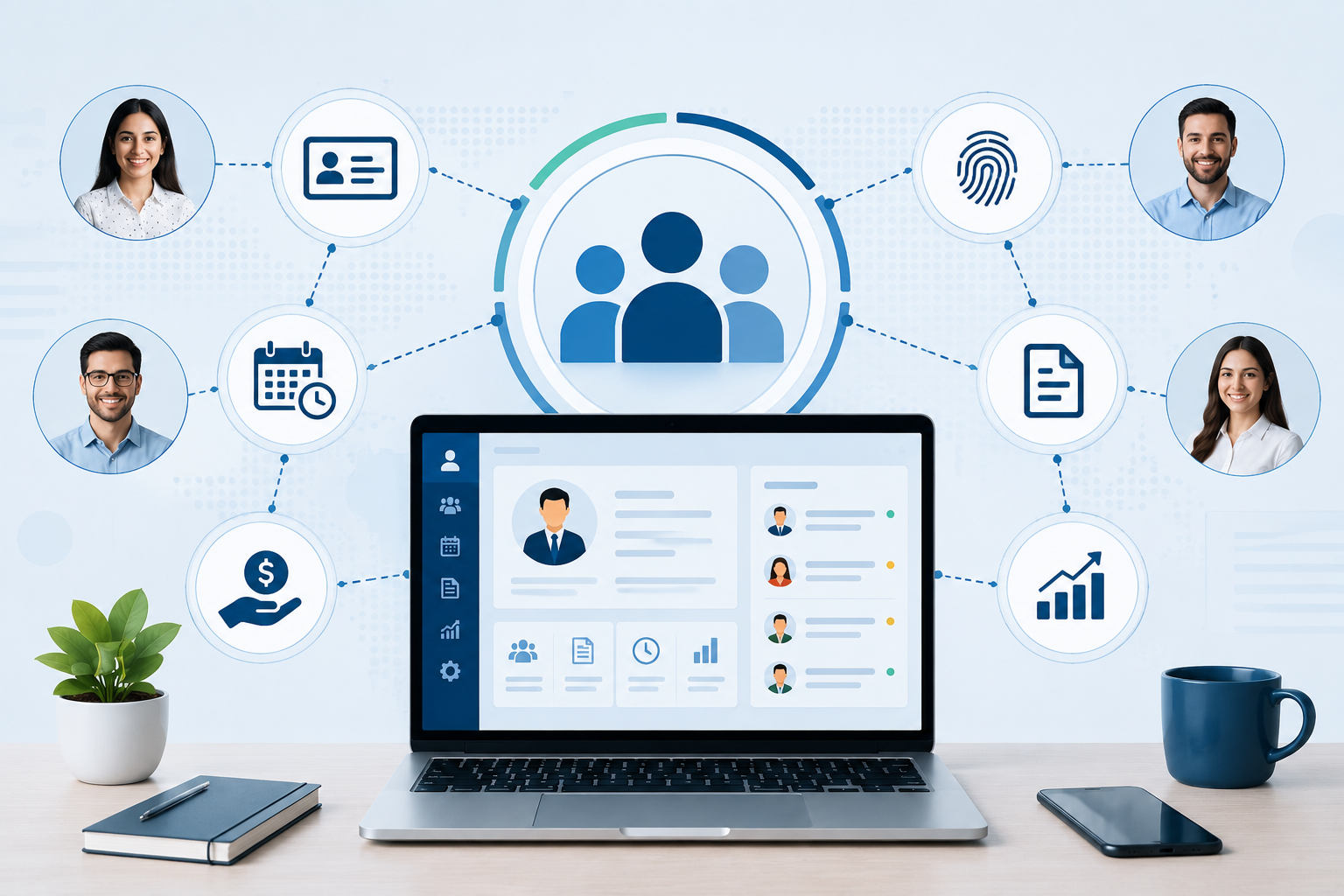
A centralized employee management system brings important workforce information and HR processes into one organized platform. Modern HR systems can manage employee records, attendance, leave, payroll, benefits, reporting, and employee self-service from a common system.
What Is Centralized Employee Management?
Centralized employee management means storing and managing employee-related information and processes through a single system instead of maintaining separate spreadsheets, files, and applications.
Depending on the business, a centralized system may include:
- Employee profiles
- Attendance management
- Leave management
- Payroll information
- Employee documents
- Department and designation management
- Recruitment information
- Performance records
- Employee self-service
- HR reports
- Workforce analytics
The goal is simple: put the right employee information in one place so authorized people can access and manage it efficiently.
1. Keeps Employee Information in One Place
One of the biggest advantages of centralized employee management is having a single source of employee information.
Instead of searching through spreadsheets, email attachments, paper files, or different software systems, HR teams can access employee information from one platform.
For example, an employee profile may contain:
- Name and contact information
- Employee ID
- Department
- Designation
- Joining date
- Salary information
- Attendance records
- Leave history
- Documents
- Reporting manager
A centralized HR system can provide a comprehensive employee view while standardizing record keeping and reporting.
This becomes increasingly valuable as the organization grows.
2. Reduces Duplicate Data Entry
When businesses use multiple systems, employees may need to enter the same information repeatedly.
For example, employee information might be entered separately into:
HR records → Attendance system → Payroll spreadsheet → Leave tracker → Reports
This creates unnecessary work and increases the possibility of inconsistent information.
A centralized system can connect these processes so information can flow between relevant modules.
For example, attendance data can support payroll processing, while employee department information can be used for HR reports.
This reduces repetitive administrative work and helps improve data consistency.
3. Makes Attendance and Leave Management Easier
Attendance and leave become more complicated as employee numbers increase.
HR teams may need to track:
- Daily attendance
- Late arrivals
- Early departures
- Absences
- Work-from-home days
- Leave balances
- Leave approvals
- Overtime
- Holidays
Managing these manually can take considerable time.
A centralized employee management system can bring attendance and leave information together, allowing HR teams and managers to review employee availability and attendance records more easily.
Modern HR solutions commonly include time and attendance tracking, leave and absence management, and employee self-service capabilities.
4. Simplifies Payroll Management
Payroll depends on accurate employee information.
Salary calculations may involve:
- Basic salary
- Allowances
- Attendance
- Leave
- Overtime
- Deductions
- Bonuses
- Taxes
- Other adjustments
When these details are maintained across separate files, payroll teams may spend significant time collecting and checking information.
Centralized employee management can connect employee information with attendance, leave, compensation, and payroll processes.
This can reduce manual data entry and help HR teams process payroll more efficiently.
5. Improves HR Reporting
Growing businesses need accurate information to make workforce decisions.
Managers may want to know:
- How many employees are in each department?
- What is the current headcount?
- Which departments are hiring?
- What is the attendance trend?
- How much leave is being used?
- What is the salary cost by department?
- Which employees are approaching important milestones?
When employee information is centralized, generating these reports becomes easier.
Instead of manually combining multiple spreadsheets, HR teams can use dashboards and reports based on the information already stored in the system.
Centralized workforce data can also provide better visibility for management and support more informed workforce decisions.
6. Saves HR Teams Time
HR teams often spend a large amount of time on administrative tasks.
Searching for employee records, updating spreadsheets, checking leave balances, preparing reports, and responding to routine employee questions can take time away from more strategic activities.
Automation can reduce some of this workload.
For example, a system can automate or simplify:
- Leave requests
- Attendance calculations
- Employee notifications
- Document management
- Payroll-related processes
- Report generation
- Approval workflows
The result is that HR professionals can spend more time on employee development, recruitment, retention, and other higher-value activities.
7. Gives Employees Self-Service Access
Centralized employee management does not only benefit HR departments.
Employee self-service features can allow employees to access information and complete routine HR tasks themselves.
Depending on the system, employees may be able to:
- View their profile
- Check attendance
- Apply for leave
- View leave balances
- Access salary information
- Update selected personal details
- Submit requests
- Track approval status
- Access company documents
This reduces the need for employees to contact HR for every routine request.
It also gives employees greater visibility into their own information. Microsoft and Oracle both identify employee self-service as a common capability of modern HR systems.
8. Helps Managers Make Faster Decisions
Managers need reliable employee information when planning teams and workloads.
For example, if a manager needs to know how many employees are available for a project, which team members are on leave, or how a department is performing, centralized information can make the answer easier to find.
Instead of requesting information from multiple people, managers can use appropriate dashboards or reports.
This can improve visibility and reduce delays in everyday decision-making.
9. Improves Data Accuracy and Consistency
Employee information can change frequently.
Employees may change departments, receive promotions, update contact details, take different leave, or receive salary adjustments.
If information is maintained manually in multiple locations, one record may be updated while another remains outdated.
A centralized system provides a common source for employee information, helping reduce duplicate records and inconsistent data. Microsoft describes centralized ERP and HR data as a way to reduce errors and duplicated effort, while Oracle highlights standardized record keeping and reporting.
10. Makes Business Growth Easier to Manage
Centralized employee management becomes particularly useful when a company grows.
Consider a business that increases from:
20 employees → 50 employees → 150 employees → 500+ employees
The number of employee records, attendance transactions, leave requests, salary calculations, documents, and HR activities grows with it.
A system designed for centralized workforce management can provide a more structured way to handle this increasing volume.
Cloud-based HR systems can also provide scalability as organizational requirements change.
Centralized Employee Management vs. Manual Management
| Manual Employee Management | Centralized Employee Management |
|---|---|
| Multiple spreadsheets | Single employee database |
| Repetitive data entry | Reduced duplicate entry |
| Manual attendance tracking | Automated attendance workflows |
| Manual leave calculations | Centralized leave management |
| Separate payroll information | Connected employee and payroll data |
| Difficult reporting | Faster reports and dashboards |
| HR handles most routine requests | Employee self-service |
| Higher risk of outdated information | More consistent employee records |
| Difficult to scale | Easier to support business growth |
What Should a Centralized Employee Management System Include?
Businesses should choose features based on their size and requirements. Common capabilities include:
Employee Database
Centralized employee profiles and records.
Attendance Management
Track attendance, working hours, late arrivals, absences, and related information.
Leave Management
Allow employees to apply for leave and managers to approve or reject requests.
Payroll Integration
Connect employee, attendance, leave, compensation, and payroll information.
Employee Self-Service
Give employees controlled access to their own information and HR services.
Document Management
Store important employee documents in an organized manner.
Reporting and Dashboards
Provide management with useful workforce information.
Role-Based Access
Allow different levels of access for employees, managers, HR teams, and administrators.
Notifications and Approvals
Automate routine HR workflows and approval processes.
How Businesses Can Start Centralizing Employee Management
Businesses do not necessarily need to automate every HR process immediately.
A practical approach is to start with the areas creating the most administrative work.
Step 1: Identify Existing Problems
Look at how employee information is currently managed.
Identify:
- Duplicate data
- Spreadsheet dependency
- Manual calculations
- Repeated HR requests
- Reporting delays
- Attendance problems
- Payroll-related errors
Step 2: Centralize Employee Records
Create a reliable employee database containing the information HR needs regularly.
Step 3: Automate Repetitive Processes
Start with processes such as attendance, leave applications, approvals, and routine reporting.
Step 4: Add Employee Self-Service
Allow employees to handle routine requests themselves where appropriate.
Step 5: Connect Related Systems
Where possible, connect HR with payroll, accounting, attendance, ERP, or other business systems.
Step 6: Use Reports for Decision-Making
Once reliable data is available, use dashboards and reports to understand workforce trends and support management decisions.
Centralized Employee Management Is More Than HR Software
Centralized employee management is not simply about replacing spreadsheets with software.
The bigger objective is to create a connected employee management process.
When employee records, attendance, leave, payroll, documents, approvals, and reporting work together, businesses can reduce repetitive administrative work and improve visibility across the organization.
For growing companies, this can make everyday HR operations more organized and easier to manage.
Final Thoughts
As businesses grow, employee management becomes increasingly complex. Managing workforce information through disconnected spreadsheets, files, and systems can create unnecessary work and make it harder to maintain accurate information.
A centralized employee management system provides a more organized approach by bringing employee data and HR processes together.
It can help businesses reduce manual work, improve data consistency, simplify HR processes, support employee self-service, improve reporting, and manage workforce growth more efficiently.
For a growing business, investing in centralized employee management is not only about managing today's employees. It is about creating an HR foundation that can support the organization as it continues to grow.