Table of Contents
- Why Scalable Software Architecture Matters as Your Business Grows
- What Is Scalable Software Architecture?
- Why Architecture Becomes More Important as a Business Grows
- Scalability Is More Than Handling More Users
- User Scalability
- Transaction Scalability
- Data Scalability
- Feature Scalability
- Geographic Scalability
- Modular Architecture Makes Growth Easier
- Does Every Business Need Microservices?
- When Microservices Can Become Useful
- Database Architecture Matters Too
- APIs Make Future Integrations Easier
- Cloud Infrastructure Can Support Growth
- Security Should Scale With the Business
- Monitoring Becomes Essential
- Scalable Architecture Reduces the Cost of Future Changes
- Plan for Growth Without Overengineering
- How Businesses Can Prepare Their Software for Growth
- 1. Define Clear Modules
- 2. Use Clean APIs
- 3. Optimize the Database
- 4. Design for Horizontal Scaling
- 5. Keep Components Loosely Coupled
- 6. Implement Monitoring
- 7. Automate Deployment
- 8. Build Security Into the Architecture
- 9. Review Architecture as the Business Changes
- What Happens When Architecture Is Not Scalable?
- Scalable Architecture Is a Business Investment
- Final Thoughts
Why Scalable Software Architecture Matters as Your Business Grows
When a business is small, its software requirements are often simple. A website may handle a few hundred visitors, an ERP system may have a limited number of users, and a business application may only need to support a few basic processes.
But as the business grows, everything changes.
More customers start using the system. More employees need access. More transactions are processed. New features are added, integrations become necessary, and the amount of business data increases.
Software that worked perfectly when the business was small can eventually become slow, difficult to maintain, expensive to modify, or unreliable during periods of high demand.
This is where scalable software architecture becomes important.
A scalable architecture is designed so that software can handle increasing users, transactions, data, and business requirements without requiring a complete rebuild every time the business expands.
What Is Scalable Software Architecture?
Software architecture refers to the way different parts of an application are organized and how they communicate with each other.
A scalable architecture allows an application to grow while maintaining acceptable performance, reliability, security, and maintainability.
For example, consider a business application that initially handles 100 users. Over time, the business may grow to 1,000, 10,000, or even more users.
A scalable system should be designed so that increased demand can be handled through appropriate infrastructure, database improvements, caching, load distribution, modularization, or other architectural approaches.
Scalability is not simply about adding more servers. It starts with making sensible decisions about how the application is structured.
AWS highlights principles such as modularity, horizontal scaling, and designing systems with future growth in mind when building reliable scalable solutions.
Why Architecture Becomes More Important as a Business Grows
During the early stage of a business, developers often focus on getting the product working quickly.
That is understandable.
However, continuously adding features without considering architecture can eventually create tightly connected code where changing one part affects many other parts of the application.
As the software grows, businesses may experience:
-
Slower application performance
-
Longer development cycles
-
Difficult debugging
-
Higher maintenance costs
-
More frequent downtime
-
Difficulty adding new features
-
Database performance problems
-
Increasing technical debt
-
Security and reliability challenges
A well-planned architecture helps reduce these problems by establishing clear boundaries between different parts of the system.
Scalability Is More Than Handling More Users
When people hear the word "scalability," they often think only about supporting more users.
In reality, a business application may need to scale in several different ways.
User Scalability
The application should be capable of supporting an increasing number of employees, customers, vendors, or other users.
Transaction Scalability
An ERP, billing system, e-commerce platform, or booking application may process significantly more transactions as the business grows.
Data Scalability
Businesses continuously generate data through invoices, customer records, inventory, payments, reports, attendance, bookings, and other activities.
The database architecture must be able to handle this increasing volume efficiently.
Feature Scalability
Growth often means new requirements.
A business may initially need billing but later require inventory, CRM, accounting, reporting, mobile applications, payment gateways, or third-party integrations.
The architecture should make these additions manageable.
Geographic Scalability
Businesses expanding into different cities or countries may eventually require infrastructure capable of supporting users from different locations.
Modular Architecture Makes Growth Easier
One of the most important principles of scalable software is modularity.
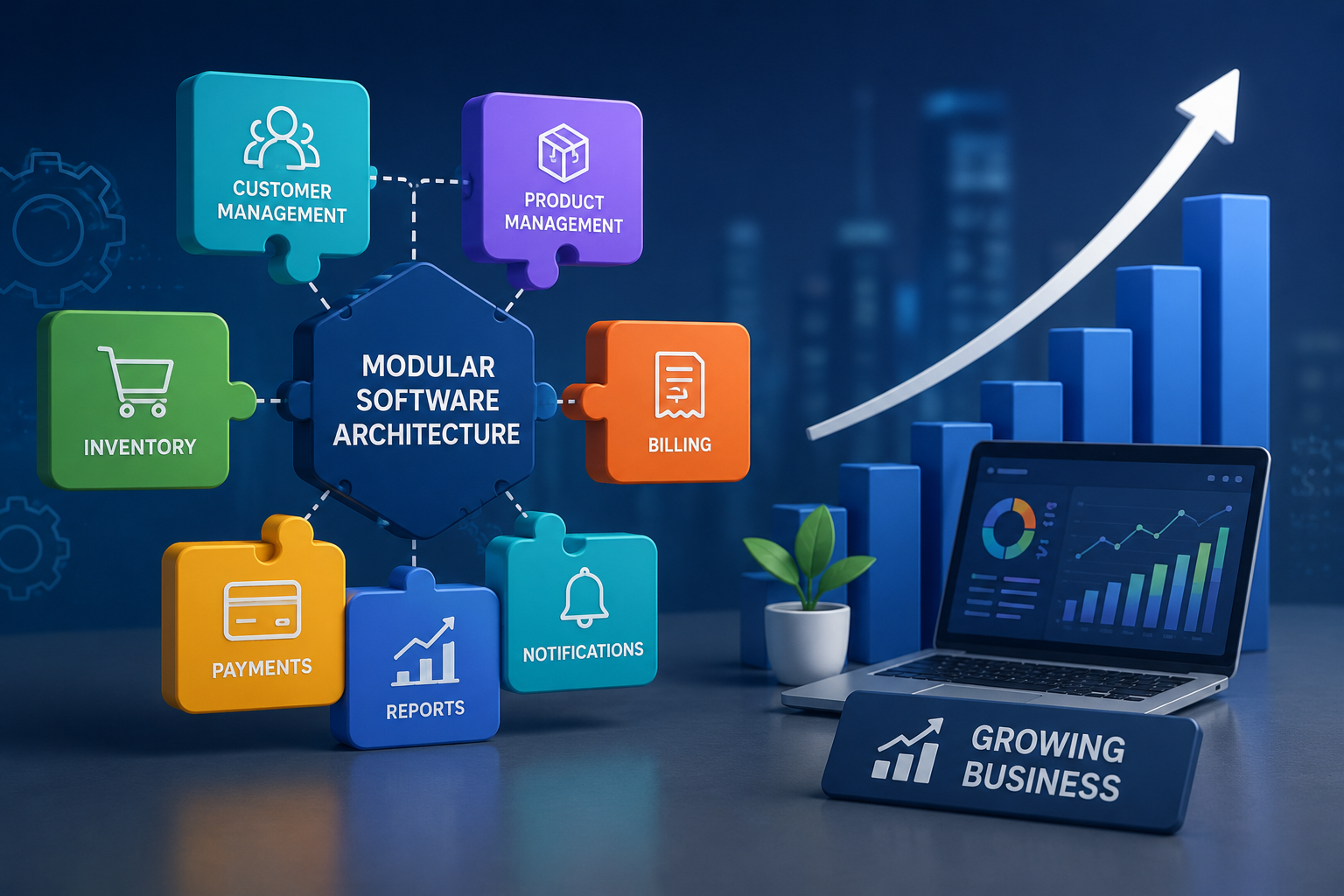
Instead of building the entire application as one tightly connected structure, functionality can be separated into logical modules.
For example, a business ERP could contain:
-
User Management
-
Customer Management
-
Sales
-
Purchase
-
Inventory
-
Billing
-
Payments
-
Accounting
-
HR & Payroll
-
Reports
-
Notifications
Each module should have clear responsibilities and well-defined interfaces.
This makes it easier for developers to modify one area without unnecessarily affecting the rest of the system.
AWS describes modularity as a way to break complex systems into smaller components that can be easier to manage, secure, and scale independently.
Does Every Business Need Microservices?
Not necessarily.
Microservices are often discussed in conversations about scalability, but they are not automatically the right choice for every business.
A traditional monolithic application can also scale, particularly when it is well structured and properly optimized. Martin Fowler notes that monolithic applications can be horizontally scaled by running multiple instances behind a load balancer.
For many small and medium-sized businesses, a well-designed modular monolith can provide a simpler starting point.
As requirements become more complex, specific components can potentially be separated into services.
This approach allows the architecture to evolve with the business rather than introducing unnecessary complexity too early.
When Microservices Can Become Useful
Microservices divide an application into independently deployable services that communicate through defined interfaces.
For example, a large platform might eventually separate:
-
Authentication Service
-
Payment Service
-
Notification Service
-
Order Service
-
Inventory Service
-
Customer Service
-
Reporting Service
One benefit is that individual services can be scaled independently when their workloads differ.
For example, if a payment service receives significantly more traffic than an internal reporting service, the infrastructure can be adjusted according to the requirements of each component.
AWS describes independent scaling as one of the advantages of microservices.
However, microservices also introduce additional complexity, including distributed communication, monitoring, deployment, debugging, and operational management.
Therefore, architecture should be selected according to the actual needs of the business.
Database Architecture Matters Too
Even if the application code is well designed, database limitations can become a bottleneck.
As business data increases, organizations may need to consider:
-
Proper database indexing
-
Query optimization
-
Database normalization
-
Efficient data relationships
-
Archiving strategies
-
Read/write optimization
-
Database backups
-
Replication where appropriate
-
Connection management
-
Monitoring and performance analysis
For example, a billing system processing a few hundred invoices per month may have very different requirements from one processing millions of transactions.
Database architecture should therefore be considered as part of the overall scalability strategy.
APIs Make Future Integrations Easier
Modern businesses rarely operate using a single software system.
A business application may need to communicate with:
-
Payment gateways
-
Accounting software
-
CRM systems
-
Email platforms
-
SMS providers
-
WhatsApp services
-
E-commerce platforms
-
Mobile applications
-
Government or third-party APIs
A properly designed API layer can make these integrations easier to manage.
Instead of connecting every system directly to every other system, APIs can provide controlled interfaces between different components.
This also makes it easier to introduce new applications in the future.
Cloud Infrastructure Can Support Growth
Cloud infrastructure can provide flexible resources as application requirements change.
Depending on the system, businesses may use:
-
Load balancing
-
Auto-scaling
-
Cloud databases
-
Object storage
-
Content delivery networks
-
Container platforms
-
Serverless services
-
Monitoring and logging
-
Automated backups
Horizontal scaling allows additional application instances to be added when demand increases. AWS identifies horizontal scaling as an important technique for handling increased load while improving reliability when systems are appropriately distributed.
However, cloud infrastructure alone does not make an application scalable.
A poorly structured application can still perform badly even when hosted on powerful cloud infrastructure.
Security Should Scale With the Business
Business growth also means more data, users, devices, integrations, and potential points of exposure.
Scalable architecture should therefore consider security from the beginning.
Important areas include:
-
Role-based access control
-
Authentication
-
Authorization
-
Encryption
-
Secure API communication
-
Input validation
-
Audit logs
-
Backup strategies
-
Monitoring
-
Vulnerability management
-
Secure payment processing
Security should not be treated as something to add after the application becomes large.
It should be part of the architecture.
Monitoring Becomes Essential
As an application grows, it becomes increasingly difficult to understand what is happening simply by looking at the system manually.
Monitoring can help businesses identify:
-
Slow API requests
-
Database bottlenecks
-
Server resource usage
-
Application errors
-
Failed transactions
-
Traffic spikes
-
Downtime
-
Security events
Modern reliability guidance also emphasizes observability and monitoring as important parts of maintaining reliable systems.
Without monitoring, a business may discover a performance problem only after customers or employees start experiencing it.
Scalable Architecture Reduces the Cost of Future Changes
One of the biggest advantages of good architecture is not simply performance.
It is changeability.
Businesses change constantly.
A company may introduce a new pricing model, launch a mobile application, add a new payment method, expand into another market, or integrate another software platform.
If the architecture is tightly coupled, each change can become expensive and risky.
If the system is modular, changes can often be isolated to specific components.
This can reduce development effort and make future improvements more predictable.
Plan for Growth Without Overengineering
There is an important balance between preparing for future growth and building unnecessary complexity today.
A small business does not necessarily need a large microservices ecosystem, multiple databases, containers, and complex cloud infrastructure from day one.
Overengineering can increase:
-
Development cost
-
Infrastructure cost
-
Maintenance requirements
-
Deployment complexity
-
Debugging difficulty
The goal should be to build an architecture that is appropriate for the current business while leaving room for future evolution.
A modular foundation can allow a system to grow gradually.
AWS similarly recommends balancing the benefits of service segmentation against the additional complexity it can introduce.
How Businesses Can Prepare Their Software for Growth
When developing or upgrading a business application, consider the following:
1. Define Clear Modules
Separate major business functions into logical components.
2. Use Clean APIs
Design clear interfaces between different systems and modules.
3. Optimize the Database
Review queries, indexes, relationships, and data storage strategies regularly.
4. Design for Horizontal Scaling
Where appropriate, ensure application components can run across multiple instances.
5. Keep Components Loosely Coupled
Avoid unnecessary dependencies between unrelated parts of the application.
6. Implement Monitoring
Track performance, errors, infrastructure usage, and important business operations.
7. Automate Deployment
Automated testing and deployment can make frequent software updates safer and more predictable.
8. Build Security Into the Architecture
Authentication, authorization, encryption, backups, and auditing should be considered from the beginning.
9. Review Architecture as the Business Changes
Architecture should evolve as user numbers, transactions, integrations, and business requirements change.
What Happens When Architecture Is Not Scalable?
Imagine a growing retail business using a billing and inventory system.
Initially, the system has:
-
2 stores
-
5 employees
-
1,000 products
-
500 transactions per month
After several years, the business grows to:
-
25 stores
-
150 employees
-
100,000 products
-
Hundreds of thousands of transactions
If the original application was built without considering growth, the business may eventually experience slow reports, database bottlenecks, difficult updates, and increasing maintenance requirements.
At this stage, fixing the architecture can become significantly more complicated than designing a flexible foundation from the beginning.
That does not mean every future requirement must be predicted.
It means the system should be designed with reasonable growth and change in mind.
Scalable Architecture Is a Business Investment
Software architecture may seem like a technical concern, but its impact reaches the entire organization.
Good architecture can support:
-
Faster product development
-
Better application performance
-
Easier maintenance
-
Improved reliability
-
More efficient infrastructure usage
-
Safer integrations
-
Easier expansion
-
Better customer experience
As a business grows, software becomes part of its operational foundation.
If that foundation cannot handle growth, technology can become a limitation instead of an advantage.
Final Thoughts
Scalable software architecture is about preparing technology for business growth without creating unnecessary complexity.
The right architecture depends on the application's size, business requirements, expected growth, development team, budget, reliability needs, and operational capabilities.
For some businesses, a modular monolith may be the right solution. For others, service-oriented or microservices architectures may become appropriate as the system grows.
The important principle is to build software that can evolve.
A business should not have to rebuild its entire technology platform every time it gains more customers, adds a new branch, introduces a new service, or connects with another system.
With thoughtful architecture, software can grow alongside the business instead of becoming a barrier to growth.